
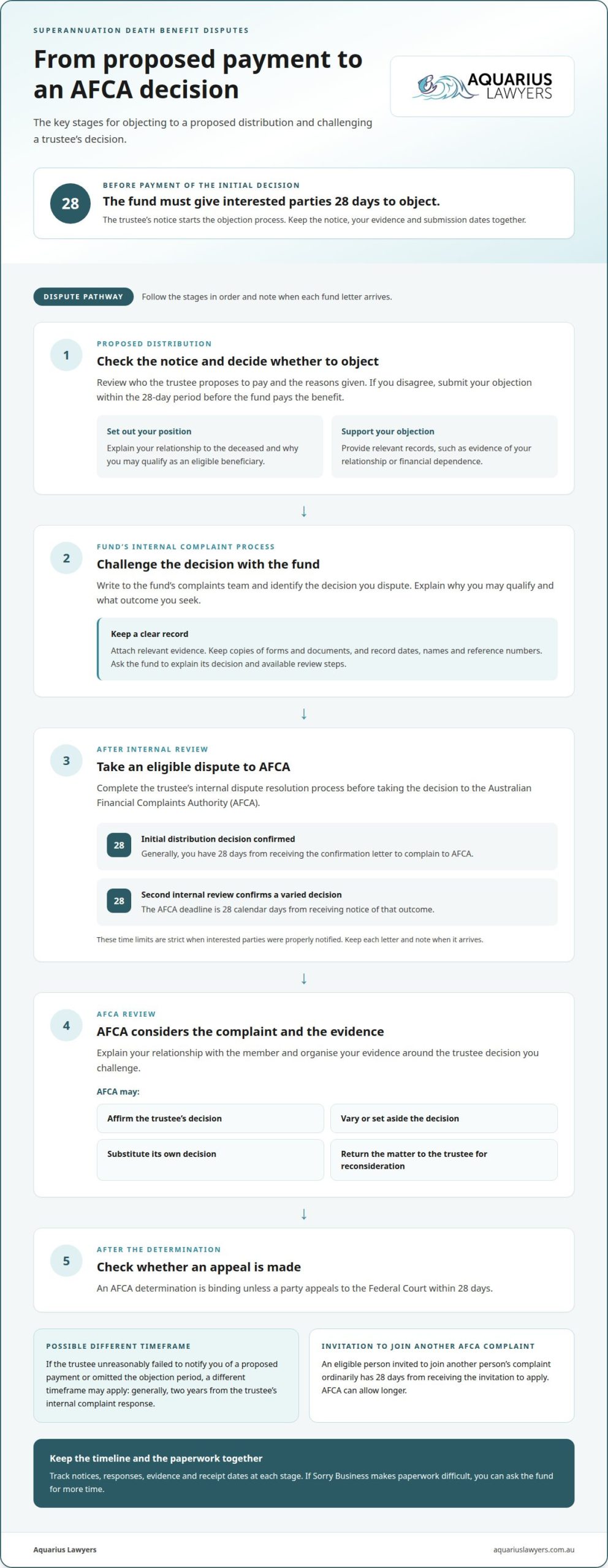
A superannuation death benefit claim dispute can arise when a fund trustee must choose between competing claimants or decide whether a nomination is valid. Eligible recipients can include the deceased’s legal personal representative and SIS dependants, including a child of any age. Before paying an initial decision, the fund must give interested parties 28 days to object.
It’s understandable to expect a super benefit to pass directly to the person named in a will or nomination. But superannuation does not automatically form part of the estate. The fund’s rules, any valid nomination and the evidence provided by each claimant can affect who receives it.
This guide explains who may claim, how trustees assess competing claims and what to do if you disagree with a decision. It also covers the fund’s objection process and how a complaint to the Australian Financial Complaints Authority (AFCA) may fit into the process for challenging an outcome.
Key Takeaways
- Identify whether you may qualify as a dependant or legal personal representative, even if you aren’t named in the will.
- Understand how a valid nomination, the fund’s rules and evidence about claimants can shape the trustee’s decision.
- Be ready to object within the relevant 28-day period if the fund notifies you of a proposed distribution.
- Follow the fund’s internal complaint process before taking an eligible dispute to the Australian Financial Complaints Authority.
- See how legal support can help you assess a disputed decision and prepare your next steps.
How do super death benefit claims work?
A super fund assesses the deceased member’s account balance and any life insurance entitlement, then pays the benefit as soon as practicable. The trustee considers the fund’s rules, any death benefit nomination and who may qualify to receive payment.
A claim usually begins by notifying the fund and completing its claim forms. The fund may request documents before deciding who can receive the benefit and how it should be paid. Keep your claim focused: identify yourself, explain your relationship to the deceased and provide records that support your claim.
Binding nomination requirements and expiry
For a nomination under the SIS Act section 59(1A) and regulation 6.17A pathway, two adult witnesses must see the member sign and date it. Neither witness can be named in the nomination, and both must sign and date the required declaration. A nomination made under this pathway generally expires after three years unless renewed. Review its date and formalities when assessing whether it can direct the trustee.
The High Court confirmed regulation 6.17A does not apply automatically to self-managed superannuation funds. Its witnessing and three-year expiry requirements therefore do not automatically apply to SMSF nominations. The SMSF deed sets the relevant framework, including provisions for nominations and trustee appointments after a member’s death.
Binding and non-binding nominations
A valid binding nomination directs the trustee to pay the benefit to the person or people nominated, subject to the applicable rules. An unchanged binding nomination under regulation 6.17A can be confirmed by signed and dated written notice to the trustee, without two witnesses. A non-binding nomination guides the trustee but leaves it discretion over the distribution.
If there is no valid binding nomination, the trustee may decide which eligible people receive the benefit, divide it between them or pay it to the estate. Probate or letters of administration may affect the process if the estate is to receive payment. This distinction matters when a will and nomination name different recipients.
A claim may require proof of death, your proof of identity and evidence of your relationship to the deceased. For an estate claim, provide documents showing who is authorised to act for the estate. Missing or incomplete paperwork can delay assessment. If Sorry Business makes paperwork difficult, you can ask the fund for more time.
What are the tax rates on superannuation death benefits in Australia? Under Australian tax law, a lump sum paid to a tax dependant is tax-free under section 302-60 of the ITAA 1997, according to the Federal Register of Legislation. For a non-tax-dependant, tax offsets cap tax on the taxable component at 15% for the taxed element and 30% for the untaxed element.
What does it cost to get legal advice or challenge a super death benefit decision? Legal advice can help you assess the nomination, organise supporting evidence and identify practical steps to challenge a disputed decision.
Complaints and external dispute resolution
Respond promptly to a proposed distribution: the trustee’s notice starts a defined objection process. Keep the decision letter, your evidence and submission dates together, as each step may affect your next deadline.
Complaints to super funds
Write to the fund’s complaints team and identify the decision you dispute. Explain your relationship to the deceased, why you may qualify as an eligible beneficiary and what outcome you seek. Attach relevant evidence, such as records supporting your relationship or financial dependence. Keep copies of all forms and documents, and record dates, names and reference numbers.
Ask the fund to explain its decision and the available review steps. If Sorry Business makes it difficult to complete paperwork, you can ask the fund for more time to return forms or provide documents.
Internal complaints and AFCA disputes
Complete the trustee’s internal dispute resolution process before objecting to its decision through the Australian Financial Complaints Authority (AFCA). If the trustee confirms its initial distribution decision, you generally have 28 days from receiving its confirmation letter to complain to AFCA. If a second internal review confirms a varied decision, the AFCA deadline is 28 calendar days from receiving notice.
These time limits are strict when interested parties were properly notified. Keep the trustee’s letters and record when each arrives. If the trustee unreasonably failed to notify you of a proposed payment or omitted the objection period, a different timeframe may apply: generally, two years from the trustee’s internal complaint response.
AFCA death benefit complaints
AFCA provides a free service for complaints about financial products and services, including superannuation death benefit distributions. It can affirm, vary or set aside a trustee’s decision, substitute its own decision, or return the matter to the trustee for reconsideration. Clearly explain your relationship with the member and organise your evidence around the decision you challenge.
An AFCA determination is binding unless a party appeals to the Federal Court within 28 days. An eligible person invited to join another person’s AFCA complaint ordinarily has 28 days from receiving the invitation to apply, although AFCA can allow longer.
What happens to a superannuation death benefit during court proceedings or an AFCA complaint? The fund must allow interested parties 28 days to object to its initial decision before paying the benefit. If AFCA later makes a determination, it binds the parties unless appealed to the Federal Court within 28 days.
Where a dispute also raises questions about estate administration, advice on Wills and Estates matters can help clarify the estate’s role alongside the AFCA complaint.
Trustee discretion and decision-making
A super fund trustee applies the fund’s rules to decide which eligible people receive the deceased member’s benefit. A superannuation death benefit claim dispute can arise when claimants challenge that assessment or a proposed distribution.
Decisions without a binding nominee
If there is no binding nomination, or the nomination is invalid, the trustee decides how to distribute the benefit under the fund’s rules. It may identify eligible dependants, divide the payment between them or pay it to the deceased’s legal personal representative for the estate. A non-binding nomination can guide the decision, but does not remove the trustee’s discretion.
A will does not automatically direct the trustee. For example, a person named in the will may still need to qualify under super law and the fund’s rules. The trustee must decide who is eligible to receive the benefit within that framework.
Assessing competing claimants
When several people claim the benefit, the trustee may weigh financial need, financial dependence and the closeness of each person’s relationship with the deceased. It may also consider each claimant’s estate entitlements and whether a beneficiary nomination may have been invalidated. These factors help the trustee assess competing claims, rather than simply favouring the person named in the will.
A dispute may concern whether someone was wholly or partly dependent on the deceased, or how to divide the benefit among eligible claimants. A superannuation death benefit claim dispute may also arise when claimants disagree about a nomination’s validity or evidence of dependence. The fund may need to identify or contact potential beneficiaries before deciding, which can extend the assessment.
Evidence for claims and disputes
What evidence supports a superannuation death benefit claim or dispute? A claim may require proof of death, your proof of identity and evidence of your relationship to the deceased. If the estate claims payment, provide documents establishing who can act for it. For a dispute, connect each document to the specific issue you challenge.
For example, documents showing financial support may help substantiate a claim of dependence. Relationship records can clarify your connection to the member. Nomination documents may help address arguments about validity or effect. A focused submission explains how the evidence relates to eligibility, the fund’s rules and the competing claims.
Assessment and distribution decisions
The trustee generally checks for a valid nomination, considers who may qualify under super law and the fund’s rules, then decides distribution. Before paying an initial decision, the fund must give interested parties 28 days to object. If it varies that decision, a potential beneficiary can object to the varied decision within 28 days.
Read the notice for the reasons, proposed recipients and objection deadline. State which finding you challenge and provide relevant evidence. If the trustee confirms its decision after an internal review, complete that process before taking your complaint to the Australian Financial Complaints Authority.
Who may claim a superannuation death benefit
Eligibility depends on the deceased member’s nomination, the fund’s rules and Australian superannuation law. A will alone does not determine who receives super, so a superannuation death benefit claim dispute may arise when eligible claimants disagree about entitlement.
Under the Superannuation Industry (Supervision) Act 1993 Cth, usual eligible recipients include the deceased’s legal personal representative and SIS dependants. A child can qualify at any age. A person named in a nomination, someone dependent on the deceased, or someone in a close personal relationship may also have a claim.
A spouse or de facto partner, including a same-sex partner, is generally within the eligible recipient group. Other claims may depend on evidence of financial dependence or the nature of the relationship. If several eligible people claim, the trustee assesses their positions under the fund’s rules. A superannuation death benefit claim dispute can concern whether a claimant qualifies or how the benefit should be divided.
The legal personal representative acts for the estate. This may be an executor or an administrator, depending on the estate’s circumstances. The fund may require documents showing who is authorised to act. Probate or letters of administration may be needed for payment to the estate, affecting the time required to progress the claim.
The benefit can include the member’s account balance and any life insurance entitlement. The fund assesses payment under its rules and any valid nomination, rather than treating the will as an automatic direction. This distinction matters when estate plans and super nominations name different recipients.
To support a claim, provide proof of death, your proof of identity and evidence of your relationship to the deceased. Depending on the basis of your claim, documents may also show financial dependence or your authority to represent the estate. Explain how each document supports your eligibility and, if relevant, why the trustee should assess competing claims differently.
For example, a child, surviving partner and estate representative may each have a potential claim. The trustee considers who qualifies and how the fund’s rules apply. If another claimant’s relationship or dependence is disputed, focus your submission on evidence relevant to that issue, rather than assumptions about who should inherit.
If you’re assessing how super interacts with estate administration, seek guidance on Wills and Estates to clarify the representative’s role and the documents supporting an estate claim.
Aquarius Lawyers
Aquarius Lawyers provides legal advice on estate planning and other legal matters. If you are an executor, dependant or competing claimant, legal guidance can help clarify how the fund’s decision, nomination and estate administration affect your position in a disputed superannuation death benefit claim.
Bring the trustee’s decision and correspondence, nomination documents and evidence supporting your claim. These materials help define the issues, assess available options and consider relevant deadlines for an objection or complaint. If the dispute also affects the estate, clarify how the representative’s role fits into the fund’s process.
Contact Aquarius Lawyers to discuss your circumstances and the practical next steps available to you.
Take a clear next step
If you are dealing with a superannuation death benefit claim dispute, first identify the specific decision you want addressed. Separate facts you can document from assumptions about what the deceased intended. A clear account of your position helps explain the outcome you seek and why.
Before taking further action, consider how the super decision connects with estate administration and any wider family arrangements. These issues may follow different pathways, so treating them as one question can obscure what needs attention first. A focused discussion can help you set priorities and choose a practical way forward.
Contact Aquarius Lawyers for advice about your circumstances and possible next steps. With a clear plan, you can approach the dispute with greater confidence.
Frequently Asked Questions
Are self-managed superannuation fund disputes different?
Yes. An SMSF dispute may turn on who can act as trustee after a member dies. Under SIS Act section 17A(3)(a), the deceased member’s legal personal representative may act in the member’s place from death until death benefits commence to be payable, without breaching SMSF membership conditions. This can matter when the remaining trustees need to administer the fund while the benefit is being determined.
Can a binding death benefit nomination be disputed?
Yes. A challenge may concern whether the fund holds the nomination the member signed, whether a later document changed it, or whether the trustee relied on the correct version. Ask the fund to identify the nomination it considered and keep copies of relevant correspondence. State precisely what you dispute, rather than simply saying the result seems inconsistent with the member’s wishes.
How is a dispute about an APRA-regulated fund pursued?
For an APRA-regulated fund, make your case specific: identify the trustee’s finding you challenge, explain why it matters to the distribution and state the outcome you seek. Organise supporting documents by issue so the decision-maker can follow your reasoning. AFCA provides external dispute resolution for eligible complaints about superannuation death benefit distributions, offering a pathway beyond the fund’s own review process.
What happens to super when someone dies?
The fund handles the deceased member’s super claim, and an insurer assesses any insurance claim involved. If the benefit is directed to the estate, the executor or administrator may need to complete estate administration before the funds can be dealt with. Keep the fund’s correspondence with the estate records so the representative can track requests, decisions and documents needed for administration.
What is a superannuation death benefit in Australia?
A superannuation death benefit is a payment from a super fund following a member’s death. Payment options can differ depending on the recipient’s status: a dependant may be able to choose a lump sum or income stream, while a non-dependant receives a lump sum. This distinction can affect how a recipient plans to manage the payment, so clarify the available form before making distribution decisions, and consider seeking strategic advice from financial advisers such as financialmentors.com.au to assist with ongoing wealth management.
Who can receive a superannuation death benefit in Australia?
Potential recipients include a spouse or de facto partner, children, other eligible dependants and the deceased member’s legal personal representative. A child may qualify regardless of age, while a person in a close personal relationship may also have a claim. Once eligibility is assessed, the recipient’s dependant status can affect whether payment may be received as an income stream or must be paid as a lump sum.
Disclaimer
Please note that legal rules change and this is not a substitute nor construed as legal advice. It is general information only.