
Most people think a bail hearing is a desperate plea for freedom, but it’s actually a cold, strategic calculation of risk. If you or a loved one are facing the Magistrate, the most dangerous thing you can bring into the courtroom is a lack of preparation. Understanding exactly what happens in a bail hearing isn’t just about knowing where to stand; it’s about mastering the “show cause” and “unacceptable risk” tests that determine whether you walk out the front door or stay in custody.
You’re likely feeling the heavy weight of the unknown right now, and the stress of finding a surety or organising security only adds to the pressure. It’s a high-stakes environment where the legal jargon can feel like a barrier to justice. This guide provides a clear pathway through the NSW legal process so you can approach the bench with grounded confidence. We will break down the specific criteria used under the Bail Act 2013, the significant impact of the April 2024 legislative amendments, and the practical steps you must take to present a compelling case for release.
Key Takeaways
- Learn how the “show cause” and “unacceptable risk” tests form the legal foundation for every release application in NSW courts.
- Gain a step-by-step walkthrough of what happens in a bail hearing, from the initial “mention” to the physical layout of the courtroom.
- Discover how to organise a robust “bail package” that uses strategic conditions and security to address the Magistrate’s concerns effectively.
- Understand the critical role of an “Acceptable Person” and exactly what documents they need to provide to act as a surety.
- Identify common conditions you might face and the importance of the Bail Acknowledgment in securing a final release from custody.
Understanding Bail: Your First Step in the NSW Criminal Justice System
Bail is essentially a conditional liberty. It is the temporary release of a person charged with an offence, allowing them to remain in the community while they await their day in court. In New South Wales, the starting point for any legal professional is the presumption of innocence. This principle dictates that the law should generally favour liberty, ensuring that an individual is not punished by imprisonment before a jury or Magistrate has even heard the evidence. Understanding what happens in a bail hearing is vital because this first court appearance is often the most critical moment for your entire defence strategy.
If bail is granted, you can prepare your case from the comfort of your home, maintain your employment, and stay connected with your family. If it is refused, the logistical and emotional hurdles of your legal journey increase tenfold. It’s a high-stakes environment where the quality of your initial application can dictate your freedom for months or even years while the matter progresses through the system.
Police Bail vs. Court Bail
The process begins the moment an arrest occurs. Once you are taken to the police station, an “authorised officer” has the power to grant or refuse initial bail. This is often the first opportunity for release. If the police refuse bail, they are legally required to bring you before a Magistrate as soon as practicable, which is almost always within 24 hours. At this stage, the decision-making power shifts from the police to the judiciary. While the police look at the immediate circumstances of the arrest, a Magistrate takes a broader, more analytical view of the legal tests required for release.
The Role of the NSW Bail Act 2013
Every decision made in a courtroom regarding your freedom is governed by the Bail Act 2013 (NSW). This legislation replaced older, more rigid systems with a model focused on risk management. It’s a complex framework that requires a solicitor to address specific “bail concerns” such as the risk of re-offending or failing to appear in court.
A “one size fits all” approach never works in these proceedings. What satisfies a Magistrate in the Downing Centre might not carry the same weight in a regional court like Dubbo or Wagga Wagga. Success depends on a solicitor’s ability to navigate these local nuances and present a “bail package” that directly addresses the court’s specific concerns. When you consider what happens in a bail hearing, remember that it is less about a plea for mercy and more about a strategic demonstration that any potential risks can be mitigated through strict, enforceable conditions.
The Legal Tests: ‘Show Cause’ and ‘Unacceptable Risk’ Explained
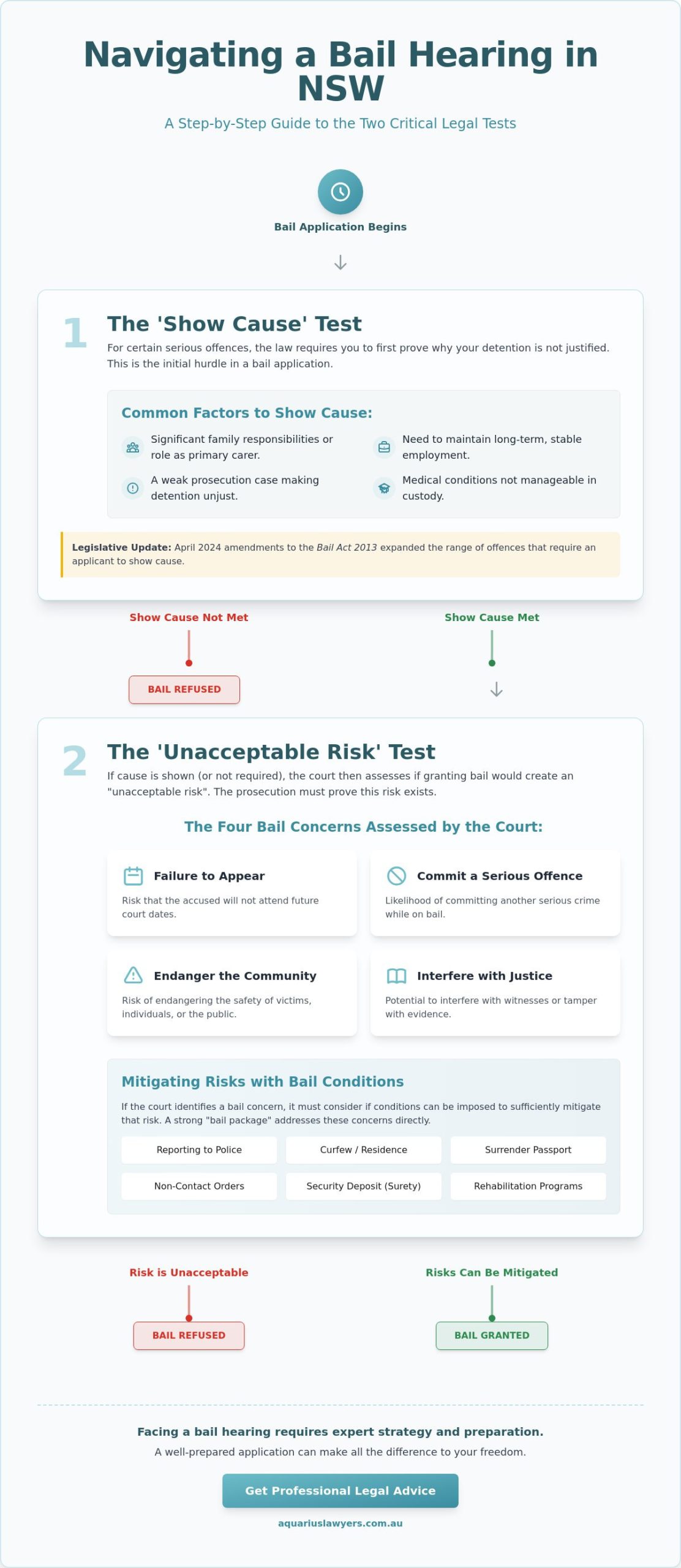
The legal logic inside a NSW courtroom is specific and methodical. When people ask what happens in a bail hearing, they’re often surprised to learn it isn’t a single decision. It’s a two-stage hurdle. First, the court determines if the offence is serious enough to require the accused to “show cause.” If that hurdle is cleared, or if the offence doesn’t trigger it, the Magistrate moves to the “unacceptable risk” test. This structure ensures that liberty is only restricted when the community’s safety or the integrity of the justice system is truly at stake.
Do You Need to ‘Show Cause’?
Under the Bail Act 2013, certain serious charges carry a “show cause” requirement. This means the default position is detention unless the accused can justify why their stay in custody isn’t warranted. Since the Bail and Crimes Amendment Bill 2024 became effective on April 3, 2024, the list of show cause offences has expanded to include a wider range of serious property and firearms offences. Showing cause isn’t about a simple plea. It requires demonstrating concrete factors such as:
- Significant family responsibilities or being a primary carer.
- The need to maintain long-term, stable employment.
- Ongoing medical conditions that can’t be managed in a correctional centre.
- An exceptionally weak prosecution case that makes detention clearly unjust.
The Four Unacceptable Risks
Once the show cause hurdle is cleared, the Magistrate assesses four specific risks. Understanding bail in NSW involves knowing that the court must refuse bail if these risks cannot be managed by conditions. The four risks are:
- Failure to appear: The risk that the accused will skip court.
- Serious re-offending: The likelihood of committing further crimes while on release.
- Community safety: Protecting victims or the general public from harm.
- Interfering with justice: The risk of tampering with evidence or witnesses.
A skilled criminal law solicitor doesn’t just argue against these risks; they build a “bail package” to neutralise them. This formula is simple: for every risk identified, a matching condition is proposed. If the concern is re-offending, a curfew is suggested. If the concern is flight risk, a surety or security is offered. This strategic approach is exactly what happens in a bail hearing when a defence is properly prepared. It turns a plea for freedom into a practical plan for risk management.
Inside the Courtroom: A Step-by-Step Walkthrough of the Hearing
Walking into a NSW Local Court can feel like stepping into a different world. Understanding what happens in a bail hearing requires a clear picture of the room’s physical layout. The Magistrate sits at the front on an elevated bench, presiding over the matter. Directly below them is the Court Clerk, who manages the recording and paperwork. As you face the bench, the Police Prosecutor usually sits at the bar table on the right, while your defence solicitor takes the left. If the accused is in custody, they will typically appear via an Audio Visual Link (AVL) from a correctional centre, though they may sometimes be brought into the “dock” in person.
The proceedings begin with the “Mention.” A court officer calls the name of the accused, and both legal representatives announce their appearance. This is the moment where the strategic work discussed in previous sections is put to the test, and you see exactly what happens in a bail hearing from a procedural standpoint. There is no jury; the decision rests entirely with the Magistrate.
Who Speaks and When?
The Police Prosecutor leads the charge. They hand the Magistrate the “Police Facts Sheet”, which is the police version of the alleged crime, along with the accused’s criminal history. The Prosecutor will argue why bail should be refused, specifically pointing to the “unacceptable risks” they believe exist. They don’t need to prove the person is guilty at this stage; they only need to show that the risks of release are too high.
Next, your solicitor makes their “submissions.” This is a persuasive oral argument that addresses the court’s concerns. They will explain how the “bail package” we mentioned earlier neutralises the police’s arguments. If a family member is providing a surety, the solicitor will present their details to the court. For more complex cases where security is involved, Supreme Court bail procedures provide the framework for how that money or property is formally lodged.
The Magistrate’s Decision
Once the arguments are finished, the Magistrate delivers their decision. They will weigh the police allegations against the defence’s proposed conditions. The Magistrate will then give a “judgement,” which is a summary of their reasons for either granting or refusing bail. If the court needs more information, such as a confirmed address or a report from a rehabilitation centre, they might “adjourn” the application. This means the hearing is paused and will resume on another day, usually within a week, once that specific information is provided. It’s a methodical process designed to ensure that every decision is backed by evidence and the law.
Preparing for Success: How Families and Lawyers Organise a Strong Case
Success in court is often decided before the Magistrate even takes their seat. While the legal tests are the framework, the “Bail Package” is the practical solution. This package is a curated set of conditions designed to show the court that any risks are manageable. At Aquarius Lawyers, we utilise modern communication tools to streamline this process, allowing families to upload character references and proof of residence securely and instantly. This efficiency is a core part of what happens in a bail hearing preparation; the faster we can verify your support network, the stronger our initial submission becomes. It’s about turning a stressful situation into a methodical, strategic operation.
Acting as a Guarantor (Surety)
An “Acceptable Person” is someone the court trusts to ensure the accused follows their bail conditions. To qualify, you generally need to be over 18, have no serious criminal record, and know the accused well. There is a critical difference between “security” and an “acknowledgment.” Security involves providing actual cash or an asset, such as a house title, to the court. An acknowledgment is a formal promise to pay a set amount if the accused fails to appear. If a breach occurs, the consequences are severe. The person offering the surety may lose their money or property entirely, which is why this role requires a high degree of trust and commitment.
Practical Documents to Bring to Court
Preparation requires more than just showing up. Families should bring physical or digital copies of specific documents to ensure the application isn’t delayed. These include:
- Proof of residence: A current lease or utility bill showing exactly where the accused will live.
- Employment evidence: A letter from an employer confirming the accused still has a job or a current contract of employment.
- Identification: A valid driver’s licence or passport for the person offering security.
- Medical documents: Proof of upcoming appointments or ongoing treatment if health is a factor in the application.
If you’re unsure about your eligibility as a surety or what documents you need to collect, it’s vital to speak with our criminal law experts to ensure your documentation meets the court’s strict standards. This proactive approach helps manage the uncertainty of what happens in a bail hearing, ensuring that you aren’t left chasing paperwork while your loved one remains in custody. A well-organised case is always more persuasive to a Magistrate than one built on last-minute promises.
After the Decision: Conditions, Compliance, and Legal Support
The moment the Magistrate grants release, the atmosphere shifts from tension to a need for precision. If you’ve been following the process, you know that what happens in a bail hearing concludes with the signing of a Bail Acknowledgment. This is your formal roadmap for liberty. It’s a binding legal contract between the accused and the NSW government. Every condition listed must be followed to the letter. A single slip-up, even a minor one like being ten minutes late for a curfew, can result in immediate arrest and the revocation of bail. It’s a high-stakes environment where compliance is the only currency that matters.
Understanding Your Conditions
Bail conditions aren’t suggestions; they are strict requirements designed to mitigate the risks we’ve discussed. Most release orders include a mix of standard and specific conditions. Common examples often include:
- Curfews: Requiring the accused to remain at their residence between specific hours, such as 9:00 pm to 6:00 am.
- Reporting: Mandatory check-ins at a designated police station on specific days.
- No-contact orders: Strict prohibitions against communicating with victims or witnesses.
- Place restrictions: Staying away from specific suburbs or licensed premises.
Life is rarely static. If you need to move house or change your working hours, you cannot simply ignore your existing conditions. You must apply for a “Bail Variation.” This is a strategic process where your solicitor asks the court to adjust your conditions based on changed circumstances. We assist clients in navigating these variations to ensure their liberty doesn’t interfere with their ability to work or support their family. This proactive management is a core part of what happens in a bail hearing aftermath; it keeps you out of custody while your matter progresses.
If Bail is Refused: The Next Pathway
A refusal in the Local Court is a setback, but it isn’t the end of the road. In NSW, the “one-shot” rule generally applies. This means you can’t keep making the same application to the same court unless there are significant new facts or circumstances. This is why the initial hearing is so vital. If bail is refused, the primary alternative is a Supreme Court bail application. This is a higher-level proceeding that requires a fresh perspective and a meticulously prepared case. It’s a complex environment where the synergy between traditional legal experience and a modern, evidence-based approach is most valuable.
If you find yourself in this position, you need a team that understands how to dismantle the prosecution’s arguments at a more sophisticated level. Working with an experienced criminal lawyer Sydney residents trust means having an advocate who combines courtroom grit with a strategic, modern perspective on your case. Protect your rights—contact Aquarius Lawyers for expert criminal defence in Sydney. We provide the steady, common-sense guidance needed to navigate these high-pressure outcomes and work towards a resolution that secures your freedom. Whether it’s the first appearance or a complex appeal, our focus remains on delivering a pathway to release through strategic risk management.
Take Control of Your Legal Pathway
Navigating the complexities of the NSW justice system requires more than just hope; it demands a calculated strategy. Knowing exactly what happens in a bail hearing gives you the clarity needed to prepare for the “show cause” and “unacceptable risk” tests that define your immediate future. By focusing on a robust bail package and leveraging a strong support network, you transform a stressful courtroom appearance into a professional demonstration of risk management. Success in these proceedings is the result of thorough preparation meeting expert advocacy.
Principal Katherine Hawes is a no-nonsense, innovative veteran who provides specialist expertise in NSW criminal law and Local Court procedures. We combine traditional legal credentials with a modern, strategic approach to ensure your application is as persuasive as possible. We don’t just plead for release; we build a logical, evidence-based case for it. Secure expert representation for your NSW bail hearing today.
The road ahead may feel daunting, but with the right preparation and a steady guide by your side, you can approach the bench with confidence and a clear plan for your liberty.
Frequently Asked Questions
How long does a bail hearing take in NSW?
A bail hearing generally takes between 10 and 30 minutes of actual courtroom time once the matter is called. While the legal arguments are relatively swift, you should expect to spend most of the day at court. The Magistrate’s list often contains dozens of matters, and you must wait for your solicitor and the prosecutor to be ready before the hearing begins.
Can I get bail for a serious “Show Cause” offence?
You can get bail for a show cause offence, but the burden of proof rests entirely on the accused person. You must first provide the Magistrate with a compelling reason why your detention is not justified. If you successfully “show cause,” the court then applies the standard “unacceptable risk” test to determine if release conditions can safely manage your return to court.
What is the difference between a surety and a security?
A surety is the “Acceptable Person” who guarantees you will follow your conditions, while security is the actual cash or asset they lodge with the court. In what happens in a bail hearing, these terms are linked; the surety signs an agreement to forfeit the security if the accused person fails to appear. The security acts as the financial guarantee for the court.
What happens if I cannot afford to pay the bail security amount?
If you cannot afford the security amount, the accused person will remain in custody until the funds are lodged with the court registry. If the amount is clearly beyond your financial means, your solicitor can apply for a bail variation to have the amount reduced. The court will only grant this if they believe a lower amount still effectively manages the flight risk.
Can a Magistrate refuse bail even if the police were going to grant it?
Yes, a Magistrate has the final authority and can refuse bail even if the police were initially prepared to grant it. Once the matter is in the courtroom, the Magistrate conducts an independent assessment under the Bail Act 2013. They are not bound by the police’s earlier decisions or any recommendations made at the station.
What should I wear to a bail hearing as a supporter?
Supporters should wear neat, conservative, and respectful clothing, such as business-casual attire. It is best to avoid hats, sunglasses, or clothing with large logos or slogans. Presenting a professional and stable image helps demonstrate to the Magistrate that the accused has a reliable and responsible support network waiting to assist them in the community.
How many times can you apply for bail in NSW?
You generally have one opportunity to apply for bail in the Local Court and one subsequent application in the Supreme Court. To make a second application in the same court, you must prove there are “new facts or circumstances” that weren’t available during the first hearing. This is a high legal bar, making the first application the most important.
Does a bail hearing decide if I am guilty or innocent?
No, a bail hearing does not determine guilt or innocence. It only decides if the accused should be at liberty while waiting for their trial. While the Magistrate considers the strength of the prosecution’s case, the primary focus of what happens in a bail hearing is assessing risk and community safety rather than delivering a final verdict.
Disclaimer
Please note that legal rules change and this is not a substitute nor construed as legal advice. It is general information only.