
A commercial fishing licence gives you permission to fish for sale, not unrestricted access to a catch. The rights of commercial fishers in Australia depend on the permits and concessions they hold, the fishery they operate in, and the rules for their gear, catch and location. In Queensland, commercial fishing requires a licence.
A licence is only part of the picture. Catch limits, closed seasons and protected areas can also restrict what you may do. Rules differ between Commonwealth and state-managed fisheries, so identifying which framework applies is an important part of running a fishing business.
This article explains what commercial fishing means and how permits, quotas, fishing restrictions and protected areas affect your rights. It also outlines the role of Queensland’s Fisheries Act 1994 (Qld), so you can better understand the rules that govern your operation and where legal issues may arise.
Key Takeaways
- Commercial fishing means catching fish or other marine life for sale, and you need the relevant authority to operate in the fishery and area concerned.
- Western Rock Lobster fishing is managed through licensing, quotas and minimum and maximum size limits, so confirm how each control applies to your operation.
- Commonwealth fishing permits can run for up to five years, while most are granted for one year at a time; permit conditions and transfer rules also matter.
- In Queensland, the Fisheries Act 1994 (Qld) sits alongside regulations and management plans that set controls on fishing effort, equipment and closed seasons.
- Your operating rights can depend on whether the fishery is state or Commonwealth managed, and whether protected-area rules restrict fishing in the location.
What is commercial fishing?
Commercial fishing means catching fish or other marine life for sale. Your right to fish depends on the licence or concession for the relevant fishery, species, gear and area. A licence defines the scope of your operation; it does not give unrestricted access to fish stocks or waters.
Australia’s Western Rock Lobster fishery shows how these controls work together. It operates under a licensing regime, quotas and minimum and maximum size limits. Before fishing, identify the applicable licence and quota, then check that your planned catch and gear meet the fishery’s rules. A quota limits the amount that may be taken. An individual transferable quota (ITQ) links an allocation to a holder and may be transferred where the system allows. Australian statutory fishing rights can be permanently transferred to another person or company, or leased.
The scale of the industry makes these controls commercially significant. Australian fishery production was valued at A$1.71 billion in 2016-17. For seafood exporters, permission to catch is only one part of the business: the product must also meet applicable handling, documentation and destination-market requirements. Check how the relevant fishing authority’s rules interact with your supply arrangements before committing catch to a sale.
Fishing gear and catch limits also manage environmental risks. Queensland’s Fisheries Management Plan requires trawl nets to use specified turtle-excluder devices and other bycatch-reduction devices. Gear requirements can affect what you can deploy and how you operate. Globally, the share of fish stocks within biologically sustainable levels fell from 90% in 1990 to 65.8% in 2018. Quotas, size limits and gear controls are tools for managing pressure on stocks and reducing unintended catch.
Eligibility and licensing requirements depend on the fishery and the authority responsible for it. The relevant scheme sets the licence category and operating criteria, so there is no single national eligibility test.
Reporting, logbook and catch-traceability duties depend on permit and fishery conditions. Commercial fishing vessels operating in or transiting through an Australian Marine Park must have an installed and activated Vessel Monitoring System by 1 July 2028; phased implementation began on 1 July 2024. Fish receivers handling southern bluefin tuna must ensure each fish is tagged, weighed and measured, with correct documentation before domestic sale or export.
Assistance, compensation or review options depend on the decision and the rules governing the affected fishery. Identify the authority’s decision, the affected concession and the applicable terms to establish which review pathway or assistance arrangements may apply.
Permit duration and conditions
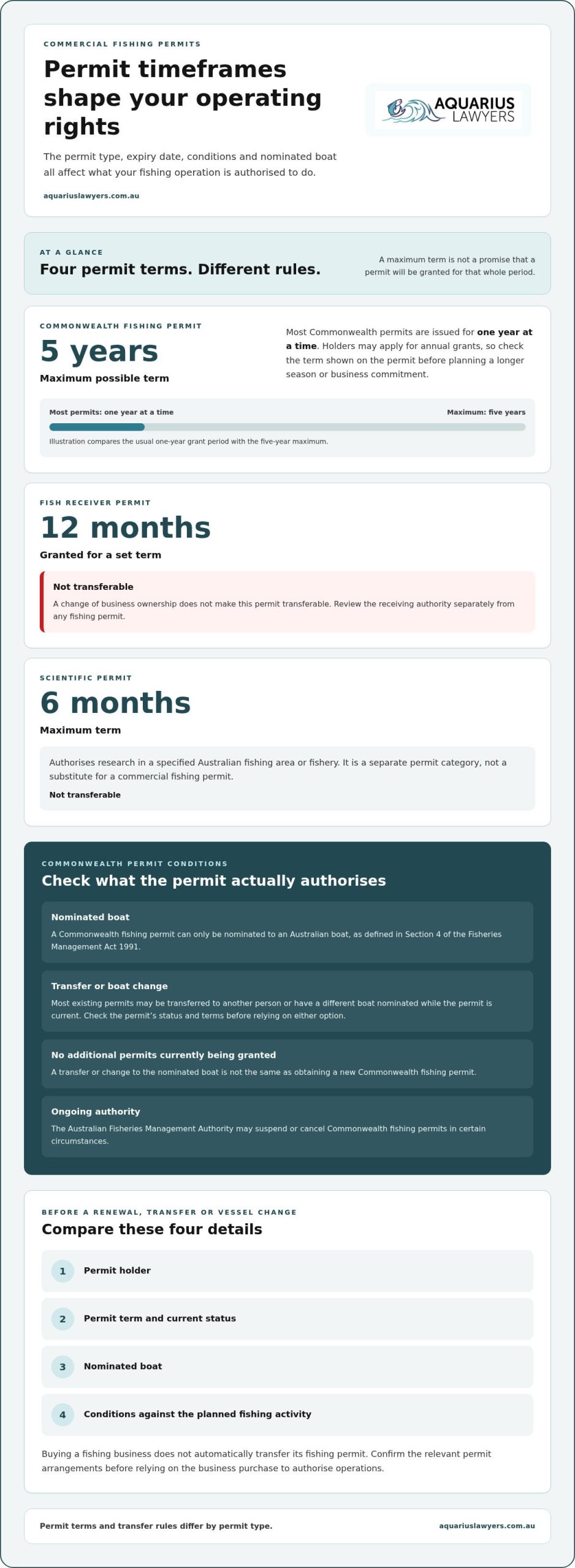
A Commonwealth fishing permit does not have a standard term across all fisheries. It may be granted for a maximum of five years, but in most Commonwealth fisheries, permits are issued for one year at a time. Holders may apply for annual grants. The five-year maximum does not mean you will receive a five-year permit. Check the term on your permit before planning a longer fishing season or business commitment.
This distinction matters when scheduling vessel use, crew and supply arrangements. If your permit is granted for one year, you need a fresh annual application to continue operating. Set a reminder well before expiry and review the permit conditions against your planned fishing activity. The permit’s duration alone does not show which fishing activities it authorises.
Commonwealth fishing permits are tied to authorised fishing arrangements, including the nominated boat. A permit can only be nominated to an Australian boat, as defined in Section 4 of the Fisheries Management Act 1991. Most existing permits may be transferred to another person or have a different boat nominated while the permit is current. Those options are not the same as obtaining a new permit: currently, no additional Commonwealth fishing permits are being granted.
Before a transfer or boat change, check the proposed arrangement against the permit’s current status and terms. For instance, a buyer considering an operating fishing business should not assume that buying the business automatically transfers its fishing permit. Transferability and the nominated boat can affect whether the planned operation is authorised.
Other permits have different terms. Fish receiver permits are granted for 12 months and cannot be transferred. That distinction matters if your business receives fish rather than catching it. A proposed change of ownership does not make a non-transferable receiver permit transferable, so separate the receiving authority from any fishing permit when reviewing business arrangements.
Scientific permits are a separate category, not a substitute for a commercial fishing permit. They authorise research in a specified Australian fishing area or fishery for a maximum of six months and are not transferable. Make the permit type clear in contracts and operational plans: its purpose and term determine which activities it authorises.
The Australian Fisheries Management Authority (AFMA) may suspend or cancel Commonwealth fishing permits in certain circumstances. Treat a permit as an ongoing legal authority subject to conditions, not simply as an asset recorded in a sale. Before acting on a renewal, transfer or vessel change, compare the permit’s holder, term, nominated boat and conditions with the proposed operation. This can reveal gaps before they disrupt fishing activity.
Queensland fisheries legislation
Queensland commercial fishing is regulated through legislation, regulations and fishery-specific management instruments. The Fisheries Act 1994 (Qld) provides the legislative framework for commercial, recreational and Indigenous fishing. It sets the foundation for fisheries management, while supporting rules give operational detail. For your business, the practical question is how each layer applies to the fishery, species, location and activity you plan to undertake.
The Fisheries (General) Regulation 2019 (Qld) and Fisheries (Commercial Fisheries) Regulation 2019 (Qld) provide technical and geographic detail for fisheries management mechanisms. These instruments help define how controls apply in particular places and commercial fisheries. Read the relevant provisions alongside the Act rather than relying on a licence document alone. A concession may identify your authority, while regulations and management instruments set further operating boundaries.
Some fisheries also have a management plan. The Fisheries (East Coast Trawl) Management Plan 2010 (Qld) is subordinate legislation, meaning it sits beneath the Act and regulations within the legislative framework. Queensland commercial fishing is subject to controls on fishing effort and equipment. Queensland’s Fisheries Management Plan also specifies closed seasons for commercial fishing. These controls can affect whether you may fish, where you may operate and which equipment you may use.
For example, if you operate in an East Coast Trawl fishery, identify the relevant plan and area before scheduling a trip. Then compare your planned activity with the applicable effort, equipment and seasonal controls. A change in vessel, target species or fishing method may bring different conditions into play. Assess the proposed operation against the rules for that fishery rather than assuming one Queensland licence covers every commercial fishing activity.
How do commercial fishing rights differ between Australian states and fisheries? Each state has its own legislative framework and fishery controls, and rules can also vary between fisheries within a state. In Queensland, the applicable Act, regulations and management instruments determine the rights attached to your operation.
What workplace safety, vessel registration and crew employment rules apply to commercial fishing businesses? Fisheries legislation governs fishing permissions and fishery controls. Workplace safety, vessel registration and crew employment are subject to separate legal requirements, which depend on the vessel and employment arrangements.
What penalties and enforcement actions apply for illegal commercial fishing or breaching licence conditions? The relevant offence provisions and the nature of the breach determine the consequences. In Commonwealth fisheries, AFMA may suspend or cancel permits in certain circumstances. Queensland breaches are addressed under the relevant Queensland legislation.
When planning a change to your operation, review the governing instruments together. Compare the Act, regulations and any fishery-specific plan with your proposed area, method, equipment and season. This helps pinpoint where your permission ends and another restriction applies.
What rights do commercial fishers have in Australia under federal and state laws?
Your fishing rights depend on who manages the fishery and what authority you hold. Australian Commonwealth fisheries generally operate beyond 3 nautical miles, while state rules govern other fisheries. The line is not the only factor: some Queensland fisheries, including tuna, are also regulated under the Commonwealth Fisheries Management Act 1991 (Cth). Identify the fishery first, then match your concession and planned activity to its governing framework.
For Commonwealth-managed fisheries, the Fisheries Management Act 1991 provides different pathways. Statutory fishing rights are granted under Section 31 where a fishery has a statutory management plan. The plans themselves are determined under Section 17. Commercial fishing permits are granted under Section 32. These are distinct authorities, so holding one does not automatically mean you hold the other.
Both statutory fishing rights and fishing permits in Commonwealth fisheries can only be nominated to an Australian boat, as defined in Section 4 of the Act. Currently, no additional Commonwealth fishing permits are being granted. Most existing permits may be transferred to another person or have a different boat nominated while current. AFMA may suspend or cancel permits in certain circumstances, making the permit’s status and conditions material to your operating rights.
Location adds another layer of controls. Commercial fishing is not allowed in National Park or Sanctuary zones in Australian Marine Parks. Fishing elsewhere in those parks requires approval, provided through class approvals. Fishers with an existing Commonwealth or state government fishing concession generally do not need a separate permit or individual licence to operate in Australian Marine Parks, and do not have to pay new or additional fees. Check the zone and applicable approval before planning a trip.
Torres Strait fishing follows a separate Commonwealth framework under the Torres Strait Fisheries Act 1984 (Cth). A Queensland concession should not be treated as authority to fish there. Likewise, a Commonwealth permit does not remove restrictions imposed by protected-area zones or the relevant fishery’s management arrangements. Your right is defined by the combination of authority, nominated boat, fishery and location.
Use this sequence to assess an operation: identify whether the fishery is Commonwealth, state-managed or jointly regulated; confirm the applicable concession or permit; check the boat nomination; then assess location-based restrictions. For a proposed transfer, vessel change or disputed suspension, get fisheries legal guidance before relying on the authority to operate.
Also confirm whether the activity involves receiving fish: fish receiver permits are granted under Section 91 of Australia’s Fisheries Management Act 1991. Scientific permits in Australia are granted under Section 33 of the Fisheries Management Act 1991; they are not transferable and have no application fee.
Aquarius Lawyers: Marine Law
Aquarius Lawyers advises commercial fishers on Marine Law, Fisheries Law, Aquaculture Law and Commercial Law matters. Speak with the firm when a permit, quota, fishing access decision or proposed transfer raises questions about your operating rights or business arrangements.
Legal advice can clarify how the relevant rules apply to your concession, vessel and planned operations. It can also help you assess the business implications of a licence change or fisheries decision before acting. The issue may involve the fishing authority itself, the commercial agreement behind a transaction, or both.
If a fisheries decision or business arrangement affects your operation, contact Aquarius Lawyers to discuss your situation.
Protect your next business decision
Before committing to a change in your fishing business, set out the decision, the documents it depends on and the operational consequences if plans change. Clear records help you assess your position and make considered choices about timing, negotiations and business commitments.
The rights of commercial fishers in Australia can shape how you plan and protect your operation. If a legal issue could affect a significant business decision, consider seeking advice before committing to a course of action.
Contact Aquarius Lawyers for advice. Take the next step with a clearer view of your options.
Frequently Asked Questions
How do commercial fishing licences and quota entitlements work in each Australian state and territory?
Licences and quota entitlements are specific to the fishery and the authority that administers it. If you plan to operate across state or territory borders, assess each fishery separately rather than treating an existing entitlement as nationwide access. Record the authority, concession holder, authorised species and fishing area for each operation. This gives you a clearer basis for checking that your business plans, catch commitments and vessel arrangements align with the relevant entitlement.
What catch limits, quotas, seasons and gear restrictions apply to Australian commercial fishers?
Controls vary by fishery. In Australia’s mackerel icefish fishery, CCAMLR guidance requires more than 75% of available fish to remain uncaught, and trawl nets targeting mackerel icefish must have a minimum mesh size of 90mm. These rules show why a general quota figure or gear description may not answer your operational question. Match the species and fishing method to the specific fishery controls before setting catch plans.
How are commercial fishing rights allocated, transferred, renewed or suspended in Australia?
The relevant fishery scheme and the terms of the authority govern allocation and changes to an entitlement. For a proposed business or vessel transaction, compare the current entitlement with the proposed holder, vessel, species and operating area. Keep the concession and transaction records together, and establish whether the proposed change has taken effect before relying on it for future operations. A change in ownership alone does not establish which fishing activity is authorised.
What penalties and enforcement actions apply for illegal commercial fishing or breaching licence conditions?
AFMA may suspend or cancel Commonwealth fishing permits in certain circumstances.
Disclaimer
Please note that legal rules change and this is not a substitute nor construed as legal advice. It is general information only.