
A Will isn’t always the final word on how an estate is shared. In NSW, an eligible person under section 57 of the Succession Act 2006 (NSW) can apply for further provision if they believe the deceased didn’t make adequate provision for them. Wherever you are located, a family provision claim lawyer at Aquarius Lawyers can help you assess whether you’re eligible and understand the steps involved.
You may think contesting a Will means proving it is invalid. A family provision claim is different: it asks the Supreme Court of NSW for a share, or a larger share, of the estate. This guide explains who may be eligible, the time limit for starting a claim, and how negotiation and mediation can help resolve a dispute. It also outlines what to consider before proceeding, so you can assess your options more clearly.
Key Takeaways
- Check whether you’re an eligible person under section 57 of the Succession Act 2006 (NSW); eligibility depends on your relationship with the deceased and, in some cases, whether you were dependent on them.
- Act promptly: you generally have 12 months from the date of death to commence a family provision claim as of right.
- A claim asks the Supreme Court of NSW for a share, or a larger share, of the estate because you believe you haven’t received adequate provision.
- Negotiation and mediation may resolve a dispute without a final hearing, but a matter that doesn’t settle at mediation can proceed to one.
- Understand the possible legal and filing expenses, and the risk of being ordered to pay the other side’s costs if your claim is unsuccessful.
Eligibility to contest a Will in NSW
In NSW, you can make a family provision claim only if you’re an eligible person under section 57 of the Succession Act 2006 (NSW). Part 3 of the Act provides the rights to apply. The claim is for further provision from the deceased estate if you believe the Will, or the intestacy rules, left you without adequate provision.
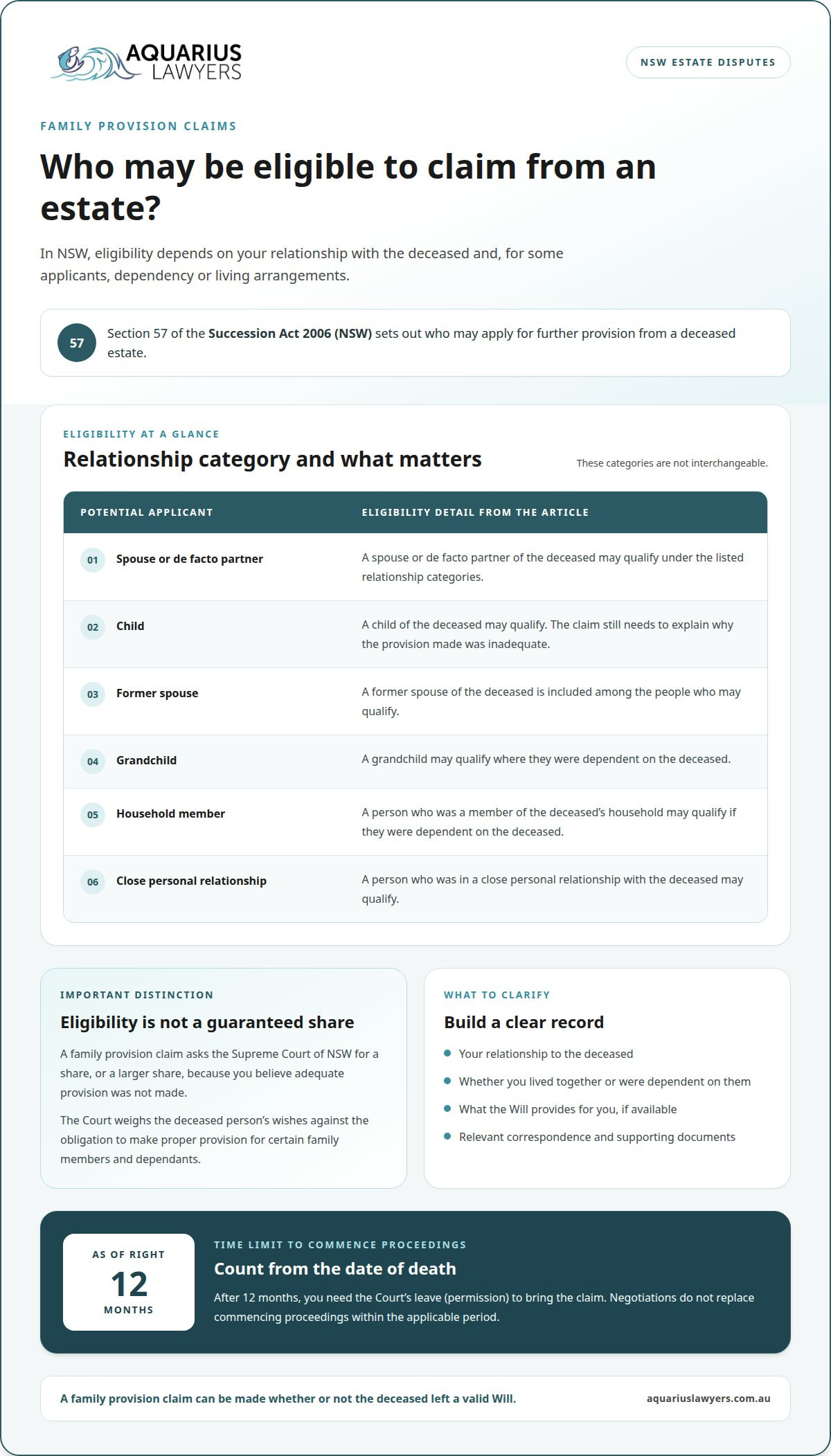
Eligibility depends on your relationship with the deceased and, for some applicants, your dependency or living arrangements. People who may qualify include:
- A spouse or de facto partner of the deceased.
- A child of the deceased.
- A former spouse of the deceased.
- A grandchild who was dependent on the deceased.
- A person who was a member of the deceased’s household and dependent on them.
- A person who was in a close personal relationship with the deceased.
These categories are not interchangeable. Being a relative, for example, does not automatically make you eligible. For some other relatives or people connected to the deceased, eligibility may depend on the circumstances, including dependency and living arrangements. If you are a grandchild, household member or person in a close personal relationship, identify the facts that connect you to the relevant category before taking further steps.
Eligibility is only the starting point, not a guarantee of receiving a share. A family provision claim asks the Court to consider whether further provision should be made from the estate. The Court weighs the deceased person’s wishes against the obligation to make proper provision for certain family members and dependants. Your relationship, dependency and the provision made for you are therefore important to explain clearly. For example, a child who received nothing and a dependent household member who received little must each establish their eligibility and explain their circumstances.
Prepare a clear record before seeking advice. Note your relationship to the deceased, whether you lived together, any dependency, and what the Will provides for you. Keep relevant correspondence and documents that support these details. A family provision claim may be made whether or not the deceased left a valid Will. If there is no valid Will, intestacy rules apply, but the claim still concerns whether adequate provision was made for an eligible person.
You do not have to hire a lawyer to contest a Will in NSW. When looking for a family provision claim lawyer in Sydney, consider their experience with NSW estate disputes and ask how they assess eligibility, evidence and the court process. Bring details of your relationship and dependency, along with the Will if available, so the discussion can focus on the relevant facts.
Negotiation and mediation before court proceedings
A family provision claim is an application to the Supreme Court of NSW for a share, or a larger share, of a deceased person’s estate. Negotiation may resolve a dispute before the Court makes a final decision. If the parties cannot agree, mediation offers a structured opportunity to discuss settlement and narrow the issues. A settlement can resolve the claim without a final hearing, but it should be based on clear information about the estate and each party’s position.
Keep the deadline in view while exploring settlement. In NSW, you have 12 months from the date of death to commence legal proceedings as of right. After that period, you need the Court’s leave, or permission, to bring the claim. Negotiations do not replace commencing proceedings within the applicable period. If discussions are continuing near the deadline, get advice about protecting your position rather than assuming an agreement will be reached in time.
If proceedings are needed, a claim usually begins by filing a summons in the Supreme Court of NSW. The application is made in the Court’s Equity Division. Once a family provision application is before the Court, it is referred to mediation. With a mediator, the claimant and the estate’s representatives can consider options, clarify what is agreed and identify what remains disputed. If the matter does not settle, it will be listed for a final hearing.
Gather the material that explains your claim before negotiation or mediation. Collect the Will, if available, correspondence about the estate and documents showing your relationship with the deceased. Where relevant, organise records that explain your financial position, needs, dependency or living arrangements. A concise chronology can connect those records to the events behind the dispute. These materials help the parties discuss the provision made and any further provision sought.
When deciding whether further provision should be made, the Court considers eligibility, applicable time limits and other relevant factors. Be ready to explain both why you can apply and why the estate’s provision is inadequate. The deceased person’s wishes also matter: the Court balances them against the obligation to make proper provision for certain family members and dependants. A negotiation proposal should address the actual estate and your circumstances, not simply express disagreement with the Will.
Before mediation, identify the outcome you’re seeking, the evidence supporting it and the points you could negotiate. Keep copies of filed documents and written proposals together, so you can respond accurately during discussions. If settlement isn’t reached, those records can help clarify the issues for the final hearing. Act early, keep the 12-month deadline prominent, and treat each negotiation step as part of a considered claim strategy.
Costs of contesting a Will in NSW
Before taking a family provision claim further, understand the documents, decisions and estate information involved. A clear process helps you identify what needs attention at each stage.
Understanding the claim process
In NSW, a family provision application is filed in the Equity Division of the Supreme Court with a Summons and an Affidavit. The Summons sets out the orders sought, while the Affidavit presents evidence supporting the application. Read both documents carefully before filing. They should give a consistent account of your relationship with the deceased, the provision made and the outcome you seek.
Executors and beneficiaries may need to respond to and defend a claim. The application can affect both those responsible for administering the estate and those who may benefit under the Will. Identify who is involved and keep correspondence organised. A clear record of each party’s position makes it easier to see what is agreed and what remains in dispute.
If a claim is unsuccessful
If a family provision claim is unsuccessful, the Court will not make the further provision sought. Its decision turns on the claim presented, including eligibility, applicable time limits and other relevant factors. Before proceeding, ensure your supporting material explains why you qualify and why the provision made is inadequate. A claim should be grounded in your circumstances, not simply dissatisfaction with the Will.
Executors and beneficiaries should also understand the issues they may need to address. For example, they may need to respond to the claimant’s account of their relationship with the deceased or the provision already made. Keep responses focused on the evidence and the estate’s circumstances. Clear, organised material helps identify the real points in dispute.
Build a working file before the matter advances. Keep the Will, relevant correspondence, filed Summons and Affidavit, and documents supporting your account together. Arrange them by date or topic, and note which fact each document supports. This makes gaps easier to identify and helps keep your position consistent in discussions and court documents.
As you prepare, separate facts from assumptions. Record what you know about the estate, what the Will provides and which parts of your account are supported by documents. If an executor or beneficiary disputes a point, note the disagreement and any material that may clarify it. This preparation can keep discussions focused on the matters the Court must decide, rather than letting unresolved details obscure your position.
If the claim does not succeed, the Court will not make the further provision requested. Use this possibility to test whether your evidence supports the orders you seek and whether each document helps explain your case. Careful preparation gives you a clearer basis for presenting your position as the dispute progresses.
Making a family provision claim for inadequate provision
A family provision claim asks the Supreme Court of NSW for further provision from an estate. It differs from challenging a Will’s validity: the claim focuses on whether an eligible person received adequate provision, not whether the Will should be set aside. You can make a claim whether or not the deceased left a valid Will.
The distinction matters. A validity challenge concerns whether the Will is legally valid. A family provision claim instead asks the Court to consider your circumstances and the provision made for you. For example, an eligible person may accept that a Will is valid but still argue that it failed to make adequate provision.
To assess a family provision claim, the Supreme Court of NSW considers eligibility, applicable time limits and other relevant factors. The Court balances the deceased person’s wishes against the obligation to make proper provision for certain family members and dependants. Explain why you qualify and why the provision made does not meet your circumstances.
You do not have to wait for a Grant of Probate or Letters of Administration before making an application. The absence of either grant does not, by itself, prevent you from starting a claim. If there is no valid Will, intestacy rules apply as if they were the Will, but an eligible person may still seek further provision from the estate.
Build your case around clear facts. Record your relationship with the deceased, what the Will or intestacy rules provide, and why you believe that provision is inadequate. Gather documents that support your account, such as correspondence about the estate or records showing your circumstances. A concise timeline can connect events, your relationship and the provision you received. Focus on evidence relevant to the claim, rather than disagreement with the deceased’s choices alone.
Time also affects your options. In NSW, you have 12 months from the date of death to commence proceedings as of right. After that period, the Court’s leave is required. Mark the date of death and treat the deadline as a practical step in planning your claim. Early legal advice can help you understand your position, organise supporting information and protect your interests while you consider negotiation or a court application.
If you’re weighing whether the estate made adequate provision, seek advice about your estate dispute options. A clear account of your relationship, the provision made and the relevant dates gives the discussion a practical starting point.
Aquarius Lawyers: Marine Law
Aquarius Lawyers provides Marine Law, Fisheries Law, Aquaculture Law and Commercial Law. These areas may be relevant if an estate includes a commercial fishing vessel, fishing interests, aquaculture operations or other marine-related business assets. A family provision dispute concerns whether an eligible person received adequate provision. Questions about marine or commercial assets are separate issues that may also need attention.
If the estate includes a vessel, fishery or aquaculture business, clarify what those assets involve and how they relate to the estate. This context can help identify the legal issues to address alongside the family provision matter.
Contact Aquarius Lawyers to discuss marine or commercial legal issues connected with estate assets.
Take the next step with a clear plan
Before acting, write down the decision you need to make and the information you still need. Separate confirmed details from assumptions, then note any questions about your options and the process. This gives your first discussion a practical focus and helps you decide what to do next.
If you need guidance on your estate matter, contact Aquarius Lawyers to discuss your situation. A considered next step can help you move forward with greater confidence.
Frequently Asked Questions
How to contest a Will?
Start by identifying what you want the Court to decide, then collect the current Will and any earlier versions you have. Make a dated note of concerns about how the document was prepared, and preserve relevant messages without marking original documents. This helps clarify the issue for an initial discussion. Take your records to a NSW estates practitioner and ask which legal pathway fits the dispute.
Who can make a family provision claim in New South Wales?
A person must fall within an eligible category under section 57 of the Succession Act 2006 (NSW). If your circumstances are less straightforward, prepare a chronology of your relationship with the deceased, including relevant addresses, periods of residence and any dependency. Records such as correspondence or documents showing shared household arrangements can help explain those circumstances clearly during an initial assessment.
What is the deadline to file a family provision claim in NSW?
You generally have 12 months from the date of death to commence proceedings as of right. Use the date recorded on the death certificate to mark the deadline and keep that date visible in your planning. In the immediate aftermath of losing a loved one, compassionate funeral directors such as solacefamilyfunerals.com.au often help families navigate death registration and obtain this essential paperwork. Contacting a lawyer or beginning settlement discussions is not the same step as commencing proceedings. If the period has passed, the Court’s leave is needed to bring a claim.
What eligibility and financial need factors do NSW courts consider?
The Court considers your eligibility, applicable time limits and other relevant factors. To explain your circumstances clearly, prepare a current snapshot of your income, regular commitments, assets and liabilities. Note changes that affect your position, such as a change in housing or caring responsibilities. Keep each point factual and organise supporting records so your account is easy to follow.
What does a family provision claim lawyer in Sydney charge?
A lawyer’s engagement terms set out the arrangement for your matter. Ask for the terms in writing before appointing them, and check what work is covered, who handles each stage, how updates are provided and how changes to the scope are approved. This helps you understand the proposed representation before deciding whether to proceed.
Are no-win-no-fee arrangements available for family provision claims in NSW?
No-win-no-fee terms are not automatic; the arrangement depends on the lawyer’s written terms for your matter. Ask how the agreement defines a successful outcome, which stages it covers and what happens if the claim is discontinued or changes direction. Read the conditions carefully and ask for unclear wording to be explained before signing, so you understand how the arrangement works.
Disclaimer
Please note that legal rules change and this is not a substitute nor construed as legal advice. It is general information only.