
An existing development approval isn’t a guarantee that your project can proceed as planned. Before buying, compare the DA, site constraints and consent conditions with your proposal. Property development legal advice in NSW can help identify where amendments or further applications may be needed.
Due diligence goes beyond reviewing the vendor’s documents. You need to understand whether the site can support your intended development, what obligations come with an existing consent and whether the proposed deal protects you if planning or funding circumstances change.
This guide explains how to assess an existing DA, examine site feasibility and structure development contracts around key risks. It also covers consent conditions and issues to address before you commit to a purchase or move a project forward.
Key Takeaways
- Treat an existing DA as a starting point, not proof that your proposed project can proceed unchanged.
- Assess planning controls, site constraints and consent conditions together to understand a site’s development potential.
- Structure contracts to address planning, funding, timing and exit risks before the transaction is finalised.
- Know how NSW Class 1 residential development appeals work in the Land and Environment Court if a DA is refused.
- Get legal advice early to identify issues that could affect your purchase, project structure or negotiations with council.
Can I rely on an existing DA when purchasing a development property?
No. Treat an existing development application (DA) as evidence of an approval pathway, not a guarantee that your project can proceed unchanged. Before committing, compare the approved plans and consent conditions with your intended use, design and transaction structure. A different proposal may require changes to the existing DA or further applications, which may not be approved.
Start with the property contract and DA documents. Confirm what land and work the consent covers, then identify conditions affecting access, construction, use or staging. Check whether the proposed development fits the site’s zoning and land-use controls, including the applicable Local Environmental Plan (LEP) and State Environmental Planning Policy (SEPP). Also consider strata rules, heritage constraints and environmental matters. These checks can reveal gaps between the approval on paper and the project you plan to deliver.
The legal meaning of development is broad. The Environmental Planning and Assessment Act 1979 includes land use or subdivision, building construction or demolition, and work carried out on land. For example, a DA for building work may not answer whether a proposed subdivision or changed use is permitted. Match each part of your proposal to the consent and relevant planning controls before treating the site as development-ready.
Residential development appeals follow a defined court pathway:
- A refused DA may be appealed in the Land and Environment Court.
- Class 1 proceedings cover residential development appeals.
- The appeal concerns the proposal and planning issues, not simply whether the purchase remains attractive.
- Changes to plans or circumstances can affect the case and the transaction’s timing.
Land and Environment Court representation involves more than lodging an appeal. A lawyer can assess the refusal reasons, identify disputed planning issues and coordinate the legal case with supporting material for the proposal. The council’s assessment and the consent sought shape the issues in dispute. Early review can help you decide whether to revise the proposal, pursue an appeal or reconsider the purchase. Each option has different consequences for the contract and project timetable.
Check the sale contract before signing. Standard contracts may not suit development transactions involving planning approvals, funding arrangements or staged settlements. Special conditions can address approval-related steps, while the transaction structure can specify what happens if a key condition isn’t met. Make the DA review part of contract due diligence, not a task left until after the deal is binding.
Tax advice for NSW development transactions may cover GST, stamp duty and land tax. The relevant treatment depends on the transaction and project structure, so assess these obligations alongside the contract and development plan.
For property development legal advice in NSW, align the DA review, site checks and contract terms before committing. This gives you a clearer basis for negotiating, proceeding or reconsidering the transaction.
Development contract structuring and risk assessment
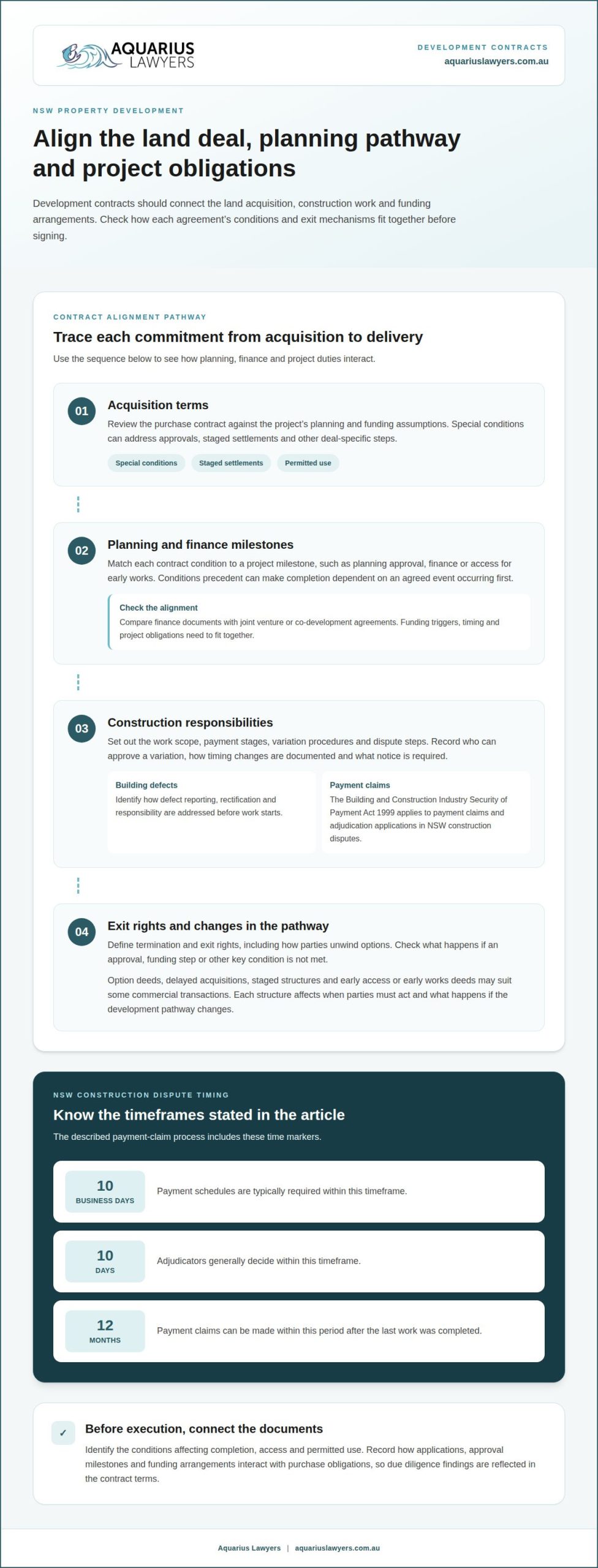
Development agreements should connect the land acquisition, construction work and funding arrangements. Review their conditions and exit mechanisms before signing.
Development contract structure and finance
Match each contract condition to a project milestone, such as planning approval, finance or access for early works. Conditions precedent can make a transaction dependent on an agreed event occurring before completion. Staged structures can also specify when land transfers, funding is drawn or work begins. An option deed gives one party the right to purchase later, often subject to conditions.
For projects involving landowners, investors and developers, joint venture or co-development agreements can record responsibilities and decision-making. Compare those agreements with finance documents to ensure funding triggers, timing and project obligations align. A mismatch can leave a developer committed under one agreement while a related funding step remains unmet.
Acquisition contracts and due diligence
Review the acquisition contract alongside the project’s planning and funding assumptions. Special conditions can address approvals, staged settlements and other deal-specific steps. Put and call option deeds, delayed acquisitions, and early access or early works deeds may suit some commercial transactions. Each structure affects when parties must act and what happens if the development pathway changes.
Before execution, identify the documents and conditions affecting completion, access and permitted use. Record how applications, approval milestones and funding arrangements interact with purchase obligations. This turns due diligence findings into contract terms, rather than leaving them as issues to resolve after commitment.
Developer risks, liabilities and building defects
NSW developer risks include disputes over construction work, payment claims, contract variations and building defects. The Home Building Act 1989 is relevant to claims for breach of warranties in NSW construction disputes. The applicable contract and facts shape the issues, so identify how defect reporting, rectification and responsibility are addressed before work starts.
Construction contracts need clear scope, payment stages, variation procedures and dispute steps. The Building and Construction Industry Security of Payment Act 1999 applies to payment claims and adjudication applications in NSW construction disputes. Under the described process, payment schedules are typically required within 10 business days; adjudicators generally decide within 10 days. Payment claims can be made within 12 months after the last work was completed.
Set out who can approve a variation, how its effect on timing is recorded, and what notice is required. Also define termination and exit rights, including how parties unwind options if a transaction does not proceed. Under the described Security of Payment process, contractors may suspend work 3 days after non-payment. These steps can affect project sequencing and commercial success, so align contract remedies with finance agreements before execution.
Pre-purchase due diligence and site feasibility
Assess the site, planning controls and legal obligations before committing to a purchase. Early review can reveal whether the proposed development fits the land and what needs further investigation.
Legal involvement in early due diligence
Involve a property development lawyer before signing, while the acquisition terms can still be shaped. Due diligence examines the property and deal for issues that could affect your intended project. The review can cover the sale contract, planning documents, access arrangements and obligations attached to the land.
In Australia, don’t rely solely on a vendor’s description of development potential. Have the legal review test the documents against your intended use, such as a residential subdivision or commercial project. Ask the lawyer to explain the scope of the review, the documents they’ll examine and how the findings could affect your acquisition decision.
Site feasibility and property checks
Site feasibility means testing whether the land can support the proposal in practice, not simply whether a development idea looks attractive. Review zoning, land-use permissibility and applicable Local Environmental Plans (LEPs) and State Environmental Planning Policies (SEPPs). Sites across NSW may face different planning controls, access issues or site constraints.
Property due diligence should also identify strata rules, easements, heritage matters and environmental concerns that may affect the proposed design or use. For example, contaminated soil could affect whether a site is suitable for residential development. Connect each issue to a decision: proceed as proposed, investigate further, change the design or reconsider the acquisition.
Check the development pathway as well. A proposal may need a development application (DA) or could follow a complying development pathway. The relevant route depends on the proposal and applicable planning controls. Map the project’s key assumptions against those controls before relying on a feasibility assessment or committing to the purchase.
Environmental, heritage and contamination laws
In NSW, the Environmental Planning and Assessment Act 1979 defines development to include land use or subdivision, building construction or demolition, and work carried out on land. LEPs, SEPPs and local permissibility requirements also inform DA assessment. Environmental and heritage matters can affect what a site can support, while contamination may change its suitability and development requirements.
Review available site and planning documents for environmental or heritage constraints, and identify where specialist assessment could inform the legal analysis. A lawyer can explain which obligations arise from the documents and how they may affect your purchase terms or proposed application.
To find a suitable NSW property development lawyer, look for relevant experience with development acquisitions, planning documents and construction or sale contracts. Ask what the review covers, which risks it assesses and how the advice will guide your next decision.
Consent conditions and council negotiations
A consent is more than permission to build. Its conditions can affect design, timing, infrastructure obligations and project feasibility.
Consent conditions
Read each condition against the approved plans and the work you intend to carry out. Identify what must happen before construction, during the work or before the development can be used. For example, a condition may require a particular design response or infrastructure contribution. Map each requirement to a project stage and responsible party.
Also check how conditions interact with other project documents. A condition affecting access or construction timing may need to be reflected in contractor agreements, finance arrangements or settlement milestones. If the consent does not match the current proposal, a Section 4.55 application is one NSW pathway for seeking a modification. Treat it as a formal step, not an assumed change.
Council negotiations
Prepare for council discussions by identifying the specific condition or proposal issue, the outcome sought and the documents supporting your position. Keep a record of submissions, council responses and revised plans. This creates a clear history for decisions about design changes, project timing and next steps, rather than leaving key matters in informal conversations.
Where negotiations concern a Voluntary Planning Agreement (VPA), clarify the proposed public benefit or contribution and how it relates to the development. A VPA is an agreement between a developer and a planning authority about public benefits or contributions connected with a proposed development. Review its terms alongside the consent and project contracts before agreeing.
Development contributions and infrastructure charges
In NSW, development contributions and infrastructure charges may arise as consent conditions or through a VPA. The obligations depend on the proposal and applicable planning arrangements. Review the consent and agreement documents to identify what is required, when it is triggered and how it connects with the project’s delivery stages.
For a development involving strata, owners and future management arrangements may also need attention. Check whether proposed contributions, infrastructure works or continuing obligations affect the site or planned development structure. Conveyancing due diligence should bring these documents together before purchase or settlement, so the transaction reflects the consent’s practical requirements.
As part of your project review, get guidance on development consent and council obligations before accepting conditions or finalising a VPA.
Aquarius Lawyers
Aquarius Lawyers can assist with commercial-law issues arising in property development transactions. Turn to the firm to assess development agreements, acquisition terms, funding arrangements or contract risks before committing to a project.
Clear contract terms can explain each party’s responsibilities, decision-making rights and options if circumstances change. Bring the relevant agreements and project details to the discussion, including planning or funding conditions affecting your proposed transaction. This can focus the advice on the decisions you need to make next.
Contact Aquarius Lawyers to discuss the commercial legal issues affecting your development transaction.
Make your next development decision with clarity
Your next step is to turn project assumptions into decisions you can act on. Set out what you need the site to achieve, which conditions must be met before proceeding, and what would make you pause or change direction. This gives your legal advice a clear purpose: helping you decide how to move forward.
Property development legal advice in NSW can help you weigh the legal and commercial implications before committing to a purchase, agreement or project milestone. If your plans involve coastal land or aquaculture interests, Aquarius Lawyers also offers Marine Law, Fisheries Law and Aquaculture Law.
Before taking a project further, write down your intended outcome and the decisions still to be made. A clear brief helps focus on the next practical step and move forward with greater confidence.
Frequently Asked Questions
What is due diligence and why should I do it?
Due diligence is a structured review of a proposed purchase and development before you commit. It tests whether the transaction’s assumptions match the documents and the project you intend to deliver. For example, if a vendor describes a site as suitable for multiple stages, the review can identify which documents support that plan and where contractual protections may be needed. The findings can inform whether you proceed, negotiate or change your proposal.
Can you assist with option deeds and delayed settlement structures?
Yes. Legal advice can help shape option deeds and delayed or conditional acquisition structures around the project’s timing and approval pathway. An option deed can give a party the right to purchase later, subject to its terms and conditions. Advice can focus on when the option may be exercised, what must happen first, and how the agreement deals with a changed project or a transaction that doesn’t proceed.
Do I need a bespoke contract for a property development transaction?
A bespoke contract may be appropriate when a standard sale contract doesn’t address the development’s specific arrangements. For example, a deal involving staged settlements, early site access or planning conditions may need tailored terms. The contract should align with the transaction structure and explain each party’s obligations, key milestones and available exit rights. The right drafting depends on the deal, not simply on whether the property is residential or commercial.
How are planning and funding risks managed in development contracts?
Development contracts can allocate planning and funding risks through conditions precedent, special conditions and staged transaction terms. For example, the parties can document which event must occur before an acquisition proceeds, or how early works relate to later funding. The agreements should also address what happens if an application changes, funding arrangements shift or a key milestone is missed. Matching these terms across related documents helps prevent conflicting obligations.
What legal advice do property developers need in NSW?
Property developers may need advice on acquisition documents, development agreements, planning conditions, construction contracts and disputes. The right scope depends on the project stage and the decisions ahead. For instance, a developer entering a joint venture may need an agreement setting out contributions, control and exit arrangements, while a buyer may need purchase terms aligned with the intended development. Property development legal advice in NSW should connect the legal documents to the project’s commercial plan.
What are the NSW planning and zoning rules for property development?
NSW planning assessment considers whether a proposal is permissible under the applicable planning controls. Local Environmental Plans (LEPs), State Environmental Planning Policies (SEPPs) and council requirements can affect land use, design and the approval pathway. Depending on the proposal, a developer may consider a development application or complying development. Check how the controls apply to the specific site and proposal; a zoning label alone doesn’t establish that every intended use or design is allowed.
Disclaimer
Please note that legal rules change and this is not a substitute nor construed as legal advice. It is general information only.