
An assault charge is an allegation, not a verdict. This guide to assault charges NSW explains what the charge may mean and why being charged does not automatically make you guilty. It is understandable to feel uncertain about what happens next, particularly when you do not know how police evidence, witness accounts or your own account will be considered.
You’ll learn how NSW assault offences differ, what may affect the charge and potential penalties, and how criminal proceedings can move through the courts. You’ll also find practical steps to help you preserve relevant information and understand the allegation before responding.
Every case depends on its own facts, evidence and circumstances. Use this overview to understand the process and identify the questions to discuss with a criminal lawyer about your situation.
Key Takeaways
- An assault charge is an allegation, not a finding of guilt. Read the charge documents carefully before drawing conclusions about the outcome.
- For assault charges NSW, the prosecution must prove the offence charged. Accounts, records and other admissible evidence may all be relevant.
- Potential consequences depend on the charge, evidence, circumstances and court outcome. Don’t assume the result before the case is assessed.
- Note key dates, keep relevant material and review your court documents. Don’t discuss case details publicly or contact witnesses about their accounts.
What do assault charges in NSW mean?
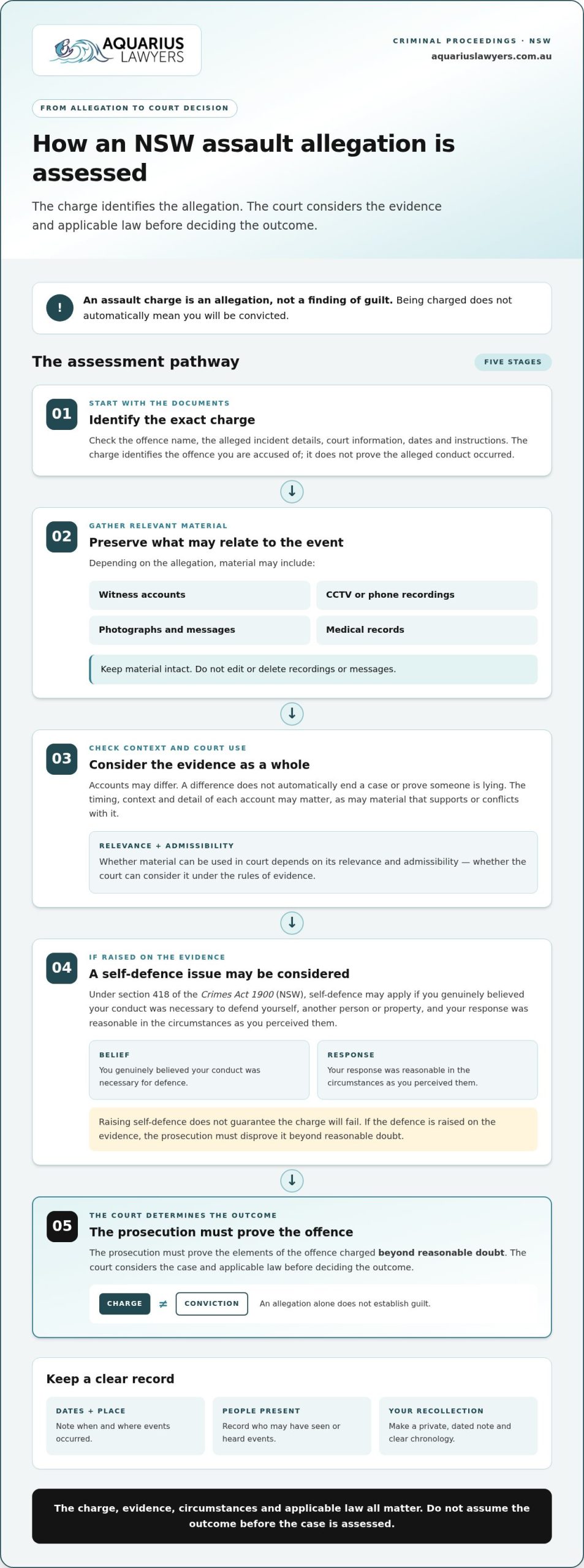
An assault charge is a formal allegation that you committed an offence. It starts criminal proceedings, but it does not prove that the alleged conduct occurred. The charge identifies the offence you are accused of; the court determines the outcome later, after considering the case through the legal process.
Keep three things distinct: an allegation is a claim about what happened, a charge identifies the offence, and an outcome is the result of the proceedings. Being charged does not automatically mean you’ll be convicted.
NSW law recognises different assault offence labels, including common assault and offences involving alleged injury. For a broad overview of the legal context, see Assault laws in Australia. This article focuses on understanding the charge and process rather than explaining the detailed elements of each offence.
Why the exact charge and circumstances matter
The offence named on your charge document and the conduct described in the case materials help define the issues the court may consider. Similar descriptions of an incident can raise different legal questions depending on what is alleged, the circumstances and the available material. Assault charges NSW therefore do not all follow the same path or carry the same potential consequences.
Start with the documents you received. Check the offence name, the alleged incident details and any court information, including dates and instructions. Don’t rely on a brief account or assumptions about what happened. A criminal lawyer can help you understand the allegation, identify relevant information and plan a response suited to your circumstances. You can also read about criminal law services if you need legal support.
How are assault allegations and evidence assessed in NSW?
In criminal proceedings, the prosecution must prove the elements of the offence charged beyond reasonable doubt. The court must be satisfied to that high standard before finding you guilty. Evidence is assessed as a whole, rather than by assuming one account or item tells the complete story.
Accounts may differ. A difference does not automatically end a case or prove that someone is lying. The timing, context and detail of each account may matter, as may evidence that supports or conflicts with it. General crime data, such as information published by the NSW Bureau of Crime Statistics and Research, cannot determine what happened in an individual case.
What evidence may be relevant to an assault charge?
Depending on the allegation, relevant material may include witness accounts, CCTV or phone recordings, photographs, messages and medical records. Whether material can be used in court depends on its relevance and admissibility. Admissibility means whether the court can consider it under the rules of evidence.
Preserve material you have. Don’t edit or delete recordings or messages. Make a private, dated note of your recollection and a clear chronology. Record, where you can:
- When and where events occurred.
- Who was present and what they may have seen or heard.
- Any records or recordings that may relate to the event.
When might self-defence become a legal issue?
Under section 418 of the Crimes Act 1900 (NSW), self-defence may apply if you genuinely believed your conduct was necessary to defend yourself, another person or property, and your response was reasonable in the circumstances as you perceived them. Whether it applies depends on the specific facts. Saying you acted in self-defence does not guarantee the charge will fail. If the defence is raised on the evidence, the prosecution must disprove it beyond reasonable doubt.
Reviewing the allegation alongside the available material can clarify the issues and help shape a response. Criminal law advice can help you assess how these principles apply to your circumstances.
What consequences can follow an assault charge in NSW?
There is no single standard outcome for an assault charge. Consequences depend on the offence charged, the alleged conduct, the evidence, relevant legal issues and, ultimately, the court’s decision. The potential pathway and consequences can differ between assault charges NSW, so another person’s experience does not predict yours.
If the court finds you guilty, it decides the outcome under the law that applies to the offence and the case before it. A conviction may have further implications, but these depend on your circumstances and the specific outcome. Without assessing the facts and applicable law, it would be misleading to predict a sentence or claim a particular personal impact.
What can affect the outcome of a case?
The court considers the charge and alleged conduct alongside the evidence and relevant legal issues. A defence may also matter if it is raised on the evidence. No single fact should be treated as decisive without considering its context and the law that applies. A careful review of the case materials can help identify what is disputed and what needs a response.
Why a charge is not the same as a conviction
A charge records an allegation; it does not establish guilt. The case proceeds through the legal process, and the court determines the outcome after considering the evidence and applicable law. The allegation alone is not a conviction, and you should not assume a sentencing outcome before the court decides the case.
Get advice based on the actual charge and documents, not assumptions about what may happen. Speak with a criminal lawyer to understand the issues in your case and plan your next steps.
What should you do after an assault charge in NSW?
Take practical steps early. The documents you keep, dates you note and decisions you make can help a lawyer understand the situation and advise you. Don’t assume the process or response will be the same for every assault allegation.
- Note key dates. Record any court date and other dates shown in your documents. Make sure you understand what action is required and when.
- Keep relevant material. Retain charge documents, messages, photographs and recordings that may relate to the allegation. Don’t alter or delete them.
- Review the court documents. Check the offence named, the alleged facts and any instructions about appearing in court.
- Protect the case. Don’t discuss details publicly or contact witnesses to discuss or influence their accounts.
Before deciding how to respond to police questions, entering a plea or making decisions about a court appearance, seek legal advice. If you’re unsure what a document requires, get advice promptly rather than guessing or ignoring it.
What information should you organise for legal advice?
Gather the charge documents and any court paperwork, along with relevant communications or records. Write a factual chronology while your recollection is clear, separating what you remember personally from what you have been told. Include dates, locations and people who may have been present. A lawyer can assess the material, identify issues to consider and discuss possible options without promising a particular outcome.
How legal advice can help you plan the next step
Legal advice can help you understand the allegation, review available material and prepare for decisions in your case. The right response depends on your circumstances and the documents, so don’t rely on general information alone. If you need guidance, contact Aquarius Lawyers’ Criminal Law Service to discuss your assault charge and plan the next step.
Take a considered step towards clarity
A charge can put pressure on you to make quick decisions. Get advice that addresses your circumstances instead of relying on assumptions or someone else’s experience. Understanding your position can help you approach the next stage with greater clarity.
Aquarius Lawyers provides criminal law services. If you’re weighing up what to do next, contact Aquarius Lawyers to discuss your next step. A conversation can help you identify the questions that matter and consider a practical way forward in your assault charges NSW case.
You don’t have to work through the uncertainty alone. Take the next step with care and get advice suited to your situation.
Frequently Asked Questions
Can assault charges be dropped in NSW?
Not necessarily. A complainant’s wish to stop the case does not, by itself, decide whether proceedings continue. The process depends on the circumstances and applicable law, so no one can promise a charge will be withdrawn. If the complainant changes their account or no longer wants to participate, tell your lawyer. Get advice about your assault charges NSW before assuming the case has ended.
What should I do if police want to speak with me about an assault allegation?
Stay calm and find out what police are asking you to do. Don’t obstruct police or ignore a lawful direction. Before answering questions about the allegation, seek legal advice so you understand the request and can make an informed decision about how to respond. What is appropriate may depend on the circumstances, including whether police have asked you to attend an interview or contacted you another way.
Can self-defence be used in response to an assault charge in NSW?
Self-defence may be available as a legal defence, but using that term does not settle the issue. Keep a factual record of what happened before, during and after the incident, including details that may help explain your actions. Don’t change or embellish your account to fit a legal label. A lawyer can assess whether the evidence supports raising self-defence in your case.
Will I have to go to court after being charged with assault in NSW?
The steps required depend on the charge and how the matter is dealt with. The court may require your participation at particular stages, so get advice promptly about what is expected and how to prepare. If a date or instruction is unclear, don’t guess or leave it until the last moment. A lawyer can explain the process and help you plan.
Does an assault charge automatically give me a criminal record in NSW?
Don’t assume a charge alone will result in a criminal record. What may be recorded or disclosed depends on the eventual outcome and the rules that apply to your circumstances. Avoid relying on general claims about how long information remains relevant or what you must disclose in a particular setting. Ask a lawyer to explain the position once the outcome and context are clear.
Disclaimer
Please note that legal rules change and this is not a substitute nor construed as legal advice. It is general information only.