
The number of people involved can change the maximum penalty for assault occasioning actual bodily harm in NSW. The offence carries a maximum of 5 years’ imprisonment, rising to 7 years if it’s committed in company.
It’s understandable to focus on the injury, but the prosecution must also prove that an assault occurred and caused actual bodily harm. The harm must be more than merely transient or fleeting, and the prosecution must prove the charge beyond reasonable doubt.
This guide explains what actual bodily harm can mean, what the prosecution must establish and how an in-company charge differs. It also covers the Local Court’s sentencing limits: when a case is dealt with summarily, the court can impose up to two years’ imprisonment. Understanding the charge and the court’s role can clarify what is at stake and why the details of the allegation matter.
Key Takeaways
- Actual bodily harm must be more than fleeting or trivial; the nature and duration of an injury can matter.
- The prosecution must prove both that an assault occurred and that it caused the alleged harm beyond reasonable doubt.
- If the charge is dealt with summarily in the Local Court, the court’s imprisonment limit is two years.
- An assault committed in company carries a higher maximum penalty, so who was involved can affect the charge’s seriousness.
- The allegation, available evidence and court pathway all shape how the case should be assessed.
What Is Actual Bodily Harm?
Section 59 of the Crimes Act 1900 (NSW) covers assault occasioning actual bodily harm. It sets out the offence and its maximum penalty, while the Local Court’s sentencing limit depends on the case being dealt with summarily.
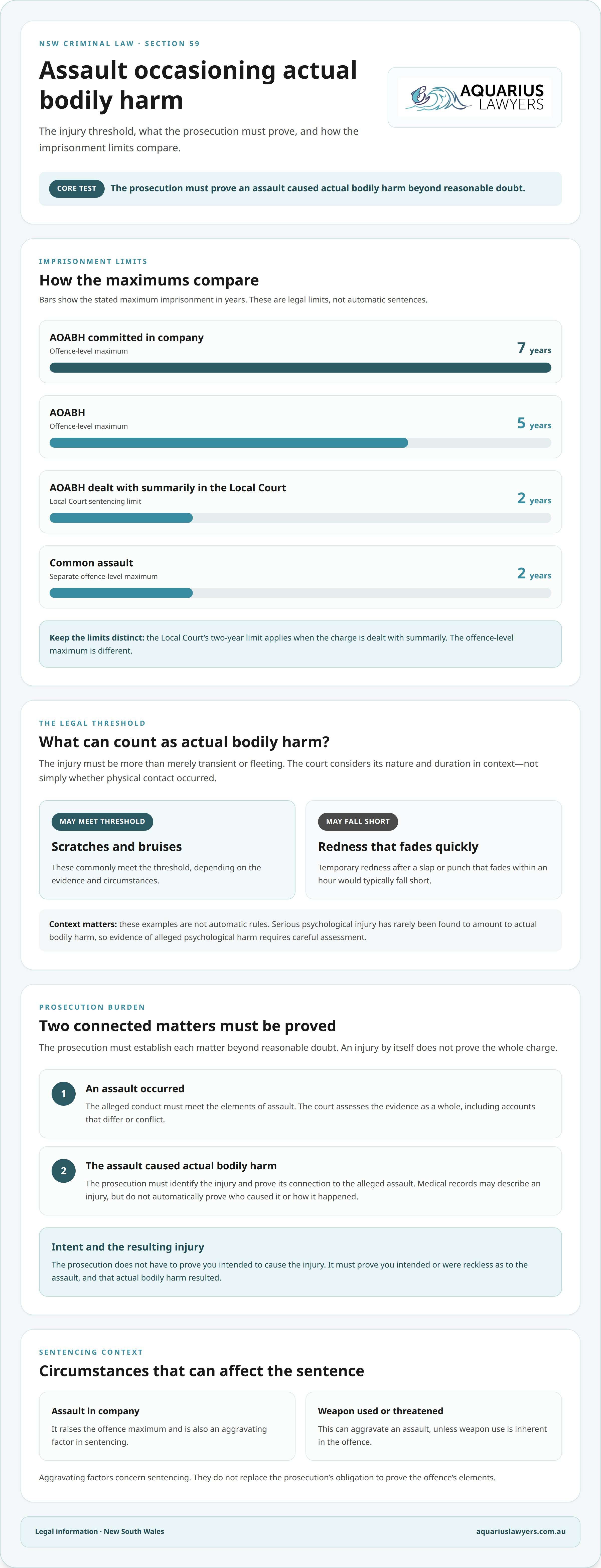
Actual bodily harm means hurt or injury calculated to interfere with a person’s health or comfort. Case law also describes it as an injury that is more than merely transient or fleeting. The focus is on the effect of the injury, not simply whether the incident involved physical contact. Scratches and bruises commonly meet the threshold. Temporary redness after a slap or punch that fades within an hour would typically fall short.
These examples are not automatic rules for every allegation. The evidence must be considered in context, including the injury’s nature and duration. A bruise that remains visible, for example, may be assessed differently from redness that fades quickly. Serious psychological injury has rarely been found to amount to actual bodily harm, so allegations based on psychological harm require careful assessment of the evidence.
The maximum penalty for this offence is 5 years’ imprisonment. If it is committed in company, the maximum rises to 7 years’ imprisonment. These are the offence-level maximums, not automatic sentences. The circumstances matter, including the extent of the injury and the degree of violence. A higher maximum for an in-company offence reflects the seriousness of that circumstance, but the charge and available evidence still need to be assessed.
When the charge is dealt with summarily in the NSW Local Court, the court’s sentencing jurisdiction is limited to 2 years’ imprisonment and a fine of A$5,500. That limit differs from the offence’s maximum penalty. The court’s available sentencing powers depend on the matter being heard summarily. The Local Court considers the proven conduct and injury when determining a sentence within its jurisdiction.
Aggravating circumstances can affect the sentence. Under section 21A(2)(e) of the Crimes (Sentencing Procedure) Act 1999, committing an assault in company is an aggravating factor. The actual use or threatened use of a weapon can also aggravate an assault under section 21A(2)(c), unless weapon use is inherent in the offence. These factors concern sentencing; they do not replace the elements the prosecution must prove.
Common assault is a separate, less serious offence, with a maximum of 2 years’ imprisonment and a fine of A$2,200. The distinction matters: a charge of actual bodily harm requires proof of injury meeting that legal threshold. A minor mark that fades quickly may be treated differently from a lasting scratch or bruise, depending on the evidence and the circumstances.
Elements of assault occasioning actual bodily harm
For a charge under section 59 of the Crimes Act 1900 (NSW), the prosecution must prove two connected matters beyond reasonable doubt: an assault occurred, and that assault caused actual bodily harm. A proven injury alone does not establish the whole offence. The prosecution must also establish the required connection between the alleged assault and the injury.
The first issue is whether the conduct amounted to an assault. Section 61 of the Act defines the basic elements of assault in New South Wales. The prosecution must prove the alleged conduct meets those elements, using evidence about what happened. For example, accounts from people involved may describe different actions, while other evidence may support or contradict those accounts. The court assesses the evidence as a whole.
The prosecution must also prove that the complainant suffered actual bodily harm. It must identify the injury relied on and prove that it resulted from the alleged assault. A medical record describing a bruise, for example, may be relevant to the injury, but does not automatically prove who caused it or how it occurred. Medical evidence must be assessed alongside the allegation and the other evidence.
The prosecution does not have to prove that you intended to cause the injury. It must prove that you intended or were reckless as to the assault, and that actual bodily harm resulted. This distinction matters: the prosecution’s case concerns the mental element connected to the assault, as well as the resulting injury. An unintended injury may still form part of an AOABH charge if the required elements are proved.
Evidence should be examined element by element. What conduct is alleged? What evidence supports that account? What injury is said to have followed, and what links it to the incident? If a witness describes one sequence but medical evidence indicates another, that difference may matter when the court assesses causation and whether the charge is proved beyond reasonable doubt. A gap in proof on one element can affect the whole case.
The maximum penalty does not determine whether the elements of the offence are established. The court considers whether the alleged assault and resulting harm are proved before sentencing becomes relevant. Evidence that someone was injured after an incident, for example, does not by itself establish that the accused committed the assault or caused the injury. The prosecution remains responsible for proving each element beyond reasonable doubt.
Keep the distinction clear: the prosecution must prove the assault, the resulting harm and the connection between them. It does not need to prove an intention to cause that harm. This can shape how the evidence is analysed and how the allegation is contested.
Local Court sentencing limits
AOABH is a Table 2 summary indictable offence, usually heard in the Local Court or Children’s Court. The prosecution may elect to have the matter dealt with on indictment in the District Court.
After a charge, the case follows the court process that applies to the alleged offence. Bail conditions and any AVO operate separately from the criminal charge. An appeal is a separate process for challenging a court decision, not an extension of bail or sentencing.
Sentencing Considerations
At sentencing, the court considers the seriousness of the offending and relevant information about the person being sentenced. It assesses both what happened and the individual circumstances before deciding the outcome.
Some statutory factors concern the setting or the victim. Under section 21A(2)(eb) of the Crimes (Sentencing Procedure) Act 1999, offending in the security of a victim’s home is an aggravating factor. Section 21A(2)(l) addresses victim vulnerability, but concerns classes of victims, not vulnerability arising only from the offence’s circumstances.
Personal circumstances can also inform the sentencing decision. Provocation is a mitigating factor under section 21A(3)(c), but it does not provide a legal defence to the charge. The prosecution’s case and any sentencing material serve different purposes: the first concerns whether the charge is proved, while the second informs the penalty after the court deals with the offence.
After being charged, you’ll generally face proceedings in the Local Court or Children’s Court, unless the prosecution elects to proceed on indictment in the District Court. The charge itself is not a sentence. Bail conditions may apply while the matter is before the court, but remain separate from any eventual sentencing decision.
Available Sentencing Orders
Sentencing orders range from non-conviction outcomes to community-based orders and imprisonment. The type of order matters because it can determine whether a conviction is recorded and what conditions apply.
Section 10 orders are among the possible outcomes. A Conditional Release Order may be imposed without conviction under section 9(1)(b), or with conviction under section 9(1)(a). A Conditional Release Order can run for up to 2 years, with standard conditions requiring good behaviour and attendance before the court if called upon.
A Community Corrections Order can be made for up to 3 years. The court selects an order by considering the offence and the relevant sentencing material. If you’re deciding how to respond to a charge, understanding the distinction between the court process, bail conditions and sentencing orders helps you identify which decision is being made at each stage.
What is assault occasioning actual bodily harm under NSW law?
NSW law places assault allegations within a broader statutory framework. Legislation can classify violence offences for other legal purposes, alongside the criminal charge. These classifications matter because the charge, a protective order and the rules about when police may bring a charge are separate issues. Understanding which process applies helps distinguish the allegation from other legal steps that may arise.
Police generally face no time limit to charge a person with assault occasioning actual bodily harm in NSW because it is an indictable offence. A lengthy gap between an alleged incident and a charge does not, by itself, decide the case. The chronology still matters: the alleged incident, when it was reported and when the charge was brought are separate points to consider when reviewing the proceedings.
The Crimes (Domestic and Personal Violence) Act 2007 defines a personal violence offence in section 4. Most violence offences listed in the relevant chapter fall within that definition. This classification is separate from deciding whether a person is guilty of a criminal offence. It provides statutory context for personal violence matters, rather than changing what a person is charged with under criminal law.
An Apprehended Violence Order (AVO) may accompany an assault charge, but it is separate from the criminal proceedings. The AVO process and criminal case involve different decisions. You may need to understand both, including what each concerns and how each proceeds. Treating them as one matter can obscure the distinct legal issues raised by the charge and any protective order.
If police lay a charge after a delay and an AVO is also in place, for example, there are separate questions to address. The timing concerns when the charge was brought; the AVO concerns a distinct protective process. Neither should be confused with the other or treated as a substitute for assessing the criminal allegation. Keeping these legal processes separate clarifies the issues that need attention.
If you’re dealing with an assault allegation alongside an AVO or a delayed charge, consider the separate legal processes before deciding how to respond. Get advice about a criminal law matter to understand how the statutory context relates to your circumstances.
Aquarius Lawyers
Aquarius Lawyers can help you understand the allegation, assess the evidence and consider the legal issues affecting your response. If you’re charged, the distinction between the alleged assault, the injury and the prosecution’s evidence matters. Clear advice can help you understand the process and make informed decisions about your next steps.
Bring your court documents and any material relevant to the incident, such as messages or photographs. This gives your lawyer context for discussing the charge, possible defences and court pathway. Contact Aquarius Lawyers to discuss your situation.
Take a clear next step
If you’re facing an assault occasioning actual bodily harm charge in NSW, focus on the decisions ahead. How you respond can affect how your case proceeds. Before deciding your next move, get advice tailored to the charge, the evidence and your circumstances.
Aquarius Lawyers can discuss your criminal law matter and explain the practical options available. The firm also provides Marine Law, Fisheries Law and Aquaculture Law for clients with legal needs in those areas.
Contact Aquarius Lawyers about your charge to discuss your situation and take the next step with greater clarity.
Frequently Asked Questions
Can ABH be downgraded to common assault?
Yes, the charge may be dealt with as common assault if the evidence does not support the more serious allegation. A downgrade is not automatic, and the complainant cannot decide the charge simply by changing their view. The available evidence and the way the prosecution proceeds matter. If you’re charged, get advice before entering a plea or making statements about the incident.
What Must Be Proven?
The court must be satisfied of the charge beyond reasonable doubt. In practical terms, the case turns on the evidence and whether it reliably supports the allegation. The timing and consistency of accounts, available recordings and relevant records may show where accounts align or differ. A lawyer can assess these materials in context, rather than treating a single document or witness account as conclusive.
Can Defences Apply to Assault Charges?
Yes. Possible defences depend on the alleged circumstances and the supporting evidence. A defence may raise an issue about the accused’s conduct, state of mind or ability to understand events. The practical task is to identify the legal issue raised by the evidence and assess whether it applies to the charge. A disagreement about what happened does not, by itself, establish a defence.
What is ABH?
ABH is short for actual bodily harm, a legal term distinguishing an injury-based assault allegation from common assault. The label does not settle the case: the court considers the evidence and circumstances. If you’re trying to understand a charge document, focus on the offence named and the particulars describing the alleged incident, rather than relying on the abbreviation alone.
Will I go to jail for ABH?
Not necessarily. Imprisonment is a possible outcome, but a charge does not mean a person will automatically be sent to jail. The court considers the circumstances and sentencing material before deciding the appropriate order. The outcome also depends on how the case is resolved. A lawyer can explain the possible pathways in light of your charge and the material before the court.
Will an Assault Charge Affect My Criminal Record?
A charge alone is not the same as a conviction. The effect on your criminal record depends on how the proceedings conclude and the order the court makes. A finding of guilt may have different consequences from an outcome without conviction. Keep your court documents, note upcoming dates and get advice about potential record implications before deciding how to respond to the charge.
Disclaimer
Please note that legal rules change and this is not a substitute nor construed as legal advice. It is general information only.