
Probate in NSW involves more than lodging an application. The executor provides information about the deceased, the will and the estate so the Supreme Court can assess the application. Clear, consistent records help keep the process organised.
This guide outlines the main stages: preparing the application, publishing the required online notice and waiting for the Court’s decision. It also explains a solicitor’s role and the information you may need to provide when seeking legal help.
You’ll learn how professional support can fit into the process and what to consider before appointing a solicitor. Understanding the roles, documents and timing involved can help you make informed decisions as executor and keep the estate’s administration on track.
Key Takeaways
- Estate asset information is central to preparing a probate application, so accurate records help establish the right basis for the filing.
- The online notice starts a required waiting period: the Supreme Court cannot grant probate until 14 days after publication.
- Most uncontested applications for a grant of representation in NSW must be filed online, a requirement that has applied since 1 August 2023.
- A solicitor can prepare and lodge the application, using the information and documents you provide to support the process.
What does probate cost for a typical estate?
The NSW probate process depends on the estate’s disclosed assets and the type of application required. The executor provides information about the deceased, the will and the estate for the Supreme Court to assess.
Fixed and Regulated Legal Costs
Schedule 3 of the Legal Profession Uniform Law Application Regulation 2015 sets the regulated solicitor work for obtaining a first grant of probate or letters of administration. The applicable scale is based on the disclosed value of estate assets, so accurate asset information matters when preparing the application.
Obtaining a grant is separate from administering the estate afterwards. The executor’s responsibilities continue after probate is granted, including managing estate records and carrying out the will’s directions. Clear accounts help distinguish application documents from records created during administration.
Estate matters may involve an application for letters of administration or resealing a grant. These are different pathways, and the required documents depend on the deceased’s circumstances and the grant being sought.
Estimated Costs for Sample Estates
Estate administration involves more than applying for the initial grant. The executor may need to identify assets, maintain records and prepare for distribution in line with the will. The work depends on the estate’s composition and the steps required to transfer or manage its assets.
For example, an estate that includes NSW property requires the executor to address the title as part of administration. Business interests may require separate attention to ownership records and ongoing obligations. These differences shape the work required after the grant.
NSW probate procedure is governed by NSW rules, which may differ from those in other Australian states. Each jurisdiction has its own application requirements and court processes. The relevant pathway depends on where the grant is sought and which assets form part of the estate.
Keep the will, asset records and estate accounts organised throughout the process. This creates a clear record of the application and subsequent administration, and helps beneficiaries understand how the estate is being managed.
How much is the Supreme Court probate filing fee?
The NSW Supreme Court filing fee depends on the sworn gross value of the estate. That value determines the fee bracket for an uncontested probate application.
Filing Fees by Estate Value
The filing fee is a court charge based on the estate’s sworn gross value, not the solicitor’s work. Keeping these separate helps distinguish the Court’s application charge from regulated legal costs and other disbursements.
From 1 July 2026, the fee schedule has graduated brackets, with the charge increasing as the estate’s value rises. The fee is nil for an estate valued under $100,000. The Supreme Court of NSW reviews its filing fees annually on 1 July, so the date of lodgement matters when estimating an application’s court charge.
For filing purposes, gross estate value is calculated from assets located in NSW, which may include property and bank accounts belonging to the deceased. In most cases, superannuation and life insurance are excluded. The Court fee is exempt from GST.
Estate Value Fee Brackets
Fee brackets group applications by sworn gross estate value, so accurate asset disclosure matters. The applicable bracket determines the court filing fee and the amount needed to lodge the application.
These thresholds apply to uncontested probate, administration or reseal applications.
A separate reporting threshold applies in NSW Probate List proceedings. Unless the Court orders otherwise, parties must inform the Court in writing if the estate’s net value is less than $1.5 million. Net value is not the same measure as the gross value used for filing fees, so don’t treat the two thresholds as interchangeable.
The Supreme Court of NSW can waive, postpone or remit court fees under the Civil Procedure Regulation 2017. These are distinct forms of relief: a waiver removes a fee, postponement delays payment, and remission reduces or returns an amount. The Court’s power does not mean relief applies automatically. A filing involving a fee concern should account for the estate’s circumstances and the application required by the Court.
When an estate has assets in several categories, careful valuation and classification help establish the correct bracket. Record NSW assets and bank accounts separately from excluded superannuation. This supports an accurate sworn gross value and avoids confusing the filing calculation with the Probate List’s net-value reporting threshold.
Online notice and publication waiting period
In NSW, an online notice is part of the application process for a grant of probate or letters of administration.
Notice publication and the waiting period
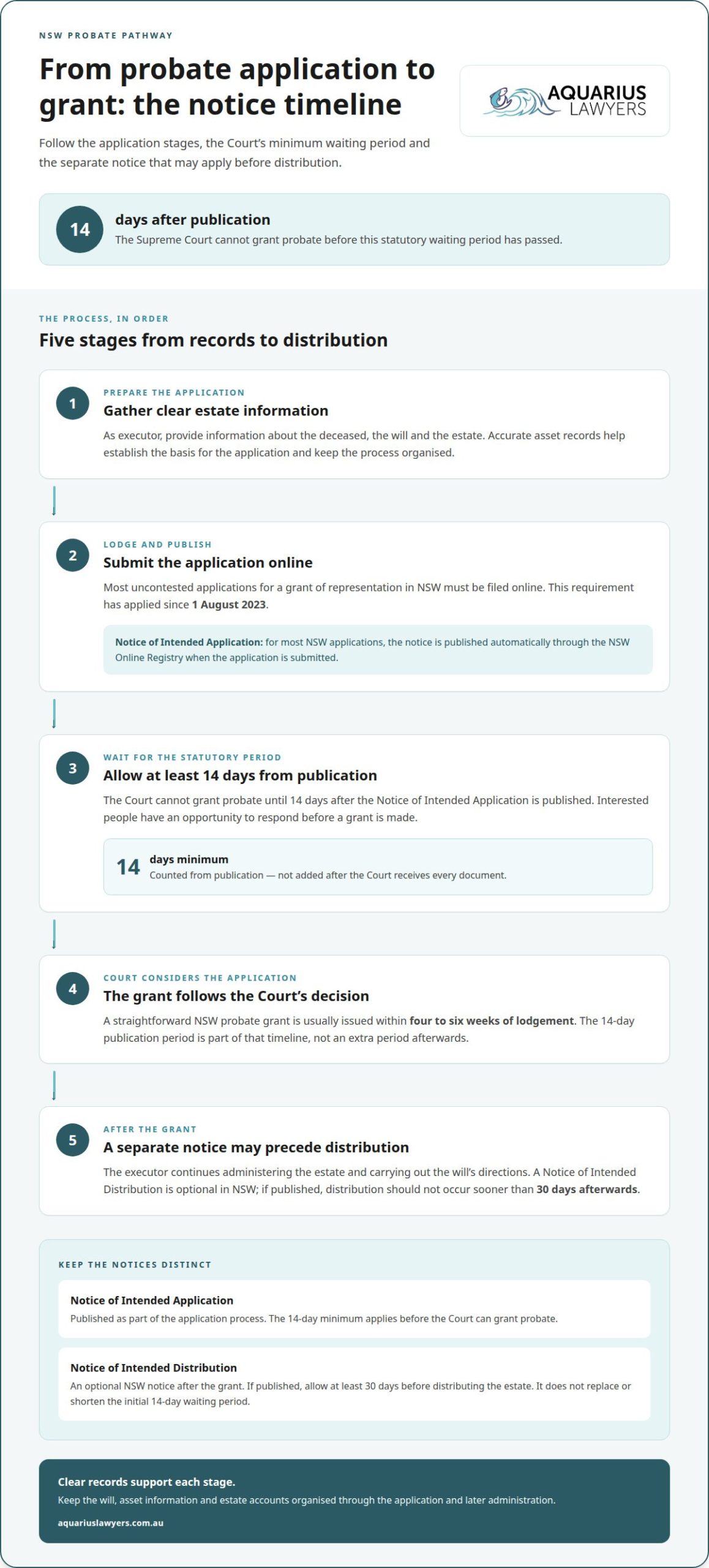
For most NSW applications, the notice of intended application is published automatically through the NSW Online Registry when the application is submitted. The Supreme Court cannot grant probate until 14 days after publication. That statutory waiting period applies before the Court can issue the grant, even when the documents are otherwise ready.
The notice gives interested people an opportunity to respond before a grant is made. If details need correcting, amending and republishing the notice can add an administrative step.
A Notice of Intended Distribution is a different notice, published after the grant when the executor is preparing to distribute the estate. It is optional in NSW. If published, distribution should not occur sooner than 30 days afterwards. That notice does not replace the notice of intended application or shorten the initial 14-day waiting period.
How long probate takes, and the effect of delay
A straightforward NSW probate grant is usually issued within four to six weeks of lodgement. The 14-day publication period is part of that timeline, not an additional period that starts after the Court receives every document.
Delays can extend estate administration, for example, when you need to respond to a Court requisition or correct application documents. The time needed to administer the estate after probate is also distinct from the time the Court takes to issue the grant.
Contested applications and executor responsibilities
A contested probate matter can involve additional court steps, such as a summons, statement of claim or hearing. Under section 98 of the Civil Procedure Act 2005, the Court can decide who pays the costs of a contested probate matter. The result may therefore differ from an uncontested application.
The NSW Trustee and Guardian may act as executor. The executor’s role and the work involved in administering the estate affect the administration process.
Legal requirements for probate applications
In NSW, applications for a first grant of probate or letters of administration are subject to Schedule 3 of the Legal Profession Uniform Law Application Regulation 2015. Administration work after the grant, contested proceedings and other professional services are separate from the process of obtaining the grant.
Applying for probate with a lawyer
A solicitor reviews the will, identifies the executor, organises the application and files it online with the NSW Supreme Court. You’ll need to provide information about the deceased, the will and the estate’s assets so the application can disclose the correct gross value.
Since 1 August 2023, most uncontested applications for a grant of representation in NSW must be filed online. The solicitor uses your information to prepare the court documents, arrange the notice of intended application and address any Court requisition, which is a request to clarify or correct something in the filing.
Start by gathering records that establish who died, who is applying and what the estate owns. A solicitor can reconcile the asset information with the value declared in the application. Missing or inconsistent details may require further work before the Court can assess the documents.
- The will and executor details: provide the will and identify the executor named to apply. If there are questions about the will or the person applying, raise them before filing.
- Death and applicant information: provide the deceased’s details and information identifying you as the proposed applicant. The solicitor uses these details to prepare the application documents.
- Asset records: collect statements, title information and valuation records for assets in NSW. These help establish the disclosed gross value and support the application.
- Liabilities and estate accounts: provide available records of debts and transactions. These help distinguish the estate’s assets from its net value and support orderly estate accounts.
Gross value matters because it informs the application. For this purpose, NSW gross estate value is based on estate assets located in NSW. In most cases, superannuation and life insurance are excluded.
Once the solicitor has reviewed the information, they prepare the application and supporting documents for online filing. For most applications, the notice is published automatically on the NSW Online Registry when the application is submitted. The Court cannot grant probate until 14 days after publication, so an accurate filing at the outset helps avoid preventable corrections during that period.
The solicitor can explain the work involved in obtaining the grant and how it differs from estate administration. In NSW, estate administration work is separate from obtaining the grant. Understanding this distinction helps you know what the application process covers.
Aquarius Lawyers
Aquarius Lawyers can advise on commercial-law issues when an estate includes a business or other commercial assets. This may be relevant when ownership, contracts or business interests need attention alongside the probate application. The grant process follows NSW requirements, while advice on commercial interests can help clarify issues affecting those assets.
An estate without business interests may not require additional commercial-law advice. If it includes a business, commercial assets or related legal questions, contact Aquarius Lawyers to discuss your situation and the next step.
Plan the next step with confidence
Your next step is to decide how the estate’s legal work will be managed. As executor, consider which decisions you can coordinate, where you need advice and what you want a solicitor to handle. Setting responsibilities early helps organise communication and gives everyone a shared understanding of what happens next.
Understanding the cost of probate in NSW in 2026 is one part of that decision. Your practical plan can also account for how you’ll keep beneficiaries informed and record key decisions as the estate progresses. If questions remain about the application or your responsibilities, note them before seeking advice. A focused discussion gives you a clearer starting point without assuming every estate needs the same approach.
Choose a pathway that fits the estate’s circumstances and the level of support you need. To discuss the next step, contact Aquarius Lawyers. A clear plan can help you move forward with greater confidence.
Frequently Asked Questions
What are the costs of probate in NSW?
Probate expenses may include the Court’s filing charge, the online notice, solicitor work and out-of-pocket items such as valuations or document-lodging services. The estate generally pays reasonable administration expenses rather than the executor paying them personally. Keep invoices and payment records with the estate accounts so each expense can be traced and explained to beneficiaries.
Are solicitor fees the same as the Court’s filing fee?
No. The Court’s filing fee covers lodging the application, while a solicitor’s fee covers professional work such as reviewing the will, preparing documents and responding to Court requests. They are separate costs. An executor may lodge an application without a solicitor and still pay the Court charge; instructing a solicitor may involve a separate charge for legal work.
Can a probate lawyer apply for you, and what should you consider when choosing one?
Yes. A solicitor can prepare and lodge an uncontested application, organise supporting documents and respond to Court requisitions. When choosing a lawyer, consider whether the proposed work clearly separates obtaining the grant from later estate administration. Ask how missing asset information, additional work and updates will be handled. This helps clarify the scope of the engagement before documents are filed.
How are probate filing fees worked out?
The NSW filing fee is based on the sworn gross value of estate assets located in NSW, not the estate’s net value. This distinction matters if the deceased had debts or assets outside the state. An interstate property, for example, is not part of the NSW asset calculation simply because the executor is applying in NSW. Superannuation and life insurance are generally excluded.
How much does a probate lawyer charge in NSW?
For the core work of obtaining a first grant, NSW solicitor charges are regulated and depend on the disclosed value of the estate’s assets. GST may be added. Other professional work, such as administration after the grant, is charged separately. Ask for the proposed scope and a breakdown of additional work so you can distinguish grant preparation from ongoing estate tasks.
Is the solicitor’s probate cost fixed in NSW?
Solicitor charges for obtaining a grant may be subject to regulation, so check the costs disclosure for the work covered. This does not mean every estate-related legal task has a fixed charge. Work after the grant, disbursements and other professional services are separate. Before proceeding, ask for the regulated charge and anticipated additional work to be identified separately in the costs disclosure.
Disclaimer
Please note that legal rules change and this is not a substitute nor construed as legal advice. It is general information only.