
A smaller business debt can follow a different court path from a larger claim. Within New South Wales, the business debt recovery process generally moves from payment reminders to a letter of demand, then to a Statement of Claim if the debt remains unpaid. The amount claimed affects which court division can hear the matter locally. If the creditor obtains judgment, enforcement is a separate step and does not itself ensure the debt is recovered.
It’s reasonable to want a clear route from an overdue invoice to payment without taking legal action before understanding the options. This guide from Aquarius Lawyers explains what a demand letter should cover, how court proceedings begin in NSW, how claim thresholds affect the court pathway and what enforcement can involve after judgment. It also covers where dispute resolution may fit and why the agreement and supporting records matter when a debt is contested.
Key Takeaways
- A clear demand letter sets out the debt, the reason it is owed and a deadline for payment.
- The claim’s value affects which NSW court division hears a debt recovery case.
- Time limits matter: a debt claim generally must be started within six years, subject to when the debt became due or was last acknowledged or repaid.
- After judgment, enforcement options can include a garnishee order or seizure and sale of a debtor’s goods.
- Judgment is not the same as payment, so the debtor’s circumstances and the available enforcement options matter.
What is a letter of demand?
A letter of demand is a formal request for a debtor to pay an overdue amount by a specified deadline. In NSW, it can set out the claim before a creditor decides whether to start court proceedings.
After payment reminders go unanswered, a business can send a demand letter or ask a lawyer to prepare one. The letter should identify the debt, state the amount owed, explain why payment is due and set a deadline. Relevant invoice details and a warning about possible legal action help make the creditor’s position clear. For example, a supplier might identify an unpaid invoice and the goods supplied under the agreement.
How a Lawyer Prepares and Sends a Demand
A lawyer prepares a letter of demand by setting out the creditor’s claim, the amount owed, relevant invoice details and a payment deadline. A clear account helps the debtor understand what is being claimed and what response is expected.
The letter can explain why the debt became due and warn that legal action may follow if it remains unpaid. The creditor’s payment terms and transaction records help describe the claim accurately. A demand should be a genuine payment request, not resemble a court document or harass the debtor.
Payment Deadlines in Demand Letters
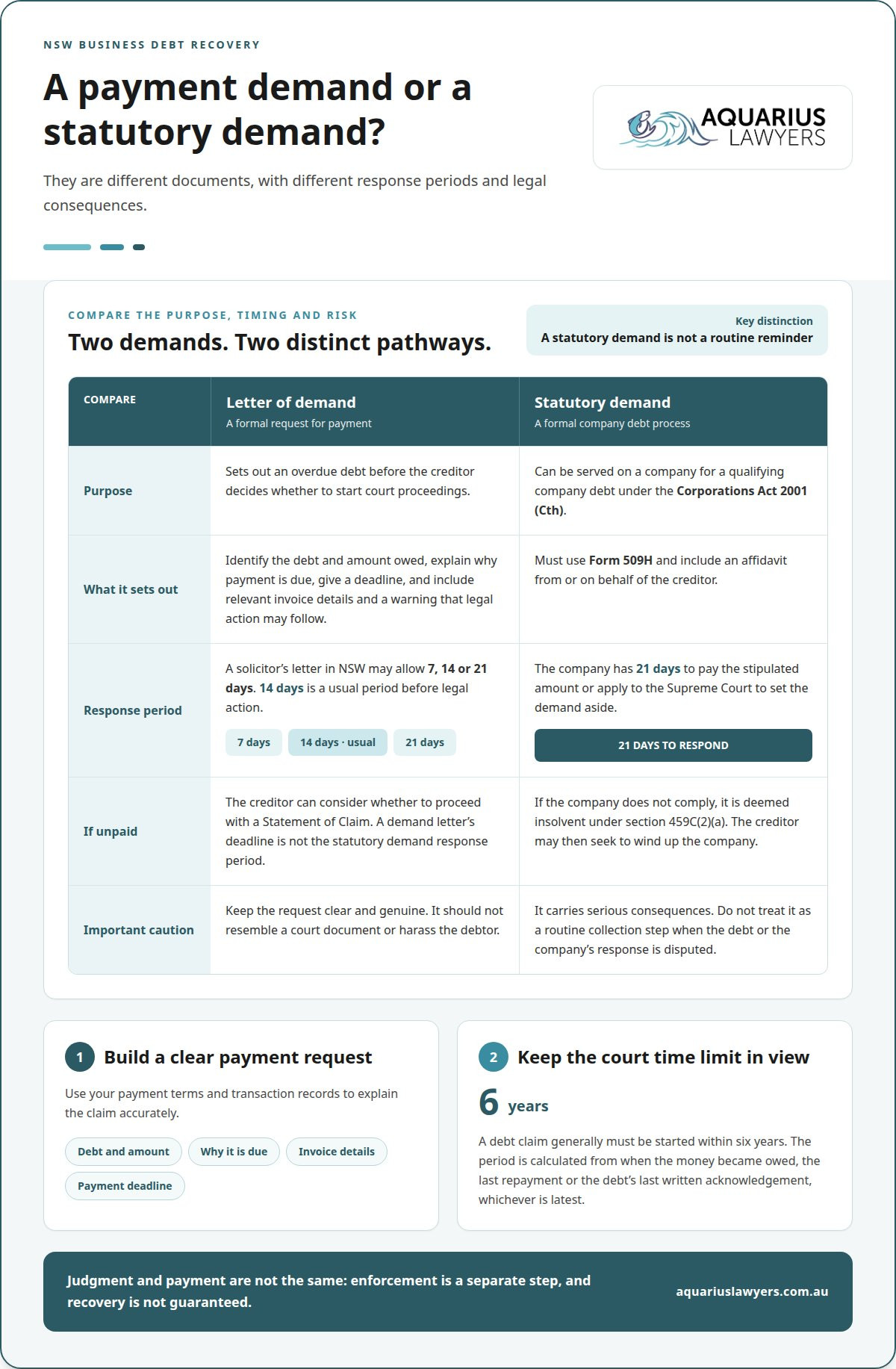
A demand letter gives the debtor a stated period to pay the debt or respond. A solicitor’s letter in NSW may allow 7, 14 or 21 days, and 14 days is a usual period before legal action.
The deadline gives both parties a clear point to decide what happens next. The creditor can consider whether payment arrives, whether the debtor disputes the amount or whether proceedings should follow. A deadline in a letter of demand is different from the statutory response period for a company served with a statutory demand.
A creditor may also serve a company with a statutory demand under the Corporations Act 2001 (Cth). The demand must use Form 509H and include an affidavit from or on behalf of the creditor. It applies to a qualifying company debt and carries serious consequences, so it is not simply another overdue-payment letter.
A company served with a statutory demand has 21 days to pay the stipulated amount or apply to the Supreme Court to set the demand aside. Under section 459C(2)(a) of the Act, a company that does not comply is deemed insolvent. The creditor may then seek to wind up the company. A statutory demand should not be treated as a routine collection step when the debt or the company’s response is disputed.
How do legal proceedings start?
A creditor generally starts court action in NSW by lodging a Statement of Claim in the appropriate court. A debtor served with the claim can file a defence. If they do not respond within the required timeframe, the creditor may seek default judgment.
Timing can determine whether a debt claim can proceed. In NSW, a creditor generally has six years to start a court case, calculated from when the money became owed, the last repayment or the debt’s last written acknowledgement, whichever is latest. Written acknowledgement or a later repayment can therefore affect the limitation period. A lawyer can assess the relevant dates before filing, particularly if the account has a long payment history.
How a Lawyer Files and Serves a Statement of Claim
To start formal court action, a lawyer prepares a Statement of Claim and lodges it with the court that can hear the amount claimed. This turns the creditor’s demand into a court proceeding and formally sets out the claim against the debtor.
For a NSW Local Court filing, the plaintiff must lodge at least 4 copies of the Statement of Claim. The claim then needs to be served on the defendant. The service date matters because it starts the period for responding. A lawyer can manage filing and service so the proceeding follows the proper sequence.
Court Jurisdiction and Claim Amounts
The amount claimed helps determine which NSW court division can hear the action. The Local Court’s Small Claims and General Divisions hear different types of claims, and the appropriate division depends on the amount claimed.
Claims above A$100,000 can be brought in the District Court or Supreme Court of NSW. The amount in dispute therefore affects where the creditor files and the court process that follows.
Legal Action and Small Claims Tribunals
For an unpaid debt, a business may seek legal advice or lodge a claim through a small claims process, depending on the amount involved. In NSW, the Local Court’s Small Claims Division provides a pathway for eligible claims, so not every dispute needs to proceed as a larger court matter.
A defendant may file a Notice of Defence within 28 days after service of a Statement of Claim. If the defendant disputes the debt, the defence can address the creditor’s claim, and a counterclaim may also arise. If the debtor does not pay or file a defence within 28 days after service, the creditor may apply for default judgment. That outcome is not automatic: the creditor must make an application to the court.
Enforcing court judgments
A judgment gives the creditor a court order, but enforcement is a separate stage. In NSW, a lawyer can assess settlement options, present evidence and pursue available enforcement processes.
Before filing, a lawyer can help narrow a dispute by reviewing the agreement, invoices and communications between the parties. A creditor may consider alternative dispute resolution after sending a letter of demand. Mediation gives the creditor and debtor an opportunity to work towards an agreement with a mediator, potentially resolving the claim without a hearing.
If negotiations fail, a lawyer can start proceedings by preparing and filing a Statement of Claim in the appropriate court. Once the defendant is served, the response and any defence help define the issues for the court. Evidence must support the creditor’s claim, such as records showing the agreement, invoice and unpaid amount. The court decides whether to enter judgment in the creditor’s favour.
Costs and Risks of Court Proceedings
Court action can provide a definite decision, but it may be stressful and time-consuming. The debtor may dispute the agreement or file a defence, requiring the creditor to present evidence and respond to those issues.
Before starting proceedings, consider the strength of the claim and the likely procedural steps. A court decision does not itself transfer money to the creditor. If the debtor does not pay, the creditor may need to take a separate enforcement step.
Court Hearings and Evidence
A hearing allows the court to consider the parties’ evidence and decide disputed issues. The court may require a person to give evidence and face cross-examination.
For example, if a debtor disputes whether contracted work was completed, the court may consider the agreement and evidence about performance. A lawyer can organise the evidence around the issues in the claim and prepare the creditor’s case for the hearing. The court then determines whether the evidence supports judgment.
After judgment, a NSW creditor can pursue enforcement within 12 years from the judgment date. Options include seeking a garnishee order, which can require a debtor’s bank or employer to make payments towards the debt, or asking the court to order seizure and sale of goods. A writ for levy of property can cover real estate if the debt exceeds $10,000, although some essential property is exempt. Enforcement of debt judgments is largely dealt with under the Civil Procedure Act 2005.
If a judgment debt remains unpaid within 28 days, interest is payable on it. Whether interest can be claimed depends on the judgment and applicable court process, so distinguish the interest component from the principal debt when assessing the amount outstanding.
Business debt recovery thresholds
A debt threshold can help identify a recovery pathway, but it does not determine whether an invoice is valid. In NSW, the amount owed, the debtor’s response and whether the claim is disputed all shape the next step. A small unpaid invoice may call for a different approach from a substantial commercial claim.
Some businesses choose to write off debts under A$2,000 because pursuing them may seem difficult, particularly if lawyers are involved. That is a commercial decision, not a rule preventing recovery. Consider the quality of the records, the debtor’s response and whether further action is proportionate to the claim. The threshold can prompt a deliberate decision rather than an automatic write-off.
The amount claimed also helps determine where court action can be brought. The NSW Local Court Small Claims Division can hear claims up to A$20,000, while its General Division can hear claims up to A$100,000. Claims above A$100,000 can be brought in the District Court or Supreme Court of NSW. These limits identify the court pathway; they do not establish the merits of a claim or ensure payment.
A business may engage a debt collection service after reminders, informal negotiations and a letter of demand have not recovered the debt. A lawyer may be more suitable if the debtor disputes the agreement, a court claim is being considered or the creditor is weighing a statutory demand against a company. The right approach depends on the recovery stage and the issues involved.
If the debtor simply missed a payment, a collection service may pursue the outstanding account. If the debtor alleges defective goods or incomplete work, legal advice can help assess the agreement, evidence and response. A defence or counterclaim may change the recovery pathway, so the amount owed alone should not determine whether to use a collection service or take legal action.
Consumer debts require particular care. The National Consumer Credit Protection Act 2009 (Cth) is excluded from the debt guidance described here. In NSW, Federal and State Fair Trading Laws prohibit misconduct associated with debt collection, and the ACCC and ASIC deal with such misconduct. Businesses contacting other businesses about payment also have legal and consumer law obligations.
Use thresholds as decision points, not automatic instructions to sue or abandon a claim. Consider the records, the debtor’s response and whether negotiation could resolve the dispute before choosing a recovery route. Get legal advice about your debt recovery options if a defence, court claim or company demand may be involved.
Aquarius Lawyers: Debt Recovery
Aquarius Lawyers can help assess an unpaid business debt and choose a suitable recovery pathway. Its Debt Recovery work may include considering the claim, the supporting agreement and the debtor’s response, then advising on possible negotiation or court action.
Seek legal advice when the debtor disputes the amount, a defence or counterclaim may arise, or you are weighing a statutory demand or judgment enforcement. For debts connected with marine, fisheries or aquaculture operations, Aquarius Lawyers’ related legal knowledge can help place the dispute in its commercial context.
To discuss your circumstances and possible next steps, contact Aquarius Lawyers.
Choose a clear path for your next step
The next move should support your business priorities, not simply pursue an unpaid balance. Consider how the dispute affects ongoing trading relationships, commercial assets and day-to-day operations. A focused legal discussion can help identify the decision that needs attention and the records that will inform it.
If the debt relates to a marine, fisheries or aquaculture business, the commercial setting may also matter. Aquarius Lawyers offers Marine Law, Fisheries Law and Aquaculture Law alongside Debt Recovery. This combination may be relevant when a payment dispute intersects with industry agreements, operations or licences.
Whether you are considering negotiation, a court claim or enforcement, clear advice can help you move forward with a considered strategy. The business debt recovery process in NSW can involve decisions with consequences beyond the invoice, so take the wider commercial picture into account as you decide what to do next.
Contact Aquarius Lawyers for guidance about your situation. A practical conversation can help you decide what to address next and keep your business moving.
Frequently Asked Questions
What happens where someone doesn’t pay a judgment debt?
If a judgment debt remains unpaid, the creditor can seek an enforcement order rather than simply restart the original claim. A court may require the debtor to explain their financial position, and available options include a garnishee order or seizure and sale of goods. A judgment can be enforced for 12 years from its date. Enforcement steps depend on the debtor’s circumstances and what property or income may be available.
What if I do not owe the debt or can not pay?
If you dispute the debt, respond to the court claim within the applicable timeframe and set out your defence. You may also have a counterclaim, such as a claim about defective goods or work that was not performed. If you cannot pay the full amount, respond to the creditor and seek legal advice about your options. Don’t ignore court documents. Get legal advice about your response and options.
What are the steps in the business debt recovery process in NSW?
A typical pathway begins with payment reminders and an attempt to resolve the overdue account. If payment still isn’t made, the creditor can send a formal demand, then consider negotiation or court action. A court claim may lead to a defence, settlement discussions or judgment. If the debtor still doesn’t pay after judgment, the creditor can consider enforcement. The best next step depends on whether the debt is disputed and what evidence is available.
How should a lawyer send a payment reminder and letter of demand for a NSW business?
A lawyer should communicate clearly and professionally about the missed payment, then set out the creditor’s formal demand in writing. A reminder can be sent by phone, email or letter, giving the debtor a chance to explain an oversight or discuss the debt. The demand should be accurate and respectful. It must not harass the debtor or be designed to look like a court document, which could mislead the recipient.
What information must a letter of demand include in NSW?
A letter of demand should identify the creditor and debtor, describe the debt, state the amount claimed and explain why it is payable. It should include relevant invoice details and a clear payment deadline, so the recipient understands which transaction is in issue. A warning that legal action may follow if the debt remains unpaid explains the consequences of not responding without making the letter look like a court document.
How long should a debtor be given to pay before starting legal action in NSW?
A solicitor’s letter of demand in NSW may give the debtor 7, 14 or 21 days to pay. A 14-day deadline is usual, but the appropriate period depends on the demand and circumstances. The letter should state the exact due date, not leave the recipient guessing. This demand deadline is separate from the response period that applies after court proceedings begin, so receiving a claim requires prompt attention.
Disclaimer
Please note that legal rules change and this is not a substitute nor construed as legal advice. It is general information only.