
What if a will’s surprising change reflects more than persuasion? Challenging a will for undue influence involves proving that pressure overpowered the will-maker’s own wishes. The person making the allegation bears the burden of proving it on the balance of probabilities, and a claim must typically be filed within 12 months of the grant of probate.
A sudden change, vulnerability or a beneficiary’s involvement may raise concern, but each needs to be assessed in context. The practical questions are how the will was prepared, what the evidence shows and whether the legal grounds fit the circumstances. Aquarius Lawyers helps clients nationwide navigate these complex matters, providing clarity both to people contesting the will and to those administering the estate.
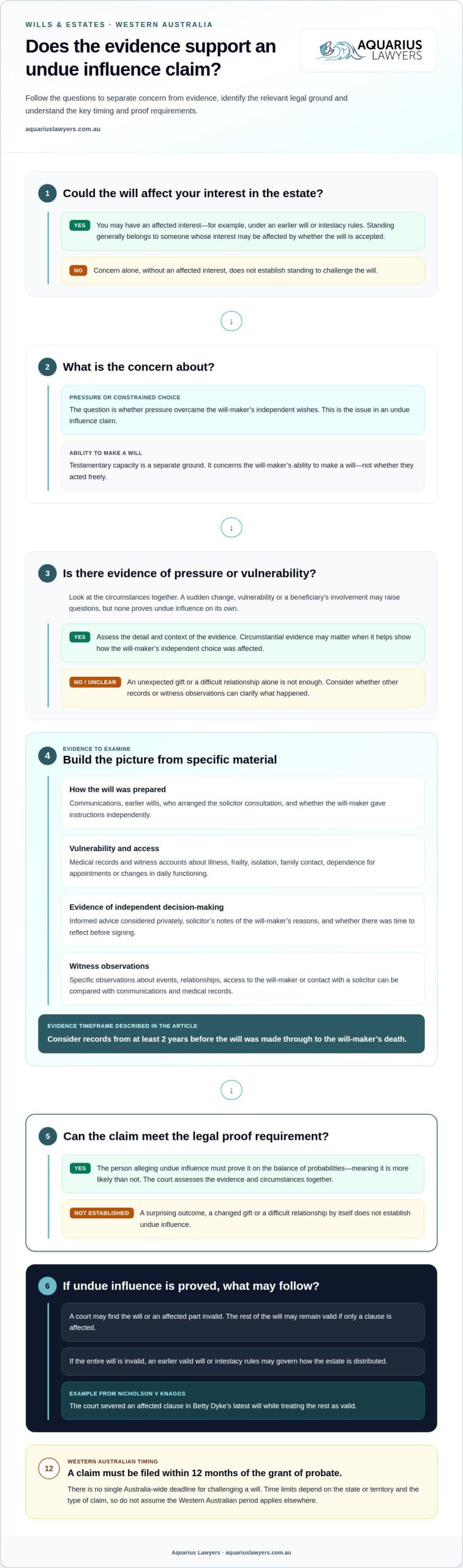
Undue influence and testamentary capacity raise different questions about how a will was made. This guide explains the distinction, the evidence that may inform a challenge and what may follow if a court finds a will or part of it invalid. It also outlines how probate timing and available evidence can shape the next steps in your dispute.
Key Takeaways
- Persuasion or an unexpected gift alone doesn’t prove undue influence; the key issue is whether pressure overcame the will-maker’s independent wishes.
- Look at the surrounding evidence, including changes to earlier wills, the will-maker’s vulnerability and another person’s role in arranging the will.
- Testamentary capacity and undue influence are separate grounds: one concerns the ability to make a will, the other whether the will-maker acted freely.
- If a court finds undue influence, the will or affected part may be invalid, which can change how the estate is dealt with.
- In Western Australia, a claim must be filed within 12 months of the grant of probate, so timing matters.
Suspect a Will Was Made Under Pressure or by Someone Who Lacked Mental Capacity in Western Australia?
A will challenge depends on evidence about the will-maker and how the document was prepared. A suspicious change may warrant investigation, but it does not establish undue influence by itself.
Standing generally belongs to someone whose interest in the estate may be affected by whether the will is accepted. This may include a person who could benefit under an earlier will or under intestacy rules. Concern alone, without an affected interest, does not establish standing.
Courts assess whether pressure overcame the testator’s independent choice, considering all the evidence. In Nicholson v Knaggs, the court found undue influence based on evidence about the neighbours’ conduct and relationship with Betty Dyke. The case illustrates that circumstantial evidence can matter, while an unexpected outcome alone is not enough.
Evidence of Pressure and Cognitive Impairment
This evidence concerns conduct that may have constrained the deceased’s choices, or a condition affecting their decision-making. It matters because pressure and cognitive impairment are distinct grounds for contesting a will.
Relevant material may include communications, medical records, earlier wills and evidence about who arranged the solicitor consultation. For example, records showing a beneficiary repeatedly conveyed instructions should be considered alongside what the testator said independently. A changed gift may raise questions, but without supporting circumstances it does not establish coercion.
Vulnerability, Isolation and Susceptibility
Evidence of vulnerability concerns circumstances that may have made the will-maker more susceptible to pressure. It matters because illness, frailty or isolation can help explain how another person’s influence operated.
Witnesses may describe reduced contact with family, dependence on a beneficiary for appointments or changes in the deceased’s daily functioning. Medical evidence can provide context about physical or mental decline. The court considers these circumstances together, rather than treating illness or isolation as proof on its own.
Evidence for Rebutting the Presumption
Evidence to rebut a presumption aims to show that the testator understood the decision and acted independently. It matters where the relationship between the parties gives rise to a presumption of influence.
Relevant evidence may show that the deceased received informed advice, considered it privately and gave instructions without another person directing the consultation. A solicitor’s notes recording the testator’s reasons may help. The court may also consider whether the person had time to reflect before signing the will.
Witness Evidence After the Testator’s Death
Witness evidence records what people observed during the will-making process or in the deceased’s relationships. It matters because the will-maker cannot give evidence after death.
Relatives, carers or friends may describe who controlled access to the deceased or arranged contact with a solicitor. Their accounts can be compared with communications and medical records. Specific observations tied to events are more useful than conclusions about another person’s motives.
Examining the process and related medical evidence from at least 2 years before the will was made until the deceased’s death can help place those accounts in context.
What is undue influence in a Will?
Undue influence may affect whether a will, or a particular gift, can stand. In Western Australia, a successful challenge can affect probate and how the estate is distributed.
There is no single Australia-wide deadline for challenging a will. Time limits depend on the state or territory and the type of claim; in Western Australia, an undue-influence or capacity claim must be filed within 12 months of the grant of probate. Don’t assume that period applies in another jurisdiction.
The alleged influencer need not be a beneficiary. The key issue is whether pressure affected the will-maker’s independent wishes, not whether that person received a gift.
Effects on the Will and Probate
If undue influence is proved, a court may find the will, or an affected part of it, invalid. This matters because probate authorises administration of the estate under the accepted will.
In Nicholson v Knaggs, the court severed an affected clause in Betty Dyke’s latest will while treating the rest as valid. If an entire will is invalid, an earlier valid will or intestacy rules may govern distribution. Western Australian will disputes are decided in the Supreme Court under the Supreme Court Act 1935 (WA), with the Wills Act 1970 (WA) governing will disputes.
A probate caveat can prevent a grant while it remains in force, but it does not prove the will is invalid. Its availability and effect depend on the jurisdiction’s rules. In Queensland, a lawyer can assist with filing a caveat at the probate registry. A caveat may pause probate and estate distribution while a suspected claim is investigated, but it is temporary and does not replace progressing the dispute.
The Burden of Proof
The person alleging undue influence must prove it on the balance of probabilities, meaning it is more likely than not. This matters because an unexpected gift or a difficult relationship alone does not establish the legal grounds.
Courts assess the evidence and circumstances together. In Hall v Hall, decided in 1868, the principle was that pressure must overpower the testator’s will. Nicholson v Knaggs shows how circumstantial evidence about relationships and conduct can support a finding. The alleged influencer need not receive property; the issue is whether pressure overcame the deceased’s independent wishes.
Probate timing shapes the practical next steps. A caveat may temporarily hold up a grant, while the grant starts Western Australia’s 12-month filing period. A lawyer can assess the grounds, evidence and procedural options, including whether a caveat is relevant. The estate’s position can change as probate progresses or assets are distributed, so delay can complicate a contest. A capacity concern is a separate ground, even where the same circumstances also raise questions about influence.
Testamentary capacity
Testamentary capacity is the mental ability to make a valid will. It concerns the testator’s understanding, not whether family members agree with the distribution. In Banks v Goodfellow, a landmark case on capacity, the court considered whether the will-maker understood what making a will involved, the property being dealt with and the claims of people who might expect to benefit.
Undue influence and lack of testamentary capacity are different grounds. Capacity asks whether the testator could make the decision; undue influence asks whether coercion overcame their free will. Suspicious circumstances, such as a beneficiary arranging a consultation, may raise concern but do not prove pressure or incapacity on their own.
Capacity is assessed when the testator gave instructions and signed the will. A diagnosis or physical decline does not automatically make a will invalid. The relevant question is how the person’s condition affected their ability to understand the decision at that time, including the estate and potential claims.
Medical records and expert opinions can help assess capacity. A geriatrician or the deceased’s personal medical practitioner may give evidence about capacity and susceptibility to influence. Records made near the signing can show changes in cognition, communication or daily function. Later recollections may add context, but should be considered alongside contemporaneous documents.
A marked departure from an earlier will can also matter. For example, a will that once divided an estate among family members may later favour one person. That change may prompt examination of the testator’s reasons, capacity and freedom of choice. The difference itself does not establish undue influence; the evidence must connect the circumstances to the decision.
Medical evidence may also help distinguish cognitive impairment from pressure. A testator could understand the will’s effect yet still face coercion, or have impaired capacity without another person influencing the decision. These claims can overlap, but each requires separate analysis. Dependence on a beneficiary, for example, may be relevant context without proving either ground by itself.
The person disputing the will must establish the relevant grounds. A careful assessment brings together the will, earlier testamentary intentions, medical material and evidence about the signing process. In Western Australia, this distinction helps determine whether a challenge focuses on capacity, undue influence or both, rather than treating an unexpected outcome as proof.
Meaning of undue influence in a will
Undue influence means pressure that overcomes a will-maker’s independent wishes, rather than ordinary persuasion. Australian courts have endorsed the coercion principle discussed in Wingrove v Wingrove: pressure must displace the testator’s free choice. A relative expressing a strong view, for example, does not by itself show that the will resulted from undue influence.
The key distinction is the effect of the pressure. A testator may choose to favour one person after a discussion and still act independently. By contrast, pressure may amount to undue influence if it leaves the testator unable to make a genuine choice. When challenging a will for undue influence, the issue is whether the will reflects the testator’s decision, not simply whether family members consider the outcome unfair.
This distinction makes the surrounding circumstances relevant. A close or dependent relationship, a beneficiary directing contact with a solicitor, or a marked change to earlier provision may help explain how a will was made. None proves coercion alone. The question is how the details fit together and whether they support the claim that the testator’s independent wishes were overcome.
Some relationships may warrant close examination, including solicitor and client, doctor and patient, or religious leader and disciple. But the relationship itself does not automatically establish that a will was coerced. A solicitor, for example, may help a client prepare a will without exerting improper pressure. The substance of the consultation, who gave instructions and whether the testator could decide independently all matter.
Birt v The Public Trustee of Queensland [2013] illustrates why a changed will is not enough on its own. Patricia Brooks’s will favoured her son, but the judge found no evidence that he had convinced her to make that change. The example shows the difference between an outcome that raises concern and evidence that links another person’s conduct to the testator’s decision.
Will disputes can also involve claims about false statements that turn a testator against family members. In Edwards v Edwards [2007] EWHC 1119 (Ch), fraudulent calumny involved allegations known to be false, or made without caring whether they were true. That English decision describes a distinct form of alleged wrongdoing; it does not make every family disagreement or inaccurate statement undue influence in Western Australia.
Records of instructions, solicitor consultations and communications can help lawyers assess what happened. When assessing grounds for challenging a will for undue influence, it is useful to distinguish the testator’s wishes, the alleged pressure and the evidence connecting them. This prevents suspicion, family conflict and proof of coercion from being treated as interchangeable.
If the will’s preparation or a solicitor’s consultation raises concerns, seek advice about the dispute and the evidence relevant to the claim.
Aquarius Lawyers: Wills and Estates
Aquarius Lawyers can help assess a suspected will dispute through its Wills and Estates offering. Turn to the firm when evidence raises concerns about pressure, capacity or the will-making process, or when you need to understand the next step in a probate challenge.
Legal advice can help clarify the relevant grounds, assess records and witness accounts, and consider how the Western Australian deadline applies to your situation. The focus is on evidence and the legal pathway, not assumptions about a beneficiary’s motives.
Contact Aquarius Lawyers to discuss a will or probate dispute.
Choose a clear path forward
The next step is to define what you want the estate dispute to resolve. A focused legal assessment can help you understand the issues, weigh your options and decide how to proceed without letting family conflict define the process. If the estate includes a working business or specialised assets, that context may also shape the questions requiring attention.
For example, an estate connected with fishing or aquaculture may involve assets or operations beyond ordinary personal property. Aquarius Lawyers offers Marine Law, Fisheries Law and Aquaculture Law alongside Wills and Estates. Those services may be relevant where these interests intersect with a will dispute.
Taking advice about challenging a will for undue influence can help you move from suspicion towards a considered decision. Discuss your situation with Aquarius Lawyers and take the next step with a clearer understanding of your options.
Frequently Asked Questions
What are the different grounds for challenging a Will’s validity?
Common grounds include undue influence, lack of testamentary capacity and concerns that the will-maker did not know or approve the document’s contents. These are distinct issues, not interchangeable labels. Someone may understand a will but sign after coercion, or lack capacity without another person applying pressure. A challenge needs evidence supporting a recognised ground; dissatisfaction with a smaller gift alone does not invalidate a will.
Are gifts to carers or new partners automatically suspicious?
No. A will-maker may choose to recognise a carer’s support or provide for a new partner. The gift alone does not show pressure or make the will invalid. Other evidence may warrant closer scrutiny, such as a beneficiary controlling access to the will-maker or the preparation process. The court considers the evidence as a whole, rather than treating a particular relationship or gift as proof.
Can a will be challenged after probate has been granted?
Yes. In Western Australia, a claim alleging undue influence or lack of capacity must be filed within 12 months of the grant of probate. The period runs from the grant date, rather than simply from the date of death. If probate has already been granted, prompt legal advice can help identify the procedural position, the evidence available and the court orders that may be sought.
What Can You Do?
Arrange legal advice promptly and describe the concern specifically, such as a changed gift, the will-making process or a person’s role. A solicitor can assess your standing, consider the relevant grounds and identify the applicable deadline. They can also advise whether court action is appropriate. This assessment helps distinguish evidence that may support a claim from family disagreement or disappointment about the distribution.
What Happens if the Will is Invalidated?
If a court finds the will invalid, distribution depends on whether an earlier valid will exists. The court may grant probate for that earlier will; if there is none, the estate may be dealt with under Western Australia’s intestacy rules. A finding about part of a will may have a different effect from setting aside the whole document. The court’s decision identifies which document or rules govern the estate.
What are suspicious circumstances in will-making?
Suspicious circumstances are details that prompt closer examination of whether the will-maker knew and approved the will’s contents. For example, a process in which someone else appears to control how instructions reach the solicitor may raise questions. That concern is not itself proof of undue influence or invalidity. It is important to distinguish doubt about knowledge and approval from evidence that pressure overcame the will-maker’s independent choice.
Disclaimer
Please note that legal rules change and this is not a substitute nor construed as legal advice. It is general information only.