What if the biggest risk in a fisheries compliance audit isn’t a missing document, but reviewing the wrong requirements? Your obligations can depend on the fishery, where you operate and the rules that apply to your business. Records may also sit across vessels, staff and different business systems, making it harder to see whether the evidence tells a consistent story.
A useful review isn’t a one-size-fits-all checklist. It’s a structured way to compare the requirements relevant to your operation with your records and practices, identify gaps and decide what needs attention. This guide explains what a compliance review can and can’t establish, which records to organise and how to assess findings without jumping to conclusions.
You’ll also learn how to turn issues into practical next steps, including when fisheries law advice may help you understand potential legal or commercial consequences. A clear review can support better governance and compliance frameworks, giving you a more organised basis for managing risk.
Key Takeaways
- Use a fisheries compliance audit to compare your operation’s activities, controls and evidence with requirements that apply to your fishery.
- Define the review scope first, then gather records that match your actual operations and verified requirements.
- Sort findings by their nature and significance so you can identify where timely fisheries law advice may be needed.
- Turn each finding into a tracked action with an accountable role, completion evidence and a review point.
What does a fisheries compliance audit review?
A fisheries compliance audit is a structured review of an operation’s activities, controls and supporting evidence against requirements that apply to that operation. Unlike a general operational check, it tests whether the work being done and the available records demonstrate alignment with relevant requirements. It can identify gaps, but it can’t guarantee ongoing compliance or predict every future issue.
The scope should reflect your fishery, business activities and operating arrangements. Fisheries management involves monitoring and compliance, as outlined in Fisheries Management, but the requirements to review depend on your circumstances. Start by defining what the review covers, rather than assuming a broad checklist fits every business.
Which parts of a fisheries business might the review cover?
Map the review to the work your business actually does. Depending on the operation and applicable requirements, this may include fishing activities, vessels, staff responsibilities, reporting processes and the records that support them. For example, you could compare relevant catch or vessel records with internal procedures, then note who keeps each record and who checks it. The aim is to test evidence against verified requirements, not assume every operator has the same obligations.
Clear governance and compliance frameworks can help organise oversight by setting out responsibilities, processes and review points. They make it easier to identify where a control sits and who follows up if evidence is missing or inconsistent.
Why does the audit scope need to fit the operation?
A checklist built for another fishery or business model may miss activities that matter to you or include requirements that don’t apply. Separate confirmed requirements from assumptions before drawing conclusions. Identify the relevant legal sources and verify they’re current and applicable to your operation before naming legislation, regulators or specific obligations.
For a potential legal issue identified in your review, fisheries and marine legal advice can help you assess the issue in context. A well-defined scope gives you a sounder basis for deciding what evidence to examine and what needs attention.
How to prepare evidence for a fisheries compliance audit
Work from the scope you’ve set, not from a generic document list. A fisheries compliance audit is easier to assess when each record has a clear purpose, an owner and a link to the control or requirement it helps examine. The FAO’s guidance on Integrated Fisheries Monitoring and Auditing also discusses the role of monitoring and documentation.
Use an ordered process:
- Define the scope: Record the activities, vessels, people and processes included.
- Identify requirements: Verify current sources relevant to those activities and separate confirmed requirements from assumptions.
- Gather evidence: Collect records that relate to the scope, including versions held across business systems.
- Test controls: Compare written procedures with available evidence and how responsibilities work in practice.
- Record findings: Note what the evidence shows, what remains unclear and what needs follow-up.
What records should an operator organise?
Select records that help assess the relevant activity or control. Depending on your operation, these may include operational records, staff responsibilities or training material, governance documents, internal procedures and compliance records. Don’t assume every record is mandatory. Map each item to the question it helps answer, such as whether a process was followed or a responsibility was assigned.
Keep ownership and version history clear. If records sit across a vessel, staff files and business systems, identify the current copy and who maintains it. Documented evidence makes findings easier to assess because it connects each issue to a verifiable record.
How can you record findings clearly?
Use a findings register to capture the issue, supporting evidence, responsible role and proposed next step. Label whether a point is supported by confirmed evidence, based on an assumption, affected by incomplete records or requires legal review. This distinction helps prevent uncertainty from being presented as a proven breach.
If a finding raises a legal question, fisheries law advice can help you assess it in context. Fisheries and marine legal advice can help identify the questions and evidence to consider before deciding how to respond.
How to assess audit findings without relying on a generic checklist
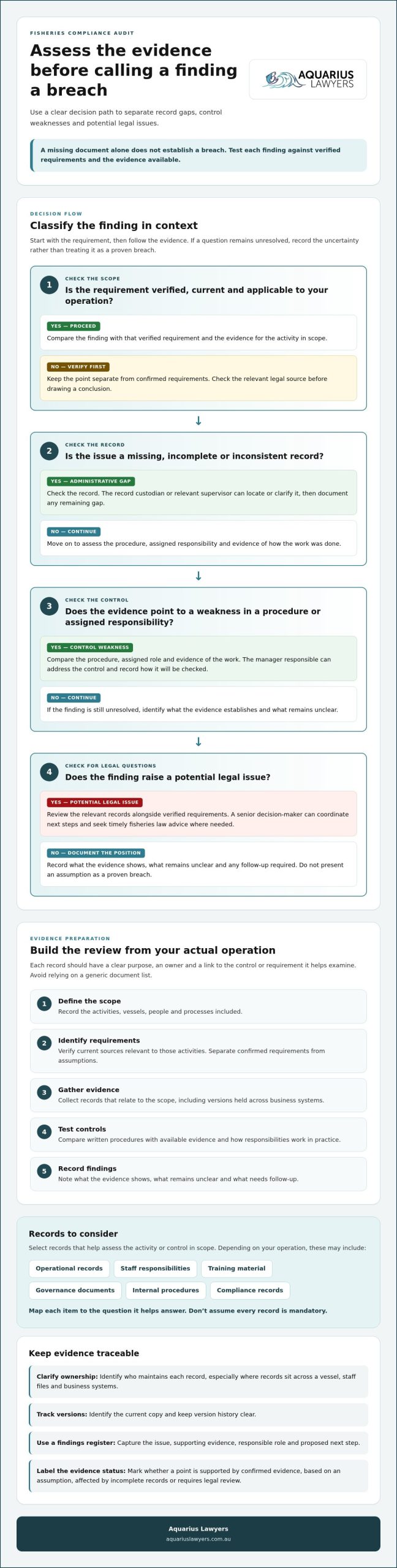
Assess each finding against the evidence and the requirements that apply to your operation. Don’t label a gap a breach simply because a document is missing. Establish what the record shows, whether a control failed and whether the issue raises a legal question. Requirements and possible consequences depend on the specific fishery and circumstances, so verify the relevant legal sources before drawing conclusions.
Use these categories to set proportionate follow-up:
- Administrative gap: Check the missing, incomplete or inconsistent record. The record custodian or relevant supervisor can locate or clarify it, then document any remaining gap.
- Control weakness: Compare the procedure, assigned responsibility and evidence of how work was done. The manager responsible for that process can address the control and record how it will be checked.
- Potential legal issue: Review relevant records alongside verified requirements. A senior decision-maker can coordinate next steps and seek timely fisheries law advice where needed.
What if the review identifies a possible infringement?
Preserve relevant records in their existing form and note when and how the issue came to light. Don’t alter or delete records. If a correction or annotation is needed, keep a clear account of what changed and why. Seek fisheries law advice promptly before assuming what the finding means, what legal exposure exists or which response options may apply. A review alone doesn’t determine those matters.
How should a business prioritise corrective action?
Prioritise according to the strength of the evidence, the issue’s operational significance and whether advice is needed promptly. Assign an accountable role, a proportionate action and a record of completion. If an issue calls for immediate containment, distinguish that step from longer-term improvements to governance and compliance frameworks. This keeps urgent responses clear while supporting better oversight.
If a finding raises a fisheries law question, seek fisheries and marine legal advice to assess the issue in context.
Turn fisheries audit findings into a practical compliance plan
A finding becomes useful when it leads to a clear action. For each item from your fisheries compliance audit, document what will change, who is accountable, what evidence will show the action is complete and when the result will be reviewed. This turns observations into follow-through rather than leaving unresolved issues in a report.
Separate immediate steps from longer-term improvements. If a process needs prompt attention, assign a responsible role and record what was done. Then consider whether staff training or changes to governance and compliance frameworks could help the process work consistently across the business. Set a review point to check whether the action addressed the identified issue.
When can fisheries law advice help?
Seek advice when a finding raises questions about the requirements that apply, an infringement notice or possible response options. Aquarius Lawyers provides legal advice and representation for commercial fisheries, including representation of an employee against Fisheries infringement notices. That experience can help assess the legal issues raised by your circumstances, without assuming a particular outcome. Learn about Seafood and Marine Legal Services in the context of fisheries law questions.
What should an operator take into a legal discussion?
Prepare a concise timeline, the relevant records, the review findings and any correspondence connected with the issue. Keep originals and note where each document came from. A clear file helps focus the discussion on what happened, what evidence supports the finding and what remains uncertain. Write down your questions in advance, including which rules apply, what risks need assessment and what next steps may be available.
A structured record can make it easier to discuss the issue and consider practical options. Keep your notes focused on the evidence, the requirements you have verified and the decisions still to be made.
Make your next compliance decision with clarity
Use the review to consider how compliance decisions fit into your wider business planning. Bring the relevant decision-makers together to discuss what the findings mean for operational priorities, commercial commitments and future planning. Identify practical constraints before settling on a response, and make sure the people affected understand the decision and their role in carrying it out.
Give the issue a clear place in your management discussions rather than allowing it to fade once the review ends. If new information changes your understanding, revisit the decision and update the reasoning behind it. A considered approach helps you respond proportionately while keeping business choices grounded in the circumstances you face.
For a fisheries law concern identified in your review, speak with Aquarius Lawyers about your next step.
Frequently Asked Questions
Is a fisheries compliance audit mandatory in Australia?
No single rule makes an internal fisheries compliance audit mandatory for every operator in Australia. A review may form part of a fishery-specific licence, approval or other arrangement, and export-registered establishments may be subject to audits under export requirements. Check the current terms that govern your operation, including any audit notice or condition. An internal review and an official audit aren’t interchangeable.
What documents should I prepare for a fisheries compliance audit?
There’s no fixed national document pack for every operator. Once the review scope is set, arrange the material in a clear, labelled folder and create an index so a reviewer can find items quickly. Before sharing records, check whether they contain personal or commercially sensitive information about other people or businesses, and use an appropriate secure method to provide them.
How often should a fisheries business review its compliance?
There’s no single review schedule that suits every fisheries business. Set a regular review point that fits your operation, then bring it forward after a material change, such as a new process, a change in staff responsibilities or repeated corrections to records. Event-based reviews can help you catch control issues before they become part of routine practice.
What should I do if an audit identifies a possible fisheries infringement?
Start by reading any notice carefully. Identify who issued it, what conduct it refers to, any response date and the method it specifies for responding. Diarise relevant dates and make sure the person responsible for managing the matter has the notice. Don’t treat an internal finding as a final determination of liability; the applicable rules and evidence need careful assessment.
Can a fisheries compliance audit guarantee that my business is compliant?
No. A review can only assess the activities and period within its scope, so it can’t assure you about matters it didn’t examine or changes that happen later. For example, a change to a business process after the review may affect how a control works. Keep compliance oversight active between reviews and reassess controls when your operation changes. If you need help assessing a fisheries law issue, speak with Aquarius Lawyers about your next step.
Disclaimer
Please note that legal rules change and this is not a substitute nor construed as legal advice. It is general information only.