What should you do if an observer’s assigned duties appear to conflict with safety onboard a commercial fishing vessel? That question is central to fisheries observer program rights, but the answer may involve more than one document.
To understand what protections may apply, separate the observer’s program conditions from vessel safety requirements and any other relevant legal obligations. The responsible agency, fishery, placement documents and circumstances all matter.
This guide explains how to identify the applicable program rules, what to review before or during a placement, and how to respond to a concern. For a Commonwealth placement, current AFMA program material is a useful starting point. If the issue involves safety, interference with observer duties or possible legal consequences, a clear record of the facts and the relevant rules can help you decide what advice you need.
Key Takeaways
- Understand what an observer monitors and why fisheries observer program rights depend on more than placement documents alone.
- Separate program arrangements from vessel safety requirements, and review current AMSA guidance for the relevant vessel and placement.
- Before boarding or raising a concern, identify the program, read its documents and keep factual notes about the issue.
- When program documents, vessel duties or legal rights appear to conflict, distinguish placement questions for the relevant agency from legal issues that may need tailored fisheries or marine law advice.
Fisheries observer program rights: what the role does and what rights mean
A fisheries observer collects independent information about fishing activity. Depending on the program, duties may include recording target catch and bycatch, observing interactions with protected species, collecting biological samples, and monitoring fishing gear or logbooks. This information can support fisheries research, compliance monitoring and management decisions. Fishery observer programs worldwide operate in varied settings, so international descriptions should not be taken as a statement of Australian entitlements.
Observer duties describe the work an observer performs; legal rights describe protections or entitlements that may apply to that person in their specific circumstances. Participation in a program does not, by itself, establish every legal entitlement. Keep three matters distinct: individual protections under applicable rules, placement conditions set by the program, and responsibilities connected with the vessel and its safe operation. The fisheries observer program rights relevant to you depend on the documents and rules that apply to your placement.
Who manages a fisheries observer placement?
The relevant fisheries agency manages its observer program and placement arrangements. For Commonwealth fisheries, AFMA material is a key reference. For another placement, identify the agency named in your documents and refer to its current guidance. AMSA does not manage observer placements. Its separate role in maritime safety is discussed in the next section. Understanding how program decisions fit into the wider marine law context can help you describe a concern accurately.
What can ‘observer rights’ refer to?
The phrase may cover questions about safety, welfare, work arrangements or program-specific conditions, such as the information provided before a trip. These are areas to examine, not a checklist of guaranteed statutory entitlements. The answer may depend on the observer’s employment or contracting circumstances, placement documents, fishery and applicable rules. Start with the program material, then distinguish what it says about the role from any wider legal question. This helps identify whether the issue concerns program administration or needs legal assessment.
Observer safety, welfare and vessel responsibilities in Australia
Observer placement arrangements and vessel safety considerations are related, but they are not the same issue. AMSA publishes guidance for operators carrying observers, while the relevant fisheries agency manages program placements. AMSA guidance is a starting point, not an automatic answer for every vessel or voyage.
Vessel safety checks concern the vessel and the proposed carriage; placement conditions concern the observer’s program. Check current AMSA material and the information provided for the particular vessel before relying on a specific safety requirement. The applicable guidance may depend on the vessel and operating circumstances.
What does AMSA say about carrying an observer?
AMSA’s published material discusses considerations such as risk assessment, certified capacity, safety equipment, and observer induction or training. Review these against current guidance rather than treating them as a universal checklist for every placement. If a document or instruction is unclear, note which vessel and placement it concerns so the question can be put in context.
For example, certified capacity concerns the vessel’s approved carrying capacity. Whether a particular check or measure applies depends on the vessel and the current guidance relevant to it.
How do safety concerns relate to observer protections?
Human Rights at Sea has reported broader concerns about observer safety, security and welfare in some fisheries settings. That material provides context, not a finding about a particular Australian placement. Conditions vary, so don’t assume every trip presents the same risks or that a reported concern proves unlawful conduct. Make a factual record of any incident and its context for later assessment.
If a concern raises questions about vessel responsibilities or fisheries rules, specialist fisheries and marine legal advice can help assess the issue in its operational context.
How to prepare for an observer placement or raise a concern
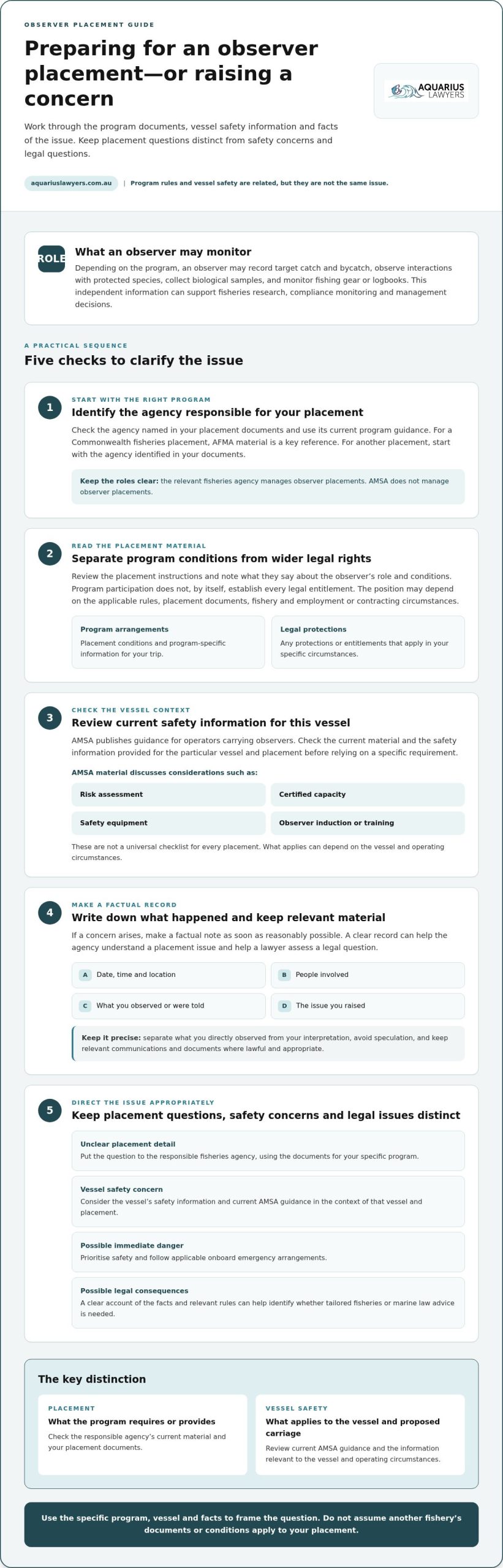
A practical preparation check can help you distinguish a placement question from a safety issue or wider legal concern. Start with the specific program and vessel, rather than assumptions based on another fishery. Fisheries observer program rights can depend on the documents and rules that apply to your placement.
What information should you check before boarding?
Read the placement instructions and identify the fisheries agency responsible for the program. Keep the relevant contact details accessible. Then review the current vessel safety information provided for your placement, including material explaining what applies to the vessel and your observer role. If a document refers to another program, don’t assume its conditions apply to yours. For a placement detail that the documents do not resolve, direct your question to the responsible agency.
What records may help clarify a concern?
If a concern arises, make a factual note as soon as reasonably possible. Record the date, time, location, people involved, what you observed or were told, and the issue you raised. Keep relevant communications and documents where lawful and appropriate. Separate what you directly observed from your interpretation, and avoid speculation. A clear record can help the relevant agency understand a placement issue and help a lawyer assess a legal question.
Deal with immediate safety concerns separately from uncertainty about program conditions or legal rights. If someone may be in immediate danger, prioritise safety and follow applicable onboard emergency arrangements. Don’t let a paperwork question delay action on an urgent safety issue. For a non-urgent placement concern, use the relevant agency contact identified in the program material. The appropriate process and response may depend on the program and circumstances.
If the documents or events raise a legal issue, specialist fisheries advice can help assess it in its operational context. Seek advice on seafood and marine legal matters where program conditions, vessel responsibilities or your legal position appear to conflict.
When fisheries observer program rights may need legal advice
A placement question usually belongs with the fisheries agency responsible for the program. A legal issue may need a separate assessment, particularly if program documents appear inconsistent with vessel responsibilities or someone disputes what protections apply. Fisheries observer program rights are not determined by a label alone. The facts, relevant documents and applicable rules all matter.
When is a concern more than a program question?
A request to clarify an instruction or confirm a placement detail may be administrative. Consider legal advice if conditions appear to conflict with vessel duties, responsibility for a safety issue is disputed, or you’re unsure how an event affects your legal position. These examples do not establish that anyone has breached a rule. An assessment depends on the placement documents, communications, circumstances and governing law.
Keep the roles clear: the relevant agency manages placement questions, while a lawyer can assess legal rights, responsibilities and options. Specialist fisheries advice considers the concern in its operational context, rather than treating a program document as the whole answer.
How can specialist marine and fisheries advice help?
A lawyer experienced in commercial fisheries can review the documents and facts together, identify the legal issues that need attention and advise on possible next steps. Where relevant, the assessment may consider how fisheries rules interact with vessel operations and other applicable obligations. This can help distinguish an unresolved program question from a dispute with wider legal implications, without assuming a particular outcome.
Aquarius Lawyers provides legal advice and representation for commercial fisheries. Protect your position by discussing the circumstances and relevant documents with a lawyer through our seafood and marine legal services.
Turn uncertainty into a clear next step
An unresolved question about fisheries observer program rights can make it difficult to know how to proceed. Rather than relying on assumptions, have the specific issue assessed against the relevant documents and operational context. Clear advice can help you understand your position and consider next steps without presuming the outcome.
For commercial fisheries, legal advice and representation can help address a concern in its fisheries context. If the issue also points to a need for clearer staff understanding, specialised training for staff working in the marine industry can support awareness of roles and responsibilities.
If you’re dealing with an unresolved marine or fisheries legal issue, take the next step with support suited to the circumstances. Discuss your marine or fisheries legal issue with Aquarius Lawyers. A focused assessment can help you move forward with greater clarity.
Frequently Asked Questions
Is there one set of fisheries observer rights that applies across Australia?
Don’t assume one checklist covers every placement. To understand your fisheries observer program rights, compare the document title, issuing agency, fishery and trip dates in your own materials. If you receive revised instructions, keep the earlier version as well. Comparing the versions can help you identify what changed and frame a focused question about a particular clause or direction.
Can a fisheries observer raise a safety concern onboard?
Take a safety concern seriously. The appropriate response depends on the circumstances, onboard procedures and applicable guidance. Be precise about the task, location and condition causing concern. If the issue is not immediate, record what you observed and the response you received. Don’t assume one reporting route applies to every program or vessel.
What does AMSA require when a commercial vessel carries a fisheries observer?
AMSA guidance discusses safety considerations for carrying observers, but a general summary is not a vessel-specific compliance checklist. Check the current guidance for the vessel and circumstances, and note the source and version you relied on. If a requirement is unclear, frame the question around the particular vessel, proposed trip and observer role so the applicable guidance can be identified.
Can an observer refuse to board a fishing vessel?
There is no universal answer for every program or situation. The relevant documents, reason for refusing and circumstances at the time may affect the assessment. If boarding is disputed, preserve the written instruction and any response explaining the concern. Don’t treat a refusal as automatically permitted or automatically a breach; get advice on the specific facts before reaching that conclusion.
When should a fisheries observer seek legal advice?
Seek legal advice if a dispute could affect your position, responsibilities or next steps, particularly where written instructions and events onboard appear inconsistent. Before a discussion, organise the relevant documents in date order and write down the decision or outcome you need clarified. This helps a lawyer assess the issue and explain options based on the evidence rather than assumptions.
Disclaimer
Please note that legal rules change and this is not a substitute nor construed as legal advice. It is general information only.