
A fraud allegation in New South Wales is not decided by its label alone. Because Aquarius Lawyers assists clients nationwide, we recognise that navigating state-specific frameworks requires specialist knowledge, especially when matters cross borders. Fraud and dishonesty offences in NSW are governed by Part 4AA of the Crimes Act 1900, while related allegations may involve other statutory provisions.
For you, the distinction between a disputed commercial transaction and criminal conduct can have serious consequences. The charge affects what is in dispute, the court process and the potential sentence. Understanding the allegation is a practical starting point, particularly when the case involves business records, statements or dealings with property.
This guide explains how NSW law treats deception and dishonesty, how fraud charges are handled, and which related offences may be alleged. It also covers how financial advantage or disadvantage can form part of a charge, what may affect sentencing, and how the evidence may inform a defence. The aim is to help you understand the legal issues before deciding what to do next.
Key Takeaways
- Deception can involve words or other conduct, but the prosecution must prove it was intentional or reckless.
- Dishonesty is assessed against ordinary people’s standards, including whether you knew your conduct was dishonest by those standards.
- The court’s jurisdiction affects the maximum penalty: the Local Court’s jurisdictional maximum is 2 years, while the District Court maximum for fraud is 10 years’ imprisonment.
- Sentencing depends on the offence and circumstances, including factors that may aggravate the offending.
- False statements, concealed records, identity information and forgery may raise related charges, so the exact allegations matter.
Deception and dishonesty
Part 4AA of the Crimes Act 1900 governs fraud offences in NSW. The prosecution must prove each element beyond reasonable doubt, including the relevant deception and dishonesty.
Deception and dishonesty definitions
Section 192B of the Crimes Act 1900 defines deception as words or other conduct about fact or law, while section 4B assesses dishonesty by ordinary people’s standards. The distinction matters because a misleading impression alone does not settle whether conduct was dishonest. The accused must also know their conduct is dishonest by those standards.
Deception can include causing a computer, machine or electronic device to respond in a way you are not authorised to cause. For example, an unauthorised electronic instruction may be relevant even without a face-to-face exchange. The court considers the conduct and its circumstances, rather than relying only on how a person describes their actions.
Intent and recklessness
Under section 192B(2), deception must be intentional or reckless. Intent means the conduct is deliberate; recklessness concerns proceeding despite the risk that the representation or conduct is deceptive. This distinction matters because an inaccurate statement does not automatically establish the required state of mind.
An honest error in a business record, for example, differs from knowingly entering false information or disregarding an obvious risk that it is false. The prosecution must prove the required mental element, not merely point to an incorrect document. Messages, records and the timing of events may help establish what you knew when the conduct occurred.
Causation and proof
For fraud by deception under section 192E(1)(b), the prosecution need not identify a person who was deceived or call that person to give direct evidence. This matters where the alleged deception caused a financial decision through an intermediary, or where the recipient cannot be identified. The prosecution must still prove the offence’s elements beyond reasonable doubt.
A NSW fraud offence can arise without physically taking property if deception induces someone to make a voluntary decision that causes financial disadvantage. The key issue is the connection between the alleged deception and the resulting decision or disadvantage. A transfer, transaction record or communication may help explain that sequence, but its significance depends on the evidence as a whole.
A genuine promise that later fails is not, by itself, deception for fraud purposes. The issue is whether the promise was deceptive when made, including whether the deception was intentional or reckless. A later failure to deliver may form part of the timeline, but alone it does not prove dishonest intent from the outset.
Similarly, borrowing property with the intention of returning it is not fraud unless the borrower later treats it as their own or disposes of it. A claim of right may also matter if you genuinely believed you were legally entitled to the benefit. These issues depend on the conduct, the belief held at the time and the evidence supporting that account.
How will the court decide my sentence?
The court and maximum penalty depend on the charge and how the case proceeds. For fraud under the Crimes Act 1900, the court’s jurisdiction affects the sentencing limits available.
For an isolated, low-value fraud matter, a non-conviction order may be relevant. A section 10 order is a possible outcome, but it is not automatic.
Court jurisdiction and penalties
The court’s jurisdiction determines whether a fraud matter is heard in the Local Court or District Court and sets the applicable maximum penalty. Fraud may be dealt with in either court, depending on the election made by the prosecutor or defendant.
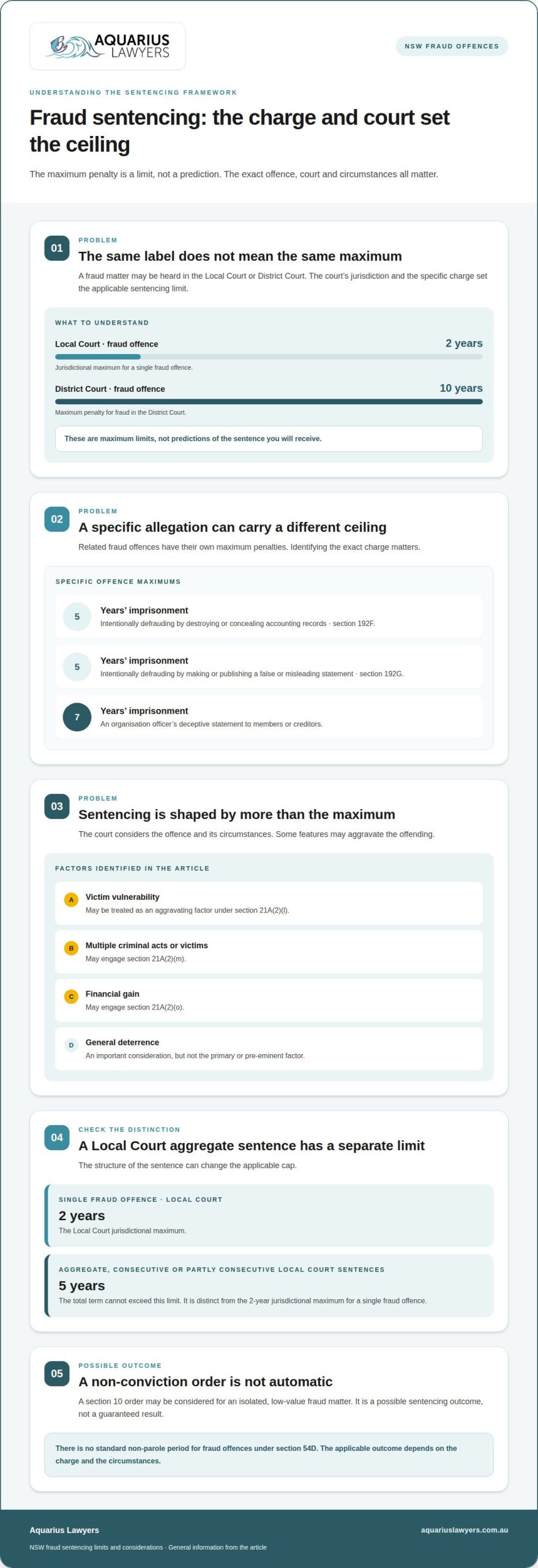
In the Local Court, the jurisdictional maximum for a fraud offence is 2 years’ imprisonment. In the District Court, fraud carries a maximum penalty of 10 years’ imprisonment. These are maximum limits, not predictions of the sentence you will receive.
Specific offences have separate maximums. Under section 192F, intentionally defrauding by destroying or concealing accounting records carries a maximum of five years’ imprisonment. Section 192G sets a five-year maximum for intentionally defrauding by making or publishing a false or misleading statement. An organisation officer’s deceptive statement to members or creditors carries a maximum of 7 years’ imprisonment.
Sentencing outcomes
Sentencing outcomes are the penalties imposed after a guilty finding or plea, within the limits that apply to the offence and court. The sentence depends on the charge and the circumstances of the offending.
General deterrence is an important consideration for NSW fraud offences, but it is not the primary or pre-eminent factor. The court may treat a victim’s vulnerability as aggravating under section 21A(2)(l) of the Crimes (Sentencing Procedure) Act 1999. Multiple criminal acts or victims within one offence may engage section 21A(2)(m), while financial gain may engage section 21A(2)(o).
Fraud offences have no standard non-parole period under section 54D. If the Local Court imposes an aggregate sentence, or consecutive or partly consecutive sentences, the total term cannot exceed 5 years. That limit differs from the Local Court’s 2-year jurisdictional maximum for a single fraud offence, so the sentencing structure matters.
Diversion and non-conviction orders
A fraud charge is not automatically dealt with through a diversion program. A section 10 non-conviction order is a separate sentencing outcome that may be considered for an isolated, low-value fraud matter.
A section 10 order allows the court to deal with the matter without recording a conviction, but it is not automatic. The court considers the specific offence and circumstances before it. If you are charged, understand how any available sentencing option applies before deciding how to respond to the charge.
Fraud by obtaining financial advantage or causing financial disadvantage
Section 192E of the Crimes Act 1900 (NSW) applies where a person, by deception, dishonestly obtains property or a financial advantage, or causes a financial disadvantage. The prosecution must establish the relevant conduct, dishonesty and connection between the deception and the outcome.
Financial advantage and disadvantage
A financial advantage can include gaining or keeping a benefit, temporarily or permanently. A financial disadvantage can also be temporary or permanent, and may occur directly or when deception induces a third person to act. This matters when the alleged benefit is not a cash payment. Retaining an advantage may be relevant even if it was initially obtained lawfully.
For example, an alleged false representation might induce someone to delay seeking repayment or cause an organisation to release funds. The question is whether the conduct caused the alleged advantage or disadvantage, not simply whether money changed hands. The action of a third person may form part of the chain if deception induced them to act.
The alleged disadvantage need not be permanent. A temporary loss of access to funds may be relevant, as may an induced decision that changes another person’s financial position. The court examines the circumstances and sequence: what was represented, who acted and what financial consequence followed.
Obtaining property or financial advantage
Section 192E covers dishonestly obtaining property or a financial advantage by deception. For this offence, property belongs to someone who possesses or controls it, or holds a proprietary right or interest in it. That definition can matter when property is held by a business or controlled by someone other than its legal owner.
Obtaining property can be alleged even if the accused was willing to pay for it. Payment does not, by itself, rule out an offence if the property was obtained dishonestly by deception. The court considers the circumstances of the transaction, including what was represented and how the property changed hands.
Section 192E(3) also allows particular sums of money or items obtained over time to be charged as one amount. For instance, separate alleged transfers may be combined in a charge. The charge’s framing matters because it identifies the property or financial advantage said to have been obtained and the conduct relied upon.
Elements of fraud
The elements under section 192E are deception, dishonesty, and obtaining property or a financial advantage, or causing financial disadvantage, by that deception. Each element matters: an inaccurate statement alone does not establish fraud unless the prosecution proves the required dishonest conduct and the alleged outcome.
In practical terms, the case turns on what deception is alleged, why it is said to be dishonest and what financial result it caused. If a third person acted, the prosecution must connect the deception to that action and its consequence. The charge may concern property, a retained benefit or a financial disadvantage.
Section 192E is distinct from sections 192F and 192G, which concern records and false or misleading statements. Those offences do not require an actual financial advantage to have been obtained. Identifying the precise section charged therefore helps clarify which alleged result the prosecution must prove.
Related fraud and dishonesty offences
NSW law includes offences involving dishonest conduct, false documents, accounting records and identity information. The charge depends on the conduct alleged and the provision relied on, so the offence name alone may not explain what the prosecution must prove.
Differences between related offences
Fraud under section 192E concerns dishonest conduct by deception, while larceny involves taking another person’s property; section 192E(4) allows fraud as an alternative to a larceny charge. Section 192C concerns obtaining property belonging to another, and identity crime offences under sections 192J-192L address dealings with identification information or document-making equipment.
“Obtaining property by deception” describes conduct that may be charged as fraud under section 192E, rather than a separate offence under that provision. Identity theft is a broad description; a charge may instead name a specific offence involving possession or use of identity information. Understanding how fraud and dishonesty offences in NSW differ matters because each provision has distinct elements and penalties.
For example, an alleged dishonest transfer may lead to a fraud charge, while taking property may be charged as larceny. Using another person’s identification information may result in an identity crime charge, even if that conduct is also part of an alleged fraud.
Fraud and dishonesty offence types
The Crimes Act 1900 contains fraud offences in sections 192E-192H, identity crime offences in sections 192J-192L, and forgery offences in sections 253-256. Other dishonesty offences include stealing and embezzlement. Section 192F concerns destroying or concealing records with intent to obtain property or a financial advantage, or cause financial disadvantage.
Section 192G makes it an offence to dishonestly make, publish or concur in making or publishing a statement. Section 192H concerns an organisation officer making a false or misleading statement with intent to deceive. Forgery offences in Part 5 include making or possessing equipment for producing a false document.
Identity-related charges also depend on the alleged conduct. Section 192J addresses dealing with identification information with intent to commit an indictable offence; section 192K concerns possession for that purpose; section 192L covers possessing equipment to make identification documents. The maximum penalty depends on the specific charge.
For fraud and dishonesty offences in NSW, police may investigate alleged transactions, accounting records, statements and identity information before laying charges. The charge identifies the conduct and legal provision relied on, and the prosecution must prove each element beyond reasonable doubt.
Possible defences depend on the charge and evidence. A genuine belief in a legal entitlement may support a claim of right. The evidence may also raise questions about whether the alleged deception was intentional or reckless, whether the conduct was dishonest, or whether the prosecution has proved the offence.
Aquarius Lawyers
Aquarius Lawyers can help you understand the charge, the evidence relied on and the legal issues raised by the alleged conduct. If you face fraud or dishonesty allegations, early advice can clarify the prosecution’s case, identify questions about intent or proof, and explain the options available in your circumstances.
That assessment can also consider how related allegations may affect your position, including claims involving records, statements or identity information. Clear advice helps you make informed decisions before taking the next step in criminal proceedings.
Contact Aquarius Lawyers to discuss your situation.
Take a clear next step
If you face fraud or dishonesty charges in NSW, consider how the allegations affect your decisions, records and day-to-day responsibilities. A considered legal response can help you understand the issues and make informed choices as your matter progresses.
For business owners, allegations may also raise separate questions about commercial dealings or industry operations. Aquarius Lawyers provides Commercial Law, as well as marine law, Fisheries Law and Aquaculture Law. Where these areas intersect with your circumstances, identifying the legal issues clearly can help distinguish them from the criminal charge.
Take the next step with advice tailored to your situation. Arrange to speak with Aquarius Lawyers about your matter, and move forward with a clearer understanding of your options.
Frequently Asked Questions
What is fraud?
Fraud is dishonest conduct involving deception that obtains property or a financial advantage, or causes financial disadvantage. Under section 192E of the Crimes Act 1900, the alleged deception may be directed at a person or operate through another person’s decision. For example, an allegation could concern a misleading instruction that prompts a business to release funds. The prosecution must prove every element beyond reasonable doubt.
In which court will fraud charges be heard in NSW?
Fraud charges may be dealt with in the Local Court or the District Court, depending on how the matter proceeds. The Local Court can deal with a fraud offence summarily, subject to its jurisdictional maximum. If the matter proceeds to the District Court, the available maximum differs. The court handling your case affects the sentencing limits, so identify the charge and court process early.
What conduct do fraud offences capture?
Fraud offences can capture dishonest deception involving property, financial advantage or financial disadvantage, as well as related conduct involving records or statements. For example, section 192F concerns destroying or concealing accounting records to defraud, while section 192G concerns a dishonest false or misleading statement. Identity information and forgery may lead to separate charges. The exact provision matters because each offence has its own elements.
What court handles a fraud case?
The Local Court commonly handles fraud matters, while a matter may proceed to the District Court following an election. The Local Court’s jurisdictional maximum for a fraud offence is 2 years’ imprisonment; the District Court maximum is 10 years’ imprisonment. These limits are not the sentence automatically imposed. The charge, election and sentencing circumstances determine the court pathway and the range of outcomes available.
What is a deception?
A deception is a representation through words or other conduct about fact or law. It can also include conduct that causes a computer or electronic device to respond without authorisation. For the relevant fraud provision, the conduct must be intentional or reckless. For instance, an electronic instruction may be alleged to be deceptive even without direct contact with another person. The context and evidence help establish what the conduct conveyed and how it operated.
What are the penalties for fraud and related dishonesty offences in NSW?
Maximum penalties vary by offence and court. Fraud under section 192E carries a maximum of 10 years’ imprisonment in the District Court, while the Local Court’s jurisdictional maximum is 2 years. Destroying records under section 192F and making a false statement under section 192G each carry a maximum of five years’ imprisonment. Identity offences have different maximums, so the specific charge is essential.
Disclaimer
Please note that legal rules change and this is not a substitute nor construed as legal advice. It is general information only.