
A boat seizure can disrupt a fishing operation before you know what happens next. If you’re deciding what to do if your boat is seized by AFMA, treat it as both an immediate vessel issue and a legal matter requiring a clear, documented response.
An AFMA boat declaration application has a specific purpose: it asks AFMA to declare a foreign boat to be an Australian boat. It does not resolve every consequence of a seizure. The application needs to explain the boat’s circumstances and intended operation so AFMA can assess it, while the seizure itself requires attention to the actions already taken.
This guide explains how a maritime lawyer can help shape the application and supporting evidence, assess the authority’s actions, and consider practical options for the vessel. The boat’s current status and the available records can affect what to do next. A structured legal response keeps separate issues distinct and gives you a clearer basis for deciding how to proceed.
Key Takeaways
- Assess whether an AFMA boat declaration is relevant: an applicant must establish lawful import for a limited period and sufficient Australian control over the boat’s operations.
- Organise evidence that links the boat’s import, ownership and operational arrangements to the proposed fishing activity.
- Set out the fishing plan clearly so AFMA can assess how the boat would be operated during the requested period.
- Distinguish a boat seizure from a declaration application. Legal advice can help assess the available options for the vessel and related fishing assets.
- Get advice promptly after a seizure so a maritime lawyer can review the circumstances, identify relevant records and address any applicable deadlines.
Evidence and fishing-plan details a lawyer needs for an AFMA boat declaration application
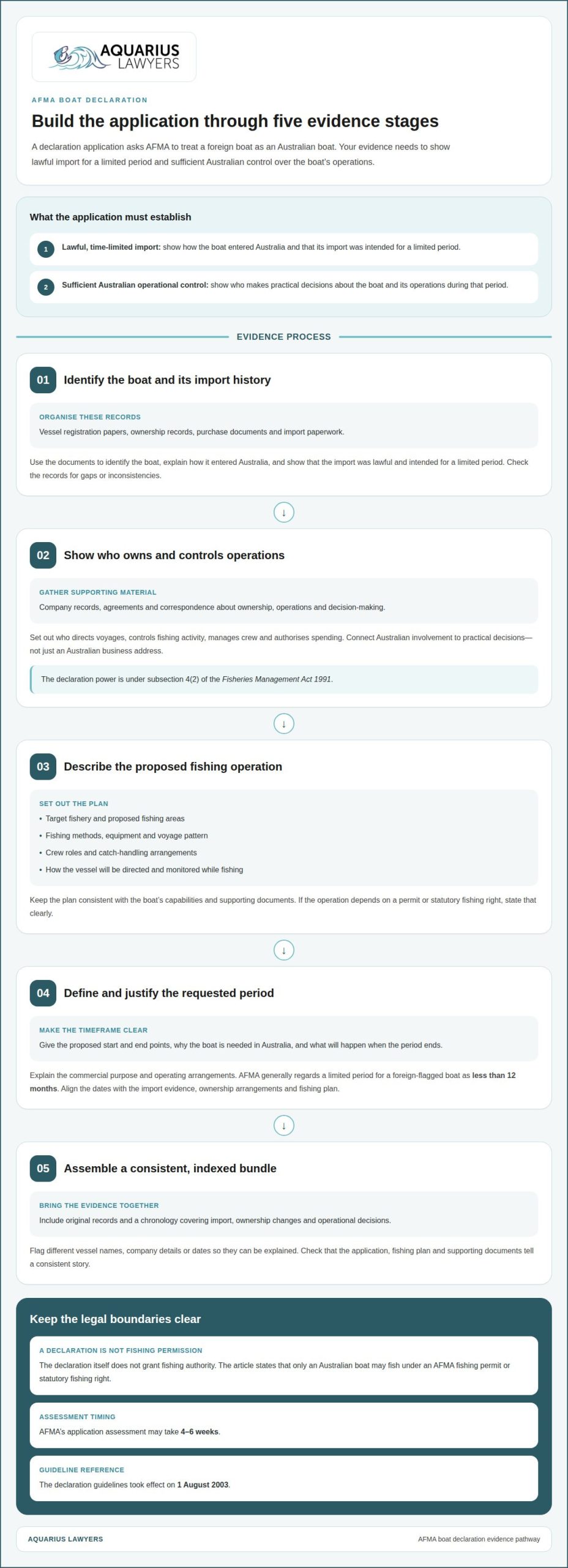
- Establish the boat’s identity and import history. Give your lawyer the vessel’s registration papers, ownership records, purchase documents and import paperwork. These records identify the boat and explain how it entered Australia. Include documents showing that the import was lawful and intended for a limited period. AFMA requires an applicant to establish lawful import for a limited period and sufficient Australian control over operations during that period. A lawyer can compare the paperwork with the proposed application and identify gaps or inconsistencies.
- Map ownership and operational control. Provide company records, agreements and correspondence showing who owns, operates and makes decisions about the vessel. Explain who directs voyages, controls fishing activity, manages crew and authorises spending. Evidence should connect Australian involvement to practical decisions, rather than relying only on an Australian business address. AFMA’s declaration power under subsection 4(2) of the Fisheries Management Act 1991 applies to a foreign boat. A lawyer can organise records to show how control would work throughout the requested period.
- Set out the proposed fishing plan. Give your lawyer a clear account of the intended operation. Identify the target fishery, proposed fishing areas, methods and equipment, voyage pattern, crew roles and catch-handling arrangements. Explain how the vessel would be directed and monitored while fishing. These details connect evidence of control to a practical operating proposal. Keep the plan consistent with the boat’s capabilities and supporting documents. If the plan depends on a permit or statutory fishing right, state that clearly rather than implying the declaration grants fishing authority.
- Define the requested period and explain why it is limited. Provide the proposed start and end points, why the boat is needed in Australia and what will happen when the period ends. AFMA generally regards a limited period for a foreign-flagged boat as less than twelve months. Explain the commercial purpose and operating arrangements for that period. A lawyer can check that the timeframe aligns with the import evidence, ownership arrangements and fishing plan, rather than presenting conflicting dates.
- Prepare a consistent, indexed application bundle. Give your lawyer the original records and a chronology of key events, including import, ownership changes and operational decisions. Flag documents that use different vessel names, company details or dates so those differences can be explained. AFMA’s application assessment may take 4-6 weeks. The declaration guidelines took effect on 1 August 2003. A lawyer can use those details to frame the application, explain its evidence and avoid treating the declaration itself as fishing permission.
What powers does AFMA have to seize a boat in Australia?
- Identify which authority took each action. AFMA may investigate alleged offences under the Fisheries Management Act 1991, but seizure events can involve other authorities. In March 2025, the Australian Border Force and AFMA intercepted Indonesian vessels near Croker Island. In May 2025, Australian authorities also apprehended Indonesian fishing vessels in northern Australian waters. Record which officers boarded the boat, who issued paperwork and which agency holds the vessel or equipment. These details help establish who made each decision.
- Separate a seizure from an AFMA boat declaration. A declaration under subsection 4(2) of the Fisheries Management Act 1991 concerns whether a foreign boat is treated as an Australian boat. It is not, by itself, a release order or permission to fish. Only an Australian boat may fish under an AFMA fishing permit or statutory fishing right. Ask your lawyer to assess the seizure action and any declaration issue as separate legal questions.
- Obtain the seizure and property records. Gather any notice, inventory, interview record or written explanation provided after officers boarded the vessel. Record which property was taken, including fishing equipment, catch, salt or other items. In May 2025, authorities seized fishing equipment from one vessel near Cartier Island. Near Ashmore Reef, authorities seized equipment and salt, then returned the catch to the ocean. The items affected can differ between operations.
- Check whether the vessel remains available for return. A seizure does not mean the boat will always be held for later release. In May 2025, all three intercepted Indonesian vessels were disposed of at sea in accordance with Australian law. In March and April 2025, two vessels intercepted near Croker Island were also disposed of at sea. Tell your lawyer promptly if officers have moved or disposed of the boat. The available options depend on what happened to the vessel and other seized property.
- Keep the alleged offence and evidence in view. AFMA investigated alleged offences against the Fisheries Management Act 1991 following the 2025 interceptions. Preserve documents about the voyage, fishing activity, crew, equipment and communications. Don’t assume that the presence of fishing gear proves a particular offence; the relevant circumstances and evidence matter. Your lawyer can compare the seizure records with the alleged conduct, identify inconsistencies and advise on the next legal step. This assessment also helps distinguish a challenge to the seizure from responding to an investigation.
AFMA may investigate alleged offences under the Fisheries Management Act 1991 following an interception, but the relevant conduct and evidence must be assessed before identifying an offence.
How can a maritime lawyer help get an AFMA seized boat released or returned?
- Confirm who holds the boat and why. A lawyer starts by identifying the authority involved, such as AFMA or the Australian Border Force. They review seizure notices, inventories and communications to establish the stated basis for taking the vessel. The Fisheries Management Act 1991 is relevant to alleged fisheries offences, but the specific action and documents matter. This first review helps direct requests to the authority responsible for the boat.
- Define what you want returned. Specify whether the request concerns the vessel, fishing gear, catch, records or another item. A lawyer can compare the seizure inventory with ownership documents, purchase records and vessel details. Different property may be held or dealt with separately, so a request for the boat should not assume that equipment or catch has the same status.
- Assess the seizure record against the alleged conduct. Your lawyer can examine what officers recorded, the location and circumstances of the interception, and the alleged offence. They can compare those details with voyage records, crew information, communications and fishing records. If the paperwork gives a different vessel name or owner, explain the discrepancy clearly. Focus on the actual grounds recorded, rather than relying on general claims about ownership.
- Prepare a practical proposal for release. A lawyer can set out where the vessel would be kept, who would control it and how its condition would be preserved. Supporting material may include ownership records, operational documents and details of the proposed arrangements. If a boat declaration is also sought, that application is distinct from a request for release. A declaration under subsection 4(2) of the Fisheries Management Act 1991 does not itself authorise fishing.
- Make a focused written request and track the response. Your lawyer can identify the relevant authority, state what property you seek and explain the supporting grounds. They can respond to requests for further information and maintain a record of communications. A clear chronology connects each document to the seizure and requested outcome. It also helps keep an AFMA investigation distinct from a separate property decision.
- Address the position if return is impossible. If the vessel has been disposed of, physical return is no longer an available outcome. A lawyer can establish what happened to the boat and identify any remaining property or decision that can still be addressed. They can also assess how the seizure relates to the ongoing investigation under the Fisheries Management Act 1991. The next step should match the vessel’s actual status and the records held by the relevant authority.
What deadlines apply when a maritime lawyer challenges an AFMA boat seizure in Australia?
- Have the seizure documents reviewed promptly. Give your lawyer every notice, inventory and communication from AFMA or the Australian Border Force. The wording may identify a decision, the responsible authority and any response date. Record when and how you received each document. These details help your lawyer assess the process and avoid overlooking a date stated in a notice.
- Separate the seizure issue from a declaration application. An AFMA boat-declaration application and a challenge to a seizure are different processes. AFMA advises that assessing a declaration application may take 4-6 weeks. That assessment period is not a deadline for challenging a seizure. Your lawyer should identify the action you want reviewed, the decision-maker and the procedure that applies before relying on any timeframe.
- Ask your lawyer to identify the applicable deadline. The next step depends on the decision being challenged, the authority involved and the available legal pathway. An AFMA notice may raise different issues from an Australian Border Force seizure record. Your lawyer can review the documents and identify any response date, review process or court timetable relevant to your case. Don’t assume the declaration assessment timeframe applies to these checks.
- Build a dated chronology for the legal review. Record the interception, boarding, seizure, notices received and later communications in order. Where possible, match each entry to a document, message or witness account. For example, note separately when officers took the boat and when the inventory arrived. A clear chronology helps your lawyer compare event dates with the notices and plan the next procedural step.
- Act quickly if the boat or property may be disposed of. Timing can affect what remedy remains practical. In May 2025, authorities disposed of three intercepted Indonesian fishing vessels at sea in accordance with Australian law. That example shows why the vessel’s current status matters. Ask your lawyer to establish whether the boat remains held, has been moved or has been disposed of, and to distinguish those facts from the status of equipment or catch.
- Keep every later date under review. Save new AFMA correspondence, investigation records and delivery details as they arrive. If a document gives a date for a response, send it to your lawyer immediately. A lawyer can then assess the decision and the relevant procedure together, rather than treating a general processing period as a filing deadline. For advice on a seizure and related fisheries issues, seek legal help with an AFMA boat seizure.
Aquarius Lawyers
Aquarius Lawyers can assess the legal issues arising from an AFMA boat seizure and help you consider a practical way forward. Its work in Marine Law, Fisheries Law and Aquaculture Law relates to the regulatory and commercial settings in which vessels operate. Advice can help you understand how the seizure may affect your wider business arrangements, not only the boat itself. It can also help you decide which legal issues need attention first and how to approach the next stage.
If an authority has seized your vessel, contact Aquarius Lawyers to discuss your situation. Bring the notices and correspondence you have received so the circumstances can be considered clearly. A focused discussion can help identify the questions to address and an appropriate next step.
Choose a clear path forward
The next decisions can shape how your business manages the disruption. Set priorities for the operation, such as communicating with business partners, coordinating staff or reviewing commitments affected by the vessel’s absence. Separate urgent commercial decisions from longer-term planning, and clarify who is responsible for each discussion. A coordinated approach can keep day-to-day decisions orderly while the legal matter progresses.
If you’re still weighing what to do if your boat is seized by AFMA, consider how immediate choices may affect the wider fishing business. For example, changes to staffing or supply arrangements may need to fit existing commercial commitments. Getting advice before making major decisions can help you assess these implications and plan a practical response.
Contact Aquarius Lawyers for advice about the legal issues affecting your vessel and business. A considered next step can help you move forward with greater clarity.
Frequently Asked Questions
How can a maritime lawyer help immediately if AFMA seizes your boat?
A maritime lawyer can assess whether the seizure paperwork identifies the correct owner, operator and vessel, then advise on communications and immediate operational decisions. If you’re unsure what to do if your boat is seized by AFMA, provide the lawyer with the notices and preserve related messages. They can also clarify who may speak for the business, helping keep communications accurate while the matter is assessed.
What documents and information should your lawyer request from AFMA after a boat seizure?
Your lawyer can ask AFMA for the legal basis and recorded reasons for the seizure, who authorised it, and the boat’s current location and custody status. They can also seek records of any transfer or handling of the vessel and property. This helps establish the sequence of decisions and identify whether other authorities or separate actions are involved.
Should you contact a maritime lawyer after AFMA seizes your boat?
Yes. If you’re deciding what to do if your boat is seized by AFMA, contact a maritime lawyer promptly to understand the available next steps. Early advice can help you manage communications and avoid assumptions about the vessel’s status. Keep notices, messages and voyage records together for review. Your lawyer can assess the circumstances and explain how the seizure may affect your vessel and fishing operation.
Disclaimer
Please note that legal rules change and this is not a substitute nor construed as legal advice. It is general information only.