
Could a missed notice date turn a manageable lease issue into a dispute? Rent, repairs, outgoings and permitted use can seem clear until the wording, records or applicable rules point in different directions. For businesses managing commercial lease obligations australia-wide, a reliable process starts with knowing who is responsible for what and when action is due.
You need more than a quick scan of the lease. Commercial and retail leases can be treated differently, and leasing laws vary between states and territories. Generic advice can be risky when a notice, proposed change or disputed responsibility could affect your position.
This guide explains where to find key obligations and how to read them in context. You’ll learn how to organise lease records, track notices and recurring duties, and respond when something is unclear. It also explains when a dispute or proposed change may call for legal advice. Clear responsibilities, reliable records and timely action can help you manage the lease and reduce avoidable disputes.
Key Takeaways
- Managing commercial lease obligations australia-wide starts with reading the signed lease alongside the law that applies where the premises are located.
- Don’t assume you’re responsible for every issue at the premises. Check how the lease allocates landlord, tenant and shared responsibilities.
- Build a lease register to track key duties, approval requirements, notices and dates, then assign someone to keep it current.
- If an obligation is unclear or disputed, identify the relevant clause and gather your records before responding.
- Distinguish a clarification request from an alleged breach, formal notice or proposed lease variation. Each may call for a different response.
What managing commercial lease obligations in Australia involves
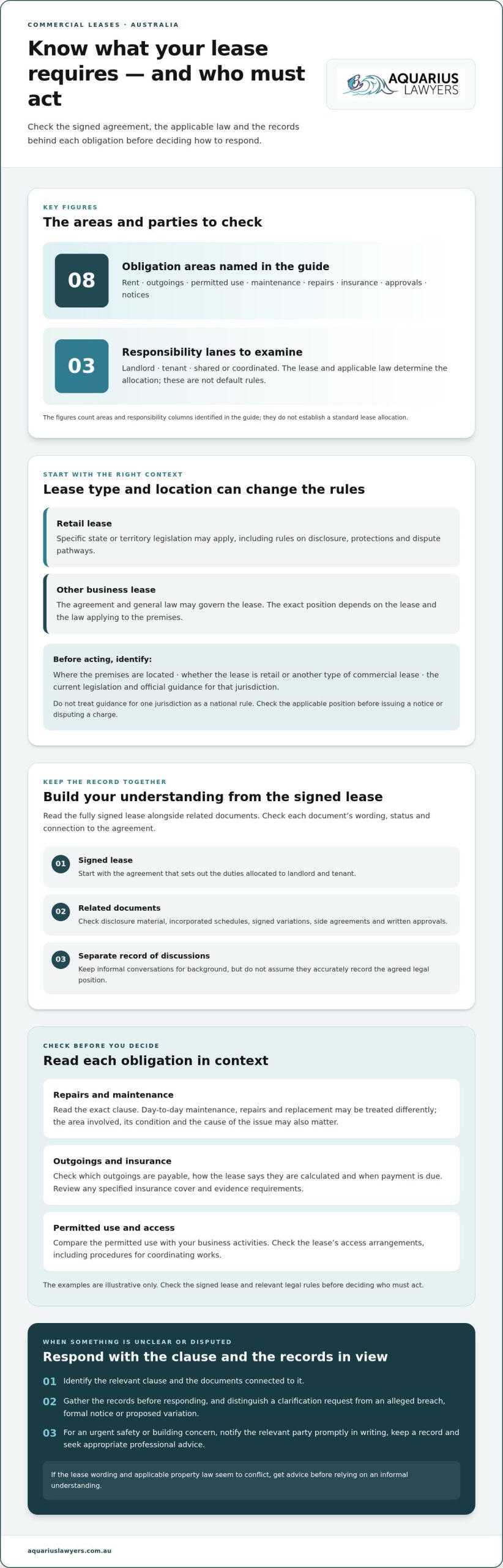
Lease obligations are the duties allocated to a landlord or tenant by the signed lease and applicable law. They may cover rent and outgoings, permitted use, maintenance, repairs, insurance, approvals and notices. The exact allocation depends on the lease wording, the premises and the law that applies in the relevant state or territory.
The signed lease is central, but applicable law may also affect your obligations. Managing commercial lease obligations across Australia means reading the agreement in its legal and practical context, rather than assuming a responsibility applies the same way everywhere.
Which documents set out your lease obligations?
Start with the fully signed lease, then read it alongside related documents. These may include disclosure material, schedules incorporated into the lease, signed variations, side agreements and written approvals. Keep the documents together so you can trace which terms apply and when they changed.
- Check which schedules the lease incorporates, including those that set out premises details or other agreed terms.
- Store signed variations and written approvals with the lease, and note the clause or activity each relates to.
- Keep a separate record of informal discussions. A conversation may explain the background, but it may not accurately record the agreed legal position.
Don’t assume every related document changes the lease. Check its wording, status and connection to the signed agreement. If documents appear inconsistent, get advice before relying on an informal understanding.
Why Australian state and territory differences matter
Retail leases may be covered by specific state or territory legislation, while other business leases may be governed mainly by the agreement and general law. The lease classification matters because statutory protections, disclosure rules and dispute pathways can differ by jurisdiction. Guidance written for one jurisdiction should not be treated as a national rule.
Rules can also affect particular obligations, including whether certain outgoings can be recovered from a tenant. The position may depend on the type of lease and the law that applies to the premises, so don’t rely on a general assumption about who pays.
Before acting, identify the property’s jurisdiction and whether the lease is retail or another type of commercial lease. Check current legislation and official guidance for that jurisdiction, especially before issuing a notice or disputing a charge. If the wording and applicable property law seem to conflict, property legal advice can help clarify how the documents fit together.
Are you responsible for everything at the premises?
No. Your business doesn’t automatically take responsibility for every part of the premises simply because you occupy it. Allocation depends on the lease wording, applicable law and circumstances, including the type and condition of the item or area involved. Check each clause rather than assuming it applies in the same way to every lease.
The examples below are illustrative only. They don’t set out a default legal allocation. Check the signed lease and any relevant legal rules before deciding who must act.
| Area to check | Landlord | Tenant | Shared or coordinated |
|---|---|---|---|
| Repairs and maintenance | Illustrative only: a clause may allocate some building repairs to the landlord. | Illustrative only: a clause may require the tenant to handle specified day-to-day maintenance. | Illustrative only: access and repair work may need to be coordinated between the parties. |
| Permitted use and access | Illustrative only: the lease may set out access arrangements for the landlord. | Illustrative only: the tenant may be limited to the permitted business use. | Illustrative only: arranging access for works may require both parties to follow lease procedures. |
| Insurance and outgoings | Illustrative only: the lease may assign certain insurance or outgoing responsibilities to the landlord. | Illustrative only: the tenant may have specified payment or insurance duties. | Illustrative only: the lease may require information or action from both parties. |
How do repair and maintenance clauses divide responsibility?
Read the exact wording. Day-to-day maintenance, repairs and replacement may be treated differently, and a clause may distinguish between parts of the premises or types of work. The condition of the premises and the cause of the issue may also matter. If there’s an urgent safety or building concern, notify the relevant party promptly in writing, keep a record and seek appropriate professional advice.
How should you read outgoings, insurance and permitted-use clauses?
Check which outgoings are payable, how the lease says they’re calculated and when payment is due. Review insurance clauses on their own terms, including any specified cover or evidence requirements. Then compare the permitted use with what your business actually does. A change in activities can raise a lease issue, so clarify the position before proceeding.
If a clause leaves responsibility uncertain or the parties disagree about what it requires, a review of your property obligations can help you assess the wording and applicable law before responding.
How to organise commercial lease obligations after signing
A signed lease is useful as a management tool only if your team can find the relevant duty, identify who must act and see when action is due. A lease register records duties, owners, dates and supporting documents. It turns dense clauses into trackable tasks without replacing the lease itself.
Build the register using this workflow:
- Extract each duty. Note the clause and summarise the required action in plain English, such as arranging specified maintenance or seeking consent before a particular change.
- Assign an owner. Name the person responsible for monitoring or completing the task. If a duty needs input from a landlord, tenant or contractor, record who must coordinate it.
- Record dates and triggers. Capture fixed due dates and events that start a time limit, such as receiving a notice or planning works. Check the lease for the applicable timing rather than assuming a standard period.
- Save evidence. Keep relevant notices, approvals, maintenance requests, responses, invoices and other supporting records with the obligation they relate to.
- Review changes. Update the register when a signed variation, written approval or other relevant document changes the position. Keep prior versions so you can follow the history.
What should a commercial lease obligation register contain?
Include the clause reference, duty, responsible person, date or trigger, required notice method and documents to retain. Add renewal options, permitted-use limits, maintenance duties and approval requirements. Set a review routine based on the lease’s dates and events, rather than applying a universal timetable. This makes upcoming actions visible while reminding your team to check the actual clause.
How can you handle notices, requests and changes in writing?
Use the notice method and recipient specified in the lease, and retain proof of sending and delivery where available. File maintenance requests, landlord responses, approvals and signed variations somewhere accessible. Keep a clear timeline and record the premises’ condition where relevant. Written records help distinguish what was requested, what was approved and what remains unresolved.
Good records help your team act consistently, but an unclear clause or disputed responsibility may still need legal interpretation. For a practical review of property-related lease obligations, get advice on your property obligations.
What to do if a lease obligation is unclear or disputed
An unclear clause, disputed charge or unexpected request can become a bigger issue if you respond before checking the documents. When managing commercial lease obligations, take a measured approach: identify the relevant clause, gather the records and establish exactly what the other party is asking you to do.
Before replying, describe the issue in plain terms. Note the clause or document involved, the conduct or decision in question, key dates and what you need clarified. Gather the signed lease, any variation or approval, relevant notices and correspondence, and records of steps already taken. Keep original documents intact and prepare a clear timeline.
Be precise about the type of communication you’re dealing with. A clarification request asks what a clause means or how a process works. An allegation of breach asserts that an obligation hasn’t been met. A formal notice may trigger a response period or other consequences under the lease or applicable law. A proposed variation seeks to change the agreement. Don’t treat one as another, and don’t assume a discussion changes the written lease.
What should you do if you receive a breach notice?
Read the notice against the lease. Identify the conduct alleged, the clause cited, the response requested and any stated timeframe. Preserve relevant communications and records, including evidence of the issue and steps taken to address it. Don’t ignore the notice, but avoid admissions or promises before you understand its terms and legal significance. If the timeframe is unclear or approaching, seek advice promptly.
When can commercial lease legal advice help?
Advice may help when repair duties are disputed, outgoings are challenged, your business activity may fall outside the permitted use, or the other party proposes a lease variation. The implications can depend on the wording, supporting documents and the law that applies to the premises. A careful review can help you understand the issues and consider a measured response without assuming a particular outcome.
Aquarius Lawyers provides commercial and property legal services to support practical, strategic decision-making on lease questions. If an obligation is disputed or the implications are significant, a Legal Strategy Session can help you assess the position and plan your next steps. Learn about Aquarius Lawyers’ legal services.
Make your next lease decision with confidence
Your lease should support the way your business needs to operate, not leave you guessing about your next move. As your plans develop, pause before agreeing to a change or acting on an uncertain interpretation. A considered decision can help you manage risk and keep your business priorities in view.
Where the legal and commercial implications aren’t clear, practical advice can help you assess your options and decide what to do next. Aquarius Lawyers is led by Principal Solicitor Katherine Hawes, with a focus on clear, strategic guidance for the circumstances of your matter.
Take a clear next step with advice focused on your situation. Book a Legal Strategy Session.
Frequently Asked Questions
Is a commercial lease legally binding after signing?
Generally, yes. A signed commercial lease can create contractual obligations, but its legal effect depends on the document, the circumstances and applicable law. Confirm you’re reviewing the complete final version and that the parties named in it match the entities involved in the tenancy. If a signature, commencement condition or clause raises doubt about whether the agreement operates as intended, get legal advice before relying on an assumption.
Can a landlord change commercial lease obligations without the tenant’s agreement?
There’s no blanket answer. The lease and applicable law determine whether a change can be made and how. Consider what the proposal would alter in practice, such as how you operate from the premises or meet a payment obligation. A request may differ from a change made under an existing lease mechanism. Before adjusting your business arrangements, understand the legal basis for the proposed change and whether it affects your rights.
Who is responsible for repairs in a commercial lease?
The lease and applicable law determine responsibility, which may depend on the type of work and the circumstances. Separate the immediate work needed to address a fault from the question of who ultimately bears responsibility. For example, arranging access for a technician doesn’t by itself establish who must pay or replace equipment. Consider how the issue affects the premises and business operations, and clarify responsibility before authorising substantial work where it’s safe to do so.
Are retail lease obligations the same across Australia?
No. Whether a lease qualifies for retail leasing protections can depend on the relevant legislation’s definitions and exclusions, not simply how a business describes itself. A shop, service business or mixed-use premises may need closer classification under the rules that apply where the property is located. Check the current official guidance for that jurisdiction before relying on a general retail leasing rule, particularly if the lease’s status affects your rights or obligations.
What should I do if I cannot meet a commercial lease obligation?
Assess the practical impact and identify what you can realistically do, and by when, before deciding how to respond. If a required activity cannot happen as planned, consider whether an alternative arrangement could meet the obligation without breaching another lease term. Don’t treat a proposed workaround as accepted unless the necessary agreement is in place. If the issue could affect continued occupation or business operations, seek legal advice before committing to a course of action.
Disclaimer
Please note that legal rules change and this is not a substitute nor construed as legal advice. It is general information only.