
A vessel can carry legal risk that isn’t obvious from its registration or sale documents. If you’ve searched “what is a maritime lien australia”, you may be trying to find out whether an unpaid claim could follow a vessel, even after ownership changes.
Not every unpaid debt creates a maritime lien. Under the Admiralty Act 1988 (Cth), a maritime lien can arise from specific recognised events and may attach to the vessel. It is different from a mortgage and from other statutory maritime claims, which can have different legal effects and priorities.
This guide explains what a maritime lien may mean for your vessel or transaction, how it differs from other claims, and what facts and documents to check before you act. The claim’s legal basis, the vessel’s ownership history and the timing of events can all matter when assessing sale or enforcement risks. If a claim could affect your maritime assets, specialist marine law advice can help you assess the vessel-specific facts before making a decision.
Key Takeaways
- To understand what is a maritime lien australia, check whether the claim falls within a category recognised under Australian law.
- Distinguish a maritime lien from a statutory maritime claim or registered ship mortgage. Each has a different legal basis and connection to the vessel.
- Before buying or selling, review the claim details, vessel records and transaction documents rather than relying on an allegation alone.
- An alleged lien does not automatically mean a vessel will be arrested. Vessel arrest is a legal process that requires careful assessment.
- If a claim could affect your vessel or transaction, organise the relevant documents and seek specialist marine law advice before acting.
What is a maritime lien in Australia, and what can it mean for a vessel?
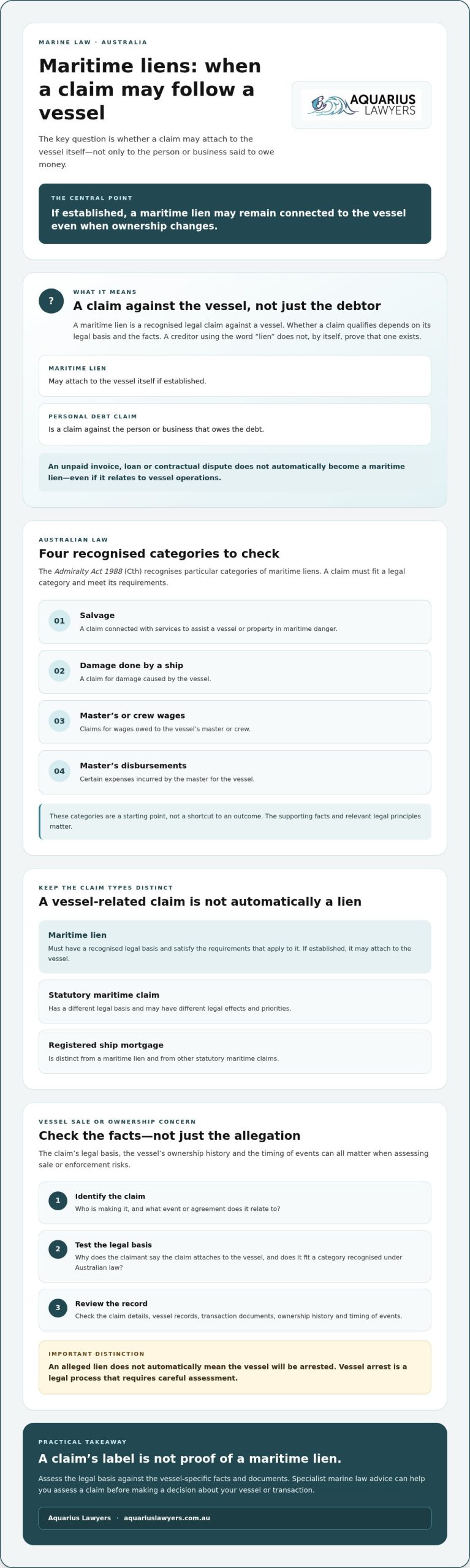
If you’re asking “what is a maritime lien australia”, the key issue is whether a claim may attach to the vessel itself, rather than only to the person or business said to owe money. A maritime lien is a recognised legal claim against a vessel. If established, it may remain connected to the vessel even if ownership changes. That can matter to owners and buyers, but an allegation alone does not prove a lien exists or determine what a court will do.
In plain terms, a maritime lien may give a creditor a claim against the vessel as property. The phrase maritime lien is also used in international maritime law, but a general overview cannot determine whether a particular claim qualifies under Australian law. The claim’s legal basis and the facts matter.
How is a maritime lien different from an ordinary debt?
A maritime lien is a claim against the vessel itself; a personal debt claim is a claim against the person or business that owes the debt. That distinction can affect how a creditor may pursue a claim, but it does not mean every unpaid invoice or loan is secured against a vessel.
An ordinary debt does not automatically become a maritime lien just because it relates to vessel operations, such as routine mechanical maintenance arranged with providers like Panama Ship Service during international transit. Its legal character depends on the facts and whether it has a recognised legal basis. Do not rely on a creditor’s use of the word “lien” as proof that the vessel is legally subject to one.
Who may need to understand maritime liens?
If you own a vessel or operate a marine business, a claim said to attach to the vessel may affect decisions about its use, sale or ownership. If you’re considering a purchase, understand the claim before proceeding. Creditors also need to distinguish a claim against a debtor from one that may be pursued against a vessel.
The issue can arise during a dispute, a sale or a change in ownership. That does not mean every vessel transaction involves a lien or an undisclosed claim. Assess each concern on its own facts rather than assuming the vessel is clear or encumbered based only on an allegation.
Start by identifying who is making the claim, what event or agreement it relates to, and why they say it attaches to the vessel. Those details are a more useful starting point for legal assessment than the label alone. Next, check which claims Australian law recognises as maritime liens.
How can a maritime lien arise under Australian law?
The Admiralty Act 1988 (Cth) is central to Australian admiralty law. It recognises particular categories of maritime liens, but a claim must fit a legal category and meet its requirements. If you’re searching “what is a maritime lien australia”, the practical question is not just what a creditor calls the claim, but whether the law treats it as a lien against the vessel.
Which claims may qualify as maritime liens?
Australian law recognises maritime liens associated with:
- Salvage: a claim connected with services to assist a vessel or property in maritime danger.
- Damage done by a ship: a claim for damage caused by the vessel.
- Master’s or crew wages: claims for wages owed to the vessel’s master or crew.
- Master’s disbursements: certain expenses incurred by the master for the vessel.
These categories are a starting point, not a shortcut to an outcome. Whether a particular claim fits depends on the supporting facts and relevant legal principles. For an overview of Australian law and claims that do not qualify as maritime liens, see this guide to Australian shipping laws and regulations, including its discussion of unpaid bunkers and the Sam Hawk case.
Does every vessel-related claim create a lien?
No. An unpaid invoice, loan or contractual dispute does not automatically become a maritime lien because it concerns a vessel. For example, a supplier’s claim for unpaid fuel may relate directly to a ship, but that connection alone does not establish a lien under Australian law.
A claim’s label alone does not establish a maritime lien. The claim must have a recognised legal basis and satisfy the requirements that apply to it. Keep the underlying claim separate from the remedy a creditor may seek. A debt may be enforceable against a person or business without being a lien against the vessel.
When assessing a demand, sale or ownership issue, consider what happened, who incurred the obligation, which documents support the claim and how Australian law characterises it. These are factual and legal questions, not matters a label can settle.
If a claim may affect your vessel or a transaction, gather the relevant agreements, invoices and correspondence. Then seek advice on the claim’s legal basis and the vessel-specific facts. Speak with a marine law solicitor before treating an alleged lien as established or dismissing it as an ordinary debt.
Maritime lien, statutory maritime claim or mortgage: what is the difference?
These terms describe different legal interests, so do not treat them as interchangeable when assessing a vessel or transaction. The Admiralty Act 1988 (Cth) provides for maritime liens and a broader range of statutory maritime claims. A ship mortgage is a separate form of security. The distinction matters because the legal basis, connection to the vessel and available steps may differ.
If you’re asking “what is a maritime lien australia”, this comparison is a starting point, not a decision about a particular vessel. Check the relevant documents and facts against the law.
| Type of interest or claim | Legal basis | Possible connection to the vessel | What to verify |
|---|---|---|---|
| Maritime lien | A recognised category of maritime lien under Australian law. | May attach to the vessel itself, rather than only to the person who incurred the liability. | Whether the claim fits a recognised category and satisfies the applicable legal requirements. |
| Statutory maritime claim | A claim within the categories set out in the Admiralty Act 1988 (Cth). | May support a claim against a vessel in appropriate circumstances, but does not necessarily amount to a maritime lien. | Whether the claim falls within the Act, who owned the vessel when proceedings begin, and what legal process may apply. |
| Registered ship mortgage | A security interest created under a mortgage arrangement and, where applicable, recorded in relevant vessel records. | May give the mortgagee rights connected with the vessel under the arrangement and applicable law. | The mortgage terms, vessel records, current ownership details and any other interests that may affect the position. |
How does a maritime lien differ from a statutory maritime claim?
A statutory maritime claim is a broader legal category, not another name for a maritime lien. The Admiralty Act 1988 (Cth) identifies claims that may be pursued through admiralty proceedings, but a claim’s inclusion in the Act does not, by itself, establish that it is a lien or attaches to the vessel. The particular provision, ownership facts and nature of the claim require assessment.
How is a ship mortgage different from a maritime lien?
A mortgage is based on a security arrangement, while a maritime lien arises from a recognised legal basis. Review the mortgage document and relevant vessel records alongside sale and ownership documents. Do not assume that registration, a lien allegation or either party’s description settles priority or enforcement. Those questions depend on the applicable law and the specific facts.
For broader context on Australian marine law, see the Australian marine law overview. If a vessel transaction or claim depends on how these interests interact, have the documents and vessel-specific facts assessed before you act.
How can a maritime lien affect a vessel sale or enforcement action?
An allegation can raise important questions during a sale, but it does not establish that a maritime lien exists or determine what happens to the vessel. A recognised lien may remain connected to a vessel after ownership changes, so a buyer should not assume a transfer alone resolves the issue. The effect of any claim depends on its legal basis and the specific facts.
Vessel arrest is a court process, not an automatic result of someone alleging a lien. A creditor seeking to enforce a claim must follow the applicable legal process. The court’s response depends on the claim and circumstances, so do not treat a demand letter or disputed invoice as proof that a vessel will be arrested or sold.
What should a vessel buyer check before completing a purchase?
Use a structured review before committing to a purchase. Ask the seller about known disputes, claims or enforcement steps, and examine available records and transaction documents. No single document should be treated as conclusive without checking its legal effect.
- Review available vessel ownership and registration records.
- Check finance documents, including any mortgage or security arrangement disclosed to you.
- Read the sale agreement and related correspondence for references to claims, disputes or outstanding obligations.
- Ask whether any claim or enforcement action has been disclosed, and request relevant supporting documents.
- Arrange independent legal review if a potential claim could affect the vessel or transaction.
Records can help identify issues, but they may not show whether a particular claim qualifies as a maritime lien or how it affects a proposed sale. Review each document’s legal effect alongside the vessel’s ownership history and the facts behind the claim.
What should an owner or creditor do when a lien is alleged?
Act methodically. Preserve relevant contracts, invoices, correspondence and vessel records. Confirm who is making the claim, what event or agreement it relates to, and the legal basis they say supports it. Do not assume the allegation proves either a lien or an underlying debt.
For buyers, owners and creditors, the practical sequence is the same: identify the claim, verify the documents, assess the vessel-specific facts, then get legal advice before deciding whether to sell, pay or pursue enforcement. If a vessel transaction or dispute is affected, seek advice on marine law issues before you act.
What should you do if a maritime lien may affect your vessel?
Whether you’re buying a vessel, dealing with a creditor’s demand or considering enforcement, take the same practical steps: organise the evidence, clarify the claim and get advice before relying on an assumption. A search for “what is a maritime lien australia” can explain the concept, but it cannot determine whether a particular claim attaches to your vessel.
What information can help a marine law solicitor assess the issue?
Prepare a clear file so a solicitor can assess the legal basis of the claim alongside the vessel-specific facts. Organise:
- Vessel identification, ownership and available registration documents.
- Relevant sale, finance, service or other contracts, along with invoices and correspondence.
- A timeline of the events, transaction or dispute, including when the claim arose and who was involved.
- Any notices, court documents or communications about enforcement.
Keep sensitive documents private. Do not post them publicly or assume that a single record settles the legal position. Your solicitor can advise which documents matter and how they should be considered together.
When should you seek legal advice about a maritime lien?
Seek advice before relying on an alleged lien in a sale, dispute or enforcement matter. A buyer may need to understand a claim before proceeding; an owner may need to respond to a demand; and a creditor may need to assess whether the legal basis supports the action they are considering.
Early document review can help identify the issues, distinguish an allegation from an established legal right, and clarify possible next steps. It cannot guarantee a particular result. The outcome depends on the applicable law and the facts of the matter.
Aquarius Lawyers provides marine law advice nationally in Australia, with experience in marine, fisheries and aquaculture matters. Principal Solicitor Katherine Hawes is known as The Fish Lawyer. For advice focused on your vessel, transaction or claim, speak with Aquarius Lawyers about a marine law issue.
Check the claim before you make your next move
Understanding what is a maritime lien australia starts with separating a recognised claim against a vessel from an ordinary debt, a statutory maritime claim or a mortgage. The label a creditor uses is not enough to establish a lien. The claim’s legal basis, supporting documents and vessel-specific facts all matter.
If you’re buying, selling or operating a vessel, review the available ownership, finance and transaction records, and keep relevant correspondence and notices together. Do not assume an ownership change removes a claim or that an allegation automatically means the vessel will be arrested. Get advice before relying on an assumption in a transaction or dispute.
Aquarius Lawyers provides marine law advice nationally in Australia, with experience in marine, fisheries and aquaculture matters. A careful review can help you understand the issues and consider an appropriate path forward, without guaranteeing a particular outcome.
Speak with Aquarius Lawyers about a marine law issue. Get advice on the claim and documents before making your next decision.
Frequently Asked Questions
What is a maritime lien in Australia?
If you’re asking “what is a maritime lien australia”, it is a recognised legal claim that may attach to a vessel because of particular circumstances. It is not simply another name for an unpaid debt. The Admiralty Act 1988 (Cth) is relevant, but whether a claim qualifies depends on its legal basis and facts. Check the applicable Australian law and get legal advice before treating an alleged lien as established.
Does a maritime lien stay with a vessel after it is sold?
A valid maritime lien may have consequences beyond a change in ownership, but the effect depends on the claim and applicable law. Do not assume a sale automatically removes a claim or that every allegation binds a buyer. Before completing a purchase, review available ownership and registration information, transaction documents and details of the claim. Ask a marine law solicitor to assess whether the alleged lien is valid and how it may affect the transaction.
Can a creditor place a maritime lien on any vessel?
No. A creditor cannot create a maritime lien just by using that label. The claim must have a recognised legal basis, and its connection to the vessel must be assessed under Australian law. An unpaid invoice may support a debt claim without necessarily creating a lien. Check the underlying agreement, invoice and related correspondence, then seek legal advice about the specific circumstances before treating the claim as secured against the vessel.
Is a maritime lien the same as a ship mortgage?
No. A maritime lien and a ship mortgage are distinct legal concepts with different sources and requirements. A mortgage is a form of security created under an arrangement; a maritime lien may arise from legally recognised circumstances. Review the mortgage documents and relevant vessel records to understand what interests may exist. Do not assume one automatically ranks ahead of the other, as any priority question depends on applicable law and the facts.
Can a maritime lien lead to a vessel being arrested?
Vessel arrest is a formal legal process, not an automatic result of someone alleging a maritime lien. Whether a proceeding may be available depends on the claim, supporting evidence, jurisdiction and applicable procedure. If you own the vessel or are asserting a claim, get legal advice before taking action or responding to an arrest application. An allegation alone does not prove that a lien exists or determine what a court will decide.
How can I check whether a vessel has a maritime lien?
Start by organising the vessel’s ownership and registration information, sale documents, finance records, relevant contracts and correspondence. These materials may help identify claims or other interests, but they may not answer whether a maritime lien exists. Make a timeline of relevant events and note any notices or enforcement communications. A marine law solicitor can review the material and assess the claim under current Australian law.
What is the difference between a maritime lien and a statutory maritime claim?
A maritime lien is distinct from a statutory maritime claim. The Admiralty Act 1988 (Cth) provides for different types of maritime claims, but a claim covered by the Act does not automatically qualify as a lien attaching to a vessel. The distinction may affect how a dispute is analysed and what legal steps may be available. Check the relevant statutory provisions and authorities for the specific claim.
Do I need a marine law solicitor if a lien is alleged against my vessel?
Legal advice can help you assess whether the claim has a recognised basis, which documents matter and what steps may be available. Seek advice before relying on an allegation in a vessel sale or dispute, or when responding to enforcement steps. A solicitor can consider the claim alongside the vessel-specific facts. The outcome depends on the law and evidence; an allegation alone does not establish a lien or liability.
Disclaimer
Please note that legal rules change and this is not a substitute nor construed as legal advice. It is general information only.