
The location of a dispute is only part of the picture. A property dispute lawyer can help you assess the issue, understand your options and plan a response that fits the facts of your case.
You may be dealing with a disagreement over a home, commercial property, boundary, fence or tree. The documents, each party’s position and whether the issue can be resolved through negotiation, mediation or litigation all shape the work involved. Clear advice early can help you make informed decisions and avoid steps that complicate the dispute.
This article explains what can affect the scope of legal work and how lawyers approach domestic and commercial property matters, including boundary, fencing and tree disputes. You’ll also learn what to expect when seeking representation, what information can help a lawyer assess your matter, and how to identify a practical way forward.
Key Takeaways
- The work involved depends on the dispute, the documents and whether negotiation, mediation or litigation is needed.
- For domestic and commercial matters, identify the property issue and the outcome you want legal advice to address.
- Boundary, fencing and tree disagreements can turn on the property details and the parties’ competing positions.
- Choose a lawyer who can explain the available pathways and the practical implications of each option.
- Organise relevant title documents, contracts and correspondence so a lawyer can assess the matter more clearly.
Getting legal advice for my Chatswood property dispute
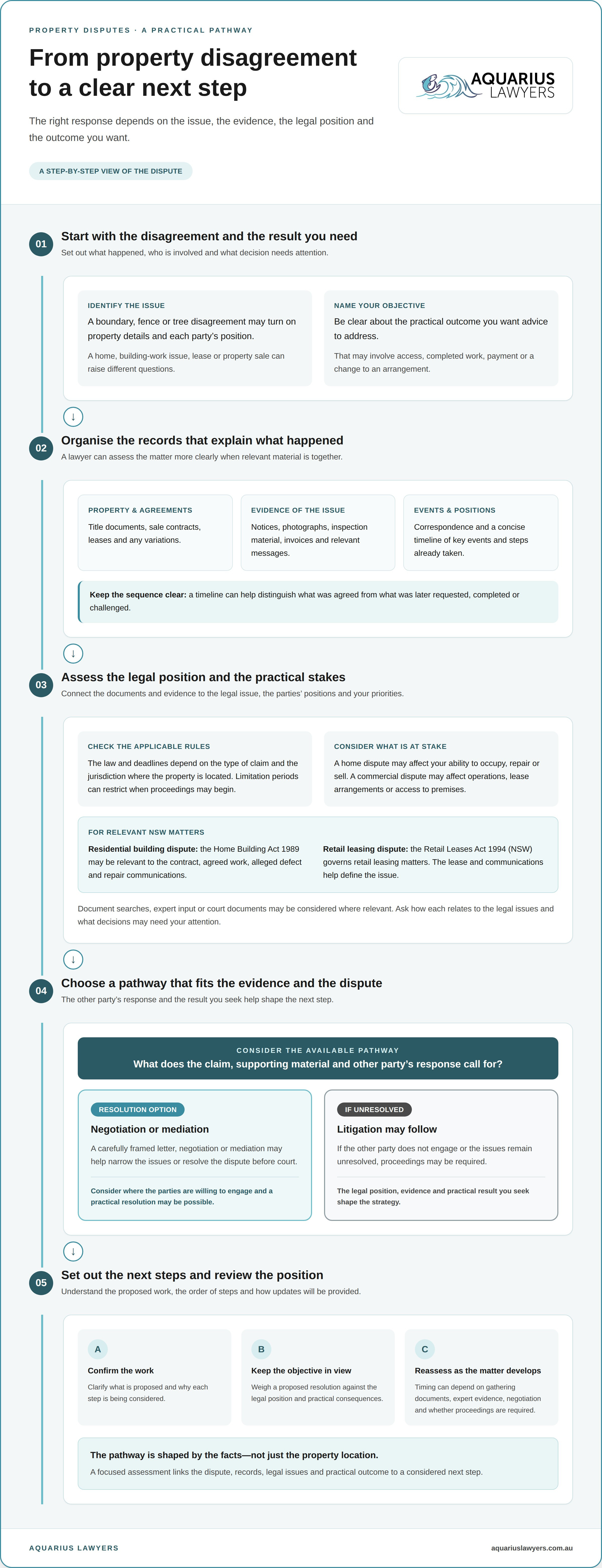
The steps in a property dispute depend on the claim, the documents and the outcome you seek. Whether you are dealing with a local matter or searching for a property dispute lawyer Chatswood clients and property owners across Australia rely on, our team at Aquarius Lawyers can identify the central disagreement, the people involved and any action already taken. A title issue affecting one parcel calls for a different analysis from a commercial dispute involving several agreements and parties.
At a consultation, explain what happened and what decision you need help making. Relevant records may include title documents, sale contracts, notices, photographs and correspondence. For example, a letter demanding repairs may clarify whether the dispute concerns work quality, an agreement or both. A short timeline can show how the disagreement developed.
Ask the lawyer to explain the proposed work, the order of next steps and how you’ll receive updates. If document searches, expert input or court documents may be relevant, ask why each is being considered. This helps you understand how the evidence relates to the legal issues and which decisions may need your attention.
To keep the matter focused, identify the outcome you want and the facts that support it. A carefully framed letter or negotiation may help narrow the issues before court documents are prepared. If the other party does not engage, the next step may change. The strategy should reflect the evidence, the legal position and the practical result you seek.
Laws and deadlines depend on the type of property claim and the jurisdiction where the property is located. Limitation periods can restrict when proceedings may begin. Legal advice should identify which rules apply to your claim and the relevant events, so you can make informed decisions about timing.
A lawyer can help explore resolution before court by reviewing the evidence, explaining your options and communicating with the other party. Negotiation or mediation may resolve some disputes, while unresolved issues may proceed to litigation. The appropriate pathway depends on the claim, supporting material and the other party’s response.
For a consultation, provide relevant agreements, notices and correspondence, along with a timeline of key events. Explain what you want to achieve and any steps already taken. If a sale has stalled, for example, include communications about the proposed settlement and identify the decision that needs legal attention.
Access to legal aid or free advice depends on the service’s eligibility rules and the type of matter. Before relying on a service, clarify what assistance it provides and whether you meet its criteria. A lawyer can explain the legal issues and help identify the kind of support that may address them.
Property disputes have no single timetable. The time involved can depend on how quickly documents are gathered, whether expert evidence is needed, the parties’ willingness to negotiate and whether proceedings are required. After reviewing the dispute and the other party’s position, a lawyer can outline the likely stages.
Domestic and commercial property matters
A dispute involving a home can affect your ability to occupy, repair or sell it. A commercial property disagreement can disrupt business operations, lease arrangements or access to premises. Start by identifying the property, the parties involved and the decision you need to make. Incomplete building work, for example, raises different questions from a dispute over a business tenant’s lease obligations.
For a residential building dispute, the Home Building Act 1989 is relevant. The legal assessment may consider the contract, the work agreed, the alleged defect and communications about repairs. A lawyer can advise on the issues raised by those documents and help frame a practical response. An inspection or expert evidence may also be relevant, depending on the dispute and the remedy sought.
Retail leasing disputes call for close attention to the lease and the parties’ communications. The Retail Leases Act 1994 (NSW) governs retail leasing matters. Issues may concern rent, permitted use, repairs, fit-out work or a disagreement about ending the lease. A lawyer can assess the relevant terms and advise how to raise the issue, respond to a claim or pursue a resolution.
Commercial property matters can involve more than the premises themselves. A lease may sit alongside a sale contract, guarantees, fit-out arrangements or agreements about shared access. If a landlord alleges that a tenant breached a term, the response should address the exact clause and supporting records. For a business buying property, a settlement dispute may require attention to the contract, notices and communications between the parties.
Useful legal work is specific to the transaction and its effect on the business. A lawyer can review the documents, identify the disputed obligations and set out options for negotiation, mediation or litigation. This can help you weigh a proposed settlement against the operational consequences of delay. For example, uncertainty about access to a warehouse may affect deliveries, staffing and customer commitments.
Keep the commercial objective in view. Resolving a lease disagreement may preserve a workable tenancy, while a sale dispute may require a decision about whether to seek performance or another remedy. The legal position, available evidence and business priorities all shape the strategy. A property dispute legal assessment can help connect those factors to a clear next step.
Before taking a position, gather the documents showing how the issue developed. Keep the contract and any variations together with relevant notices, invoices, inspection material and messages about the disputed work or obligation. A concise chronology can distinguish what was agreed from what was later requested, completed or challenged. Record the outcome you need, such as access, completed work, payment or a change to an arrangement. This makes it easier to discuss practical options and identify evidence that still needs to be obtained. A long exchange of correspondence is no substitute for addressing the precise term or decision in dispute.
The firm says it has supported Sydney clients with property transactions, disputes, and leasing matters since 2014. When seeking advice, explain how the disagreement affects occupation, business operations or a proposed transaction, and flag any deadlines or immediate decisions you face. Share the relevant records in an organised form and ask what further information may be needed. Clear instructions can help keep the assessment focused on the disputed obligations, the available evidence and a workable outcome.
Neighbour, boundary, fencing and tree disputes
A fence, overhanging branch or uncertain boundary can turn routine neighbour contact into competing claims. A solicitor can assess the property records, communications and practical issue before advising on a resolution pathway.
Neighbour, fencing and tree disputes
Fence disagreements may concern the fence’s position, condition, proposed work or how neighbours should share responsibility. Tree disputes can involve branches, roots, damage or access for maintenance. The relevant details vary, so a lawyer considers the location, the effect on each property and what each neighbour has said or done. Dated photographs and messages, for example, can help show when damage appeared and how the neighbours responded.
Boundary disputes
A boundary dispute concerns where one property ends and another begins. The fence line alone may not resolve that question. A lawyer can examine title information, plans and survey material, then compare them with the parties’ claims and the fence’s position. If the records appear inconsistent, assess the discrepancy carefully before treating a proposed boundary as settled.
Co-ownership adds another layer. When two people own a property together, they may disagree about occupation, maintenance, sale or the use of shared areas. One owner, for example, may want to sell while the other wants to keep the home. A solicitor can review the ownership documents and communications, identify the decisions in dispute, and advise on options that address both the legal position and each owner’s practical objectives.
An estate-related dispute can also affect property ownership. If a deceased owner’s property is part of an estate, disagreement may arise over who can occupy it, whether it should be sold or how co-owners should proceed. The title and estate documents help identify the people and interests involved. Legal advice can clarify what needs to be resolved before the parties negotiate a settlement or consider court proceedings.
For a neighbour dispute, a focused assessment can separate the physical issue from assumptions about ownership or responsibility. A lawyer may organise the evidence into a timeline, identify documents supporting each claim and communicate a clear position to the other party. This can help narrow the disagreement, whether it concerns a fence, tree, access or boundary. If discussions stall, advice can explain the next steps without treating litigation as the automatic answer.
Choosing a property dispute lawyer
Choose a lawyer based on how their experience and approach fit the dispute, not just their office location. Property matters can involve different issues, from a sale contract disagreement to a claim concerning commercial premises. A useful first test is whether the lawyer can explain the specific legal questions in your case and connect them to practical options.
Pay attention to how the lawyer responds to the facts you provide. Do they distinguish what is established from what remains disputed? Can they explain which issues need resolving first? In a disagreement over a commercial property transaction, for example, the lawyer should help identify whether the central issue concerns a contract term, a missed step or the parties’ different interpretations.
Ask how you’ll receive advice as the matter develops. You should understand who will communicate with you, how important decisions will be explained and what input they’ll need from you. A clear working arrangement helps you respond promptly when new information arrives or the other party changes its position.
For business-related disputes, consider whether the lawyer’s analysis accounts for operational effects as well as legal rights. A disagreement about premises may affect how a business trades or meets its commitments. The legal strategy should make those consequences clear so you can weigh them when considering a proposed resolution or deciding whether to continue disputing an issue.
Ask the lawyer to explain how the approach could change if discussion does not resolve the matter. A practical answer should set out possible stages, the issues that may require evidence and the decisions you may face. Litigation can be part of the pathway, but understanding its role helps you assess the strategy without assuming court is the immediate next step.
Look for advice that is specific, reasoned and understandable. A lawyer should be able to explain why a proposed step matters to your dispute, what it is intended to achieve and what information may affect the decision. If you need advice about a property matter, discuss your property dispute and the available legal pathways.
Aquarius Lawyers
Aquarius Lawyers can help you assess a property disagreement, understand the issues and consider a practical way forward. If your matter involves business premises, a commercial lease or property-related business obligations, commercial law may also be relevant. The next step is to discuss the dispute, the documents involved and the outcome you want to pursue. This gives you a clearer basis for deciding whether negotiation, mediation or litigation suits your circumstances.
Contact Aquarius Lawyers to discuss your property dispute and possible next steps.
Take the next step with a clear plan
The next message you send or receive could shape how your dispute develops. Before responding to a demand or accepting proposed terms, consider the implications. A property dispute lawyer can help you assess your position and choose a considered way forward.
Property matters can also intersect with business operations. Aquarius Lawyers offers Marine Law, Fisheries Law and Aquaculture Law, which may be relevant when a property issue affects interests in those sectors.
Start with the issue that needs attention and the outcome you want to pursue. Contact Aquarius Lawyers about your dispute to discuss a practical next step. A clear plan can help you move forward with confidence.
Frequently Asked Questions
Do I need to go to court for this matter?
No, a property dispute does not automatically require a court hearing. Parties may resolve issues through direct discussion, lawyer-led negotiation or mediation. Neighbours disputing a fence, for example, could agree on a practical arrangement without asking a court to decide. If discussion fails, court proceedings may be an option. A lawyer can explain the implications of each pathway and help you decide how to respond to the other party.
What types of property disputes do Chatswood lawyers handle?
Property disputes can involve ownership, sale or purchase contracts, building work, commercial leases, boundaries, fences and trees. A landlord and tenant might disagree about a lease term, while neighbouring owners may dispute where a boundary lies. Co-owners can also disagree about selling or using a property. The relevant documents and desired outcome vary, so describe the issue precisely when seeking legal advice.
How much does a property dispute lawyer cost in Chatswood?
There is no single amount that applies to every property dispute. The legal work depends on the issues, documents, number of parties and whether the matter resolves through negotiation or proceeds to litigation. Ask for an explanation of the proposed work and billing basis before it begins. Also ask which external expenses may arise, such as search or expert report fees, and how they relate to your case.
How long do property dispute cases take in NSW?
There is no single timetable for property disputes in NSW. The time involved can depend on how quickly documents are gathered, whether expert evidence is needed, the parties’ willingness to negotiate and whether court proceedings are required.
Disclaimer
Please note that legal rules change and this is not a substitute nor construed as legal advice. It is general information only.