
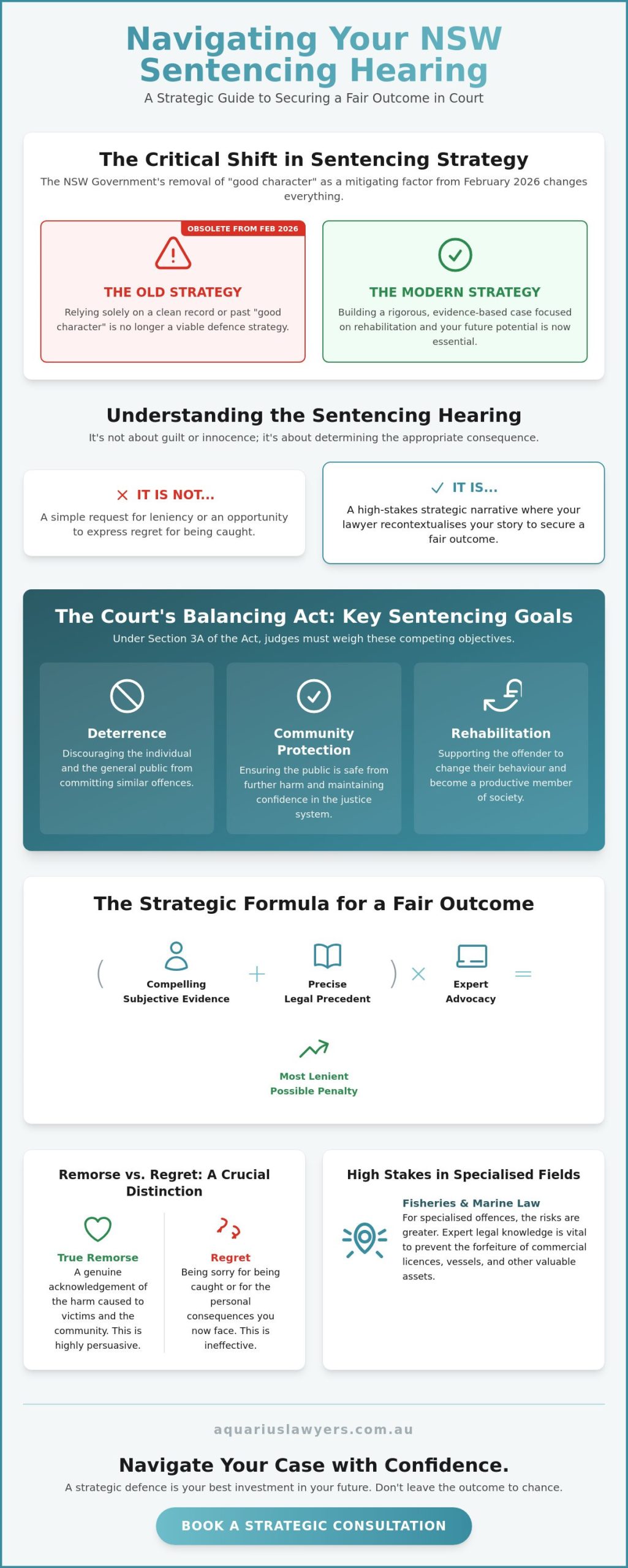
The common belief that a court appearance is simply a request for leniency is fundamentally flawed. In reality, a sentencing hearing is a high-stakes strategic narrative where your future depends on how your story is recontextualised. With the NSW Government’s February 2026 removal of “good character” as a mitigating factor, the old strategy of relying solely on a clean record is dead. Engaging an expert sentencing hearing lawyer is now about building a rigorous case focused on rehabilitation and future potential. Strategy is the only way forward.
You likely feel a sense of dread about the potential for heavy fines or imprisonment, wondering if your side of the story will actually be heard through the dense fog of legal jargon. It’s natural to worry when the rules change so quickly. This article explains how a specialist advocate uses a modern, evidence-based methodology to navigate these complexities and secure a fair outcome. We’ll show you how to move from a place of confusion to a position of informed confidence.
Discover the specific strategies used to pursue outcomes like a Section 10 dismissal and learn how to manage the factors that influence a judge’s decision. We will break down the impact of the latest 2026 legislative shifts; the goal is to provide a clear pathway from legal uncertainty to a resolved future.
Key Takeaways
- Understand the critical distinction between a plea in mitigation and a contested trial to ensure your legal strategy aligns with your specific goals.
- Learn how a specialist sentencing hearing lawyer constructs a strategic “subjective case” to recontextualise your actions and highlight your pathway to rehabilitation.
- Master the timing of your legal response to maximise the “Early Plea Discount” and utilise Section 21A mitigating factors effectively.
- Explore the unique complexities of fisheries and marine law, where specialised expertise is vital to preventing the forfeiture of commercial licences and assets.
- Discover how a pragmatic, down-to-earth approach to legal advocacy removes the confusion of “legalese” and provides a clear map for your court appearance.
What is a Sentencing Hearing in the NSW Court System?
A sentencing hearing marks the conclusion of a criminal case, occurring after a defendant has either pleaded guilty or been found guilty by a court. It’s the critical juncture where the focus shifts from the question of “did they do it?” to “what is the appropriate consequence?”. For many, this is the most stressful part of the legal process. An experienced sentencing hearing lawyer understands that this stage is not a passive event but a final opportunity to shape the court’s perception of the offender and the offence. While a trial is a battle over facts and evidence, a sentencing hearing is an exercise in context and narrative.
In New South Wales, the “rulebook” for this process is the Crimes (Sentencing Procedure) Act 1999. This legislation ensures that penalties aren’t handed out arbitrarily. It requires a Magistrate or Judge to follow a structured path, weighing the gravity of the crime against the personal circumstances of the individual. This is where a “plea in mitigation” becomes essential. Instead of contesting the charges, your legal representative presents a persuasive argument to reduce the severity of the penalty, focusing on why a more lenient outcome is justified under the law.
Local Court vs. District Court Sentencing
The venue for your hearing depends on the seriousness of the offence. Summary matters, such as most traffic offences or minor assaults, are finalised in the Local Court. These hearings are typically faster and less formal, though the pressure remains high. Indictable matters, which are more serious crimes, often move to the District Court for sentencing. In the District Court, the process is more elaborate; it involves detailed “sentencing remarks” from the Judge and often requires more extensive preparation of subjective evidence. Regardless of the court, punctuality and strict adherence to court etiquette are non-negotiable standards that your lawyer will help you manage.
The Purpose of Sentencing
Judges don’t just punish for the sake of it. They must balance several competing objectives. The concept of Punishment in Australia has evolved significantly, moving from purely retributive measures to a system that prioritises community safety and rehabilitation. Under Section 3A of the Act, the court considers:
- Deterrence: Discouraging both the individual and the general public from committing similar acts.
- Community Protection: Ensuring the public is safe from further harm.
- Rehabilitation: Supporting the offender to change their behaviour and become a productive member of society.
A vital distinction the court makes is between “remorse” and “regret”. Regret is simply being sorry you were caught or being upset about the personal consequences you now face. Remorse is a genuine acknowledgement of the harm caused to victims and the community. Demonstrating true remorse is often the most effective way a sentencing hearing lawyer can influence the court’s decision toward a more favourable outcome.
The Role of a Sentencing Hearing Lawyer: Building Your Strategy
Strategy is everything. In the NSW justice system, a fair outcome isn’t a matter of luck; it’s the result of a meticulously constructed narrative. A specialist sentencing hearing lawyer doesn’t just show up on the day to ask for mercy. They build a comprehensive case that aligns your personal history with the legal purposes of sentencing in NSW. This involves identifying a clear “pathway” to leniency by balancing the gravity of the offence against your specific life circumstances. Without a strategic map, you’re simply at the mercy of the court’s first impression.
We view a successful outcome as a logical equation: (Compelling Subjective Evidence + Precise Legal Precedent) x Expert Advocacy = The Most Lenient Possible Penalty. This no-nonsense approach is particularly vital following the February 2026 removal of “good character” as a mitigating factor. Because you can no longer rely solely on a clean record, your lawyer must focus on active rehabilitation and the low likelihood of reoffending. Standard criminal defence often misses the mark in specialised fields. If you’re facing a fisheries or marine prosecution, a specialist lawyer ensures the court understands the technical impact of licence forfeitures or boat seizures, preventing a standard penalty from becoming a financial catastrophe.
Gathering Evidence and Subjective Material
Effective preparation starts months before you step into the courtroom. We help you organise character references that carry genuine weight; a Magistrate wants to see specific examples of your contributions to the community, not just generic praise. If underlying issues like mental health contributed to the offence, we coordinate psychologist or psychiatrist reports to explain the “why” without making excuses. Documenting your commitment to a rehabilitation programme or counselling provides the court with the “proof of change” it needs to justify a non-custodial sentence.
Drafting the Plea in Mitigation
The plea in mitigation is your lawyer’s opportunity to recontextualise the offence. We craft a persuasive narrative that addresses the specific circumstances of the act while highlighting your employment history, family responsibilities, and community ties. By identifying legal precedents where similar cases received lower penalties, we provide the Judge with a solid legal framework to exercise leniency. It’s about presenting the “equation” of your life in a way that makes a harsh penalty seem unnecessary and counterproductive to your ongoing rehabilitation.
Mitigating Factors: How Your Lawyer Influences the Penalty
The law provides a specific framework for determining a sentence, but it’s the evidence presented within that framework that determines your future. Under Section 21A of the Crimes (Sentencing Procedure) Act 1999, the court must weigh aggravating factors, which increase a penalty, against mitigating factors, which decrease it. A skilled sentencing hearing lawyer acts as a strategic counterweight. Their job is to “neutralise” the aggravating factors presented by the Police Prosecutor by providing context that the police facts often omit. If the prosecution argues the offence was planned, your lawyer may present evidence of impulsive behaviour or significant personal stress that clouded your judgement. For those who have not yet reached the sentencing stage, understanding what happens in a bail hearing is equally critical, as the strategic preparation required at that earlier stage can directly influence how your matter unfolds in court.
Timing is one of the most powerful tools in your legal arsenal. The “Early Plea Discount” is a statutory entitlement in NSW that can reduce a sentence by up to 25% if a guilty plea is entered at the earliest possible stage. This isn’t just about administrative efficiency; it’s a recognised sign of remorse. Your sentencing hearing lawyer will refer to the NSW sentencing guidelines to ensure the court applies the correct principles to your specific case, ensuring you receive the full benefit of every available legal discount.
Common Mitigating Circumstances in NSW
The legal landscape shifted significantly in February 2026 with the removal of “good character” as a standalone mitigating factor. You can no longer rely on your reputation alone to secure a lighter sentence. However, the court still places immense value on a lack of prior criminal convictions and your prospects for rehabilitation. We focus on demonstrating genuine contrition through letters of apology and proactive steps, such as entering counselling programmes. Extraordinary personal circumstances, including mental health struggles or severe financial hardship, remain vital components of a persuasive mitigation strategy.
The “Section 10” Dismissal: Avoiding a Criminal Record
For many professionals, particularly those in the commercial or marine sectors, a criminal conviction is a career-ending event. The “gold standard” outcome is a Section 10 dismissal, now legally categorised as a Conditional Release Order (CRO) without conviction. To secure this, your sentencing hearing lawyer must convince the Magistrate that the offence was minor, your character is generally positive, and the impact of a conviction would be disproportionately harsh. It’s a high bar to clear. We build the necessary evidentiary foundation to show that the community is better served by your continued contribution to your industry rather than a permanent mark on your record. This same strategic approach applies to traffic-related matters; if you are facing a PCA charge, understanding how to pursue a Section 10 outcome is equally critical, and our guide for anyone seeking a drink driving lawyer Sydney explains the specific steps required to protect your licence and avoid a conviction.
Sentencing for Specialised Offences: Fisheries and Marine Law
Most generalist criminal lawyers are out of their depth when a case involves the Fisheries Management Act 1994. They understand the Local Court, but they don’t understand the industry. A sentencing hearing lawyer with a specific background in marine law provides a level of technical authority that generalists simply cannot match. In these hearings, the “offence” is often a breach of complex quota regulations or technical gear requirements. If your lawyer cannot explain the difference between a minor navigational error and a deliberate breach of safety protocols, the court is likely to impose a penalty that is far too harsh. We bridge that gap by speaking the language of both the industry and the judiciary.
The real danger in these prosecutions lies in the collateral damage. A standard fine is one thing, but the forfeiture of a commercial licence or the seizure of a multi-million dollar vessel is quite another. We focus on recontextualising the prosecution’s narrative by highlighting industry compliance and technical challenges. This “innovative veteran” approach is particularly effective in regional NSW courts where the local economy depends on the sea. Magistrates in these areas understand the weight of these penalties, provided they are presented with a clear, evidence-based argument that justifies leniency.
Commercial Fishing and Aquaculture Penalties
Commercial fishers face a unique legal threat: “Special Penalties.” Under NSW law, these are mandatory additional fines calculated based on the market value of the illegal catch. They can easily dwarf the primary fine. We mitigate this risk by documenting your history of compliance and presenting a clear “equation” of the financial impact on your family and employees. Protecting your livelihood requires more than just a plea for leniency; it requires a strategic defence of your right to work. If you are facing industry-specific charges, you need a fisheries law specialist who understands the stakes.
Maritime and Shipping Offences
Sentencing for marine pollution or vessel safety breaches often involves a mix of local statutes and international maritime standards. Whether it’s an accidental discharge or a navigation error in a busy shipping lane, the court looks for evidence of robust safety systems and immediate corrective action. We work to secure outcomes that allow for continued employment in the shipping industry, ensuring that a single mistake doesn’t result in a permanent bar from the water. By framing the incident through the lens of international best practices, we provide a pathway to a fair and proportionate outcome that protects your career at sea.
Choosing Aquarius Lawyers for Your Sentencing Hearing
Katherine Hawes leads our team as an “innovative veteran” with over 20 years of court experience. She understands that a courtroom isn’t just about the law; it’s about the people within it. Choosing the right sentencing hearing lawyer means finding someone who respects traditional legal credentials while embracing modern, forward-thinking strategies. We don’t just recite the facts. We recontextualise them to ensure the Magistrate sees the person behind the charge. Our goal is to provide a steady, common-sense guide through a process that often feels overwhelming.
Our approach is defined by “down-to-earth” pragmatism. We strip away the cold formality and archaic jargon often found in the legal industry. You’ll receive clear, common-sense guidance that makes sense in the real world. Whether your matter is in a Sydney Local Court or a regional centre, we provide accessible representation that spans the state. To provide further peace of mind, we offer fixed-fee options for many sentencing matters. This ensures you know exactly where you stand financially before your court date.
A Strategic Pathway to Resolution
We believe in a strategic pathway to resolution. This means combining traditional legal excellence with modern efficiency to protect your reputation and your future. For professionals in the marine or commercial sectors, the stakes are exceptionally high. Our niche expertise in these complex regulatory areas ensures that your case is handled with a level of technical precision that generalist firms cannot match. It’s a simple but effective formula: (Deep Experience + Modern Strategy) x Pragmatic Advice = A Fair Outcome.
Next Steps: Prepare for Your Hearing
Preparation is the key to confidence. An initial consultation allows us to assess your options and begin building your subjective case immediately. When you meet with your sentencing hearing lawyer, bring any police facts, your criminal record, and any character references you’ve already gathered. This proactive step is the first move toward resolving your legal issues and moving forward with your life. Don’t leave your future to chance; organise a confidential consultation with Aquarius Lawyers today to secure the expert advocacy you deserve.
Secure Your Future with Strategic Advocacy
Success in court isn’t a matter of luck; it’s the result of rigorous preparation and a clear narrative. We’ve seen how navigating the complex Crimes (Sentencing Procedure) Act 1999 requires a tailored approach that balances the latest 2026 legal reforms with your personal history. Whether you’re facing a standard criminal charge or a specialised marine prosecution, a robust strategy neutralises aggravating factors and highlights your genuine potential for rehabilitation. Engaging a specialist sentencing hearing lawyer ensures that technical industry details are properly explained to the Magistrate, protecting both your record and your livelihood.
Led by Katherine Hawes, famously known as “The Fish Lawyer”, our team brings over two decades of experience across the NSW Local, District, and Supreme Courts. We combine this traditional expertise with a no-nonsense, pragmatic style that gets straight to the heart of your matter. With offices in the Sydney CBD and Shellharbour, we ensure regional accessibility for clients across the state. You don’t have to face this challenge alone. Secure your future—contact Aquarius Lawyers for expert sentencing representation. With the right guide, you can step into the courtroom with clarity and confidence.
Frequently Asked Questions
Do I really need a lawyer for a sentencing hearing if I already pleaded guilty?
Yes, you absolutely need professional representation because the sentencing stage determines the actual impact the offence will have on your life. While the question of guilt is settled, the penalty is not. A sentencing hearing lawyer ensures that the court hears the context behind the act rather than just the police version of events. This is your final opportunity to influence the Magistrate’s decision regarding your future.
What is the difference between a fine and a community correction order?
A fine is a purely monetary penalty, whereas a Community Correction Order (CCO) is a more intensive sentence served in the community. CCOs can last up to three years and often include mandatory conditions like supervision by Community Corrections or community service work. While a fine ends once the payment is made, a CCO requires ongoing compliance to avoid further legal consequences.
Can a lawyer help me avoid a prison sentence in NSW?
Expert legal advocacy is often the deciding factor in avoiding a custodial sentence. Lawyers can argue for Intensive Correction Orders (ICOs), which allow you to serve a prison sentence in the community under strict supervision. By focusing on your rehabilitation prospects and the specific impact on your family or employment, a lawyer builds a persuasive case for alternatives to full-time imprisonment.
What should I wear to my sentencing hearing in the Local Court?
You should wear neat, conservative clothing that demonstrates respect for the court. Think of it as dressing for a professional job interview; a collared shirt, trousers, or a modest dress are appropriate choices. Avoid hats, sunglasses, or clothing with large logos or slogans. Your appearance is the first piece of non-verbal evidence the Magistrate sees regarding your attitude toward the proceedings.
Will my sentencing hearing happen on the same day as my plea?
It depends on the complexity of your case and the court’s schedule. For minor summary offences in the Local Court, sentencing often occurs immediately after a plea is entered. However, for more serious matters, the court frequently adjourns the hearing for several weeks. This delay allows for the preparation of pre-sentence reports or psychologist evaluations that are essential for a fair outcome.
How much does a sentencing hearing lawyer typically cost in Sydney?
Legal costs vary based on the complexity of the matter and the seniority of the practitioner involved. Many firms, including Aquarius Lawyers, offer fixed-fee arrangements for many sentencing matters to provide clients with financial certainty. You should discuss fees openly during your initial consultation to ensure the arrangement fits your requirements and provides a clear pathway forward without hidden costs.
Can a character reference really change the outcome of my sentence?
Character references are vital, but they must be highly specific to be effective. Following the February 2026 legislative changes in NSW, references that simply state you are a “good person” carry less weight than they once did. Effective references now need to focus on your genuine remorse, your specific steps toward rehabilitation, and the likely impact of a conviction on your future community contributions.
What happens if I am unhappy with the sentence the Magistrate gives me?
If you believe the sentence is too harsh or legally flawed, you generally have the right to lodge an appeal. In most cases, an appeal from the Local Court is heard in the District Court, where a Judge will review the original decision. You must act quickly, as there are strict 28-day time limits for lodging an appeal after the sentence has been handed down by the court.
Disclaimer
Please note that legal rules change and this is not a substitute nor construed as legal advice. It is general information only.