
Drug charges in NSW may be dropped if the prosecution can’t prove every element of the offence beyond reasonable doubt. Aquarius Lawyers can assess whether the evidence shows you knowingly had the drug under your control, and whether police had reasonable suspicion to search you.
It’s understandable to think that drugs found near you, or in a shared space, automatically count as yours. But possession and control are legal questions: the substance does not have to be on you or belong to you. The evidence must support the allegation that you controlled it.
This article explains how NSW law assesses possession and control, when a possession allegation may be challenged, and why a charge can carry supply implications even if no sale took place. It also covers when a non-conviction outcome may be available and what Aquarius Lawyers can examine.
Key Takeaways
- Supplying drugs doesn’t require a sale: giving or sharing them may also lead to a supply charge.
- A possession charge may be challenged by examining whether police can prove each element of the offence and whether the search had a lawful basis.
- Possession depends on knowledge and control, which can be disputed when drugs are found in a shared space or near several people.
- A court may consider a non-conviction outcome for drug possession; diversion options may also be relevant in suitable cases.
- Look closely at the evidence, the alleged level of control and the charge itself to identify the issues that may shape your defence.
Can I be charged with supply without selling drugs?
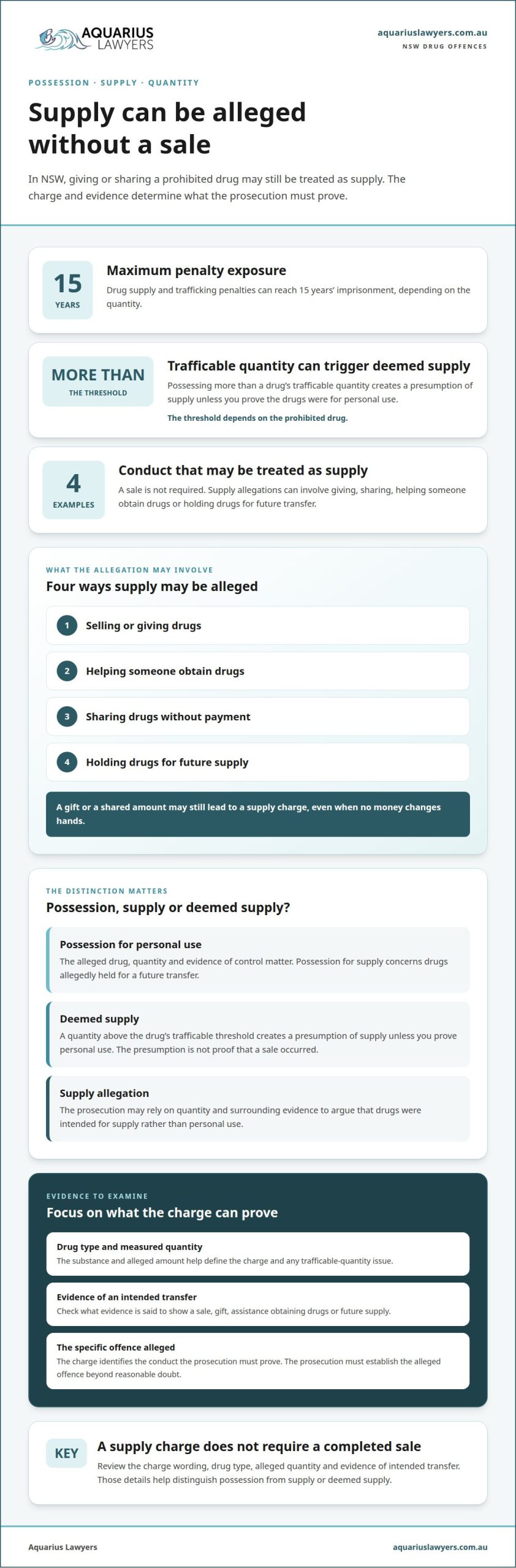
Yes. In NSW, supplying a prohibited drug can include giving or sharing it, even without payment or a sale. At court in Sydney, the prosecution presents its case and must prove the alleged offence beyond reasonable doubt; the court considers the evidence and your response.
Possession for the Purpose of Supply
Possession for supply concerns drugs allegedly held for a future transfer, not only drugs already sold. The prosecution may rely on quantity and surrounding evidence to argue that the purpose was supply rather than personal use. A possession charge can therefore carry greater implications if the allegation changes to supply. A defence lawyer can assess what the evidence supports.
Deemed Supply Without a Sale
In NSW, possessing more than a drug’s trafficable quantity creates a presumption of supply unless you prove the drugs were for personal use. This is known as deemed supply. The threshold depends on the prohibited drug, so the substance and alleged quantity matter. The presumption is not proof that a sale occurred, so read the charge and evidence carefully.
Supply offences can cover several actions. A person may be accused of selling or giving drugs, helping someone obtain them, sharing them without payment, or holding them for future supply. For example, passing a prohibited drug to a friend without payment may still be treated as supply. The alleged conduct, quantity and evidence help define the charge and possible outcome.
Drug offences also cover conduct beyond possession or a direct handover. Drug trafficking can involve importing prohibited substances, cultivating plants, manufacturing, distributing or selling drugs. Importation is a Commonwealth offence, while NSW charges may concern other alleged conduct. The distinction matters because the charge identifies what the prosecution must prove, and the defence must respond to those specific allegations.
In NSW, drug supply and trafficking penalties can reach 15 years’ imprisonment, depending on the quantity. That exposure makes the difference between possession and supply a serious issue. Review the police allegation, the drug type, the measured quantity and any evidence said to show an intended transfer. A defence lawyer can test whether the facts support supply, deemed supply or possession instead.
Keep the charge documents and any material describing the alleged drug quantity together. Note whether police allege a sale, a gift, assistance obtaining drugs or intended future supply. These details help you understand the case you must answer. A supply charge without a sale is possible, but the prosecution must still prove the elements of the particular offence.
Can Drug Charges Be Dropped in NSW?
A NSW drug charge may be dropped if the prosecution cannot establish its case. Reviewing the documents, events and evidence can help identify issues to raise and the next step in your defence.
Advice After a Drug Charge
Start with the court attendance notice and police material. Note the offence listed, court date and any bail conditions, and keep the documents together. Write a factual timeline of what happened, including where you were and who was present. Separate your own recollection from details you learned from other people or documents.
At a consultation, a Sydney lawyer handling drug possession charges can compare your timeline with the prosecution’s account and identify points that need clarification. Bring relevant messages, photographs or other records in their original form. Don’t delete or edit material that may relate to the allegation. This preparation gives your lawyer a clearer basis for advising you on your response.
Search Legality and Evidence Exclusion
Whether evidence should be excluded is a separate question from whether the prosecution can prove the charge. A lawyer can examine how police recorded the seizure, whether the records match the sequence of events and whether the material supports the allegation as charged. For example, a difference between an officer’s notes and the police statement may need closer scrutiny.
Keep the paperwork in the order you received it, and note any missing pages or unclear descriptions. Do not try to resolve inconsistencies by changing your own records. A defence lawyer can assess whether to challenge the use of particular evidence in court and explain how that issue fits into your broader defence.
Drug Defence Representation in Sydney
Representation can include reviewing police material, clarifying the allegation and preparing for court. The appropriate strategy depends on what the documents show and your position on the charge. Before a court date, ask your lawyer to explain what decisions you need to make and what material supports each option.
For drug possession charges, a Sydney lawyer can help you organise the case around specific disputed points rather than assumptions. That may include checking the charge wording against the police account and preparing questions about unclear evidence. Keep a record of court dates and comply with any bail conditions while your matter proceeds.
If you need help reviewing your case and preparing a response, seek criminal law representation.
Can I avoid a conviction for a drug offence?
Yes, a NSW court may impose a section 10 non-conviction sentence for possessing a prohibited drug. The available outcome depends on the charge and material put before the court.
Diversion and Non-Conviction Outcomes
MERIT is a voluntary 12-week program for defendants with drug issues in New South Wales. It may be relevant to discuss whether a diversion pathway fits your circumstances. Find out what participation involves and how it relates to the court process before deciding whether to take part.
A non-conviction outcome may affect the result of a drug possession case. A CRO is another possible non-conviction sentence identified for NSW drug possession charges. These are distinct pathways, so ask how each relates to the charge, your circumstances and the material the court will consider. Do not assume that attending a program automatically changes the outcome.
To prepare, gather documents showing your participation in any relevant program, treatment or support. Keep records of dates and attendance, and ensure the court receives accurate information. These practical steps give the court context when considering an outcome.
Section 10 Outcomes
For possession of a prohibited drug, a NSW court may impose a section 10 non-conviction sentence. The key point is that the court deals with the offence without recording a conviction. The charge and the material before the court remain central to whether this outcome is available.
Before court, organise information that explains your circumstances and any steps you have taken to address drug issues. A lawyer can help present that material and explain the distinction between a conviction and a non-conviction outcome. The prosecution’s case and the seriousness of the allegation still matter.
Avoiding a conviction matters beyond the immediate penalties. If you are planning international travel, establish the exact court outcome and keep the court documents. Travel and visa forms may ask about criminal history, so read each question carefully and answer accurately. Do not assume that every form uses “conviction” in the same way.
For example, if a form asks whether you have a conviction, the difference between a recorded conviction and a section 10 outcome may be relevant. Keep the wording of the court result available rather than relying on memory. If a form asks a broader question about charges or court appearances, read that wording separately; a non-conviction outcome does not erase the fact that proceedings occurred.
Ask for advice before entering a plea or making travel declarations based on an unresolved charge. The possible outcome depends on the offence, prosecution material and information presented to the court. Clear preparation helps you understand whether a diversion program, CRO or section 10 outcome is relevant to your case.
Drug possession and control
In NSW, possession turns on knowledge and control, not simply whose name is on a package. The key question is whether the evidence shows you knowingly had a prohibited drug under your control.
The Drug Misuse and Trafficking Act 1985 No 226 addresses drug possession in New South Wales. A substance doesn’t have to be physically on you or belong to you for police to allege possession. For example, drugs found in a room or vehicle may prompt questions about who knew they were there and who controlled access.
Control may be sole or shared, and the circumstances can help show who had access to the drug. The surrounding circumstances are therefore important. If police find a prohibited drug in a shared kitchen, several residents may raise questions about who knew about it and who could control access. Being nearby alone does not answer those questions.
To assess the allegation, organise the evidence around knowledge and access:
- Record where police say they found the drug, such as a bedroom, bag or vehicle.
- Identify who could access that place and whether it was shared.
- Keep any messages or records that relate to the location or your access.
- Compare the allegation with what you recall and the police material.
These details help a criminal defence assess whether the evidence supports control rather than mere proximity. Do not assume ownership is decisive: the allegation can concern a drug that belongs to someone else.
Quantity can also affect the charge. In NSW, possession of a prohibited drug can carry up to 2 years in prison or significant fines. If police allege more than possession, examine the precise charge and the evidence said to support it. A trafficking or supply allegation is different from possession, so the prosecution’s case must be considered against the offence charged.
Keep separate allegations distinct. For example, drug driving is a criminal offence under the Road Transport Act (NSW), but evidence of possession does not by itself establish that driving offence. If a case involves both allegations, identify the evidence relating to each charge and what the prosecution must prove.
If a Local Court finds an offence proven, an appeal may be made to the District Court within 28 days. That is a separate step from challenging whether the evidence proves possession. Understanding the alleged location, access and knowledge helps you identify the issue to raise in your defence.
For advice on how the evidence bears on possession and control, seek criminal defence advice about your NSW charge.
Aquarius Lawyers: Marine Law
For a drug possession charge, the relevant next step is advice on Criminal Law, not Marine Law. Aquarius Lawyers provides criminal law services to help you understand the process and prepare for decisions about your matter.
Bring your charge documents and any questions about what happens next. Contact Aquarius Lawyers to discuss your criminal law matter.
Take the next step with a clear plan
A charge can affect decisions well beyond your court appearance. Before responding to police or making a plea decision, organise your court documents and write down the questions you need answered. A Sydney lawyer for drug possession charges can help you understand the process and make informed choices about your response.
Keep separate legal or business issues distinct from your criminal matter. Aquarius Lawyers also works in Marine Law, Fisheries Law and Aquaculture Law, including matters connected with maritime and aquatic businesses.
When you’re ready to discuss your legal matter, contact Aquarius Lawyers. A clear next step can help you move forward with greater confidence.
Frequently Asked Questions
What is possession of a prohibited drug?
In NSW, possession offences are addressed by the Drug Misuse and Trafficking Act 1985 No 226. If police charge you, compare the wording on your court documents with the substance and location described in the police material. Note any difference between the description and what you recall seeing. Keep your own account factual, and avoid guessing about a substance or item you didn’t personally identify.
Can police search my car?
In NSW, police may search a vehicle if it contains prohibited plants or drugs in contravention of the Drug Misuse and Trafficking Act. If your car is searched, write down when and where it happened, who was in the vehicle and which areas police examined. Keep relevant records, such as booking or work documents, in their original form.
How much will my case cost?
The practical steps in a case depend on what you need to address. You may need advice about the charge, help reviewing police material, preparation for court or representation as the matter proceeds. Before making decisions, identify the immediate task: responding to a court notice, understanding the evidence or preparing your position. Bring the notice and relevant documents to a consultation so the discussion can focus on your case.
What are the legal costs involved?
The work involved can vary with the stage and issues in your proceedings. You may need help understanding the charge, preparing your response or dealing with a court hearing. Ask what tasks are included in the proposed legal work and which steps require your instructions. Keep a written record of the agreed scope, key dates and documents you need to provide, so you can track what happens next.
What drug possession offences and penalties apply in New South Wales?
NSW drug charges can allege different conduct, including possession, use, supply, cultivation or drug driving. Read the precise offence on your court documents rather than relying on a general label such as “drug charge”. The allegation tells you what case you need to answer. If the paperwork lists multiple offences, keep each charge separate and note its description and court date.
What counts as drug possession under NSW law?
The charge alleges that you knowingly possessed a prohibited drug. To understand the case you face, check how police identify the substance and where they say it was found. Note anything you personally observed, such as packaging or labelling, without treating an assumption as fact. This helps distinguish your direct knowledge from conclusions drawn in the police material.
Disclaimer
Please note that legal rules change and this is not a substitute nor construed as legal advice. It is general information only.