
A weapon charge can turn on more than whether an item is a firearm. Across Australian jurisdictions, including New South Wales, specific legislation such as the Weapons Prohibition Act 1998 requires a permit to possess or use a weapon listed in Schedule 1; possessing or using one without a permit is an offence. The maximum penalty can be 14 years’ imprisonment.
It’s understandable to focus first on what police found, but the item’s legal classification, your possession or use of it, and whether you were authorised all matter. Allegations involving weapons offences in NSW can concern items you may not expect to be restricted, and the circumstances can affect the charge.
This article explains what the law treats as a prohibited weapon or firearm, how charges and penalties differ, and what issues may form part of a defence. It also explains why getting expert legal advice from Aquarius Lawyers before a police interview about weapons offences in NSW can help you understand the allegation and make informed decisions about how to respond.
Key Takeaways
- A weapon’s classification under NSW law can determine whether you need a permit and which offence police allege.
- Firearms and prohibited firearms are defined under separate legislation, so the item’s features and circumstances matter.
- Possession can involve more than holding a weapon yourself; the prosecution must prove the elements of the alleged offence.
- Storage failures can carry separate penalties, with requirements differing according to the type of firearm.
- Before a police interview, legal advice can help you understand the allegation, assess the evidence and make informed decisions about your response.
What is a prohibited weapon?
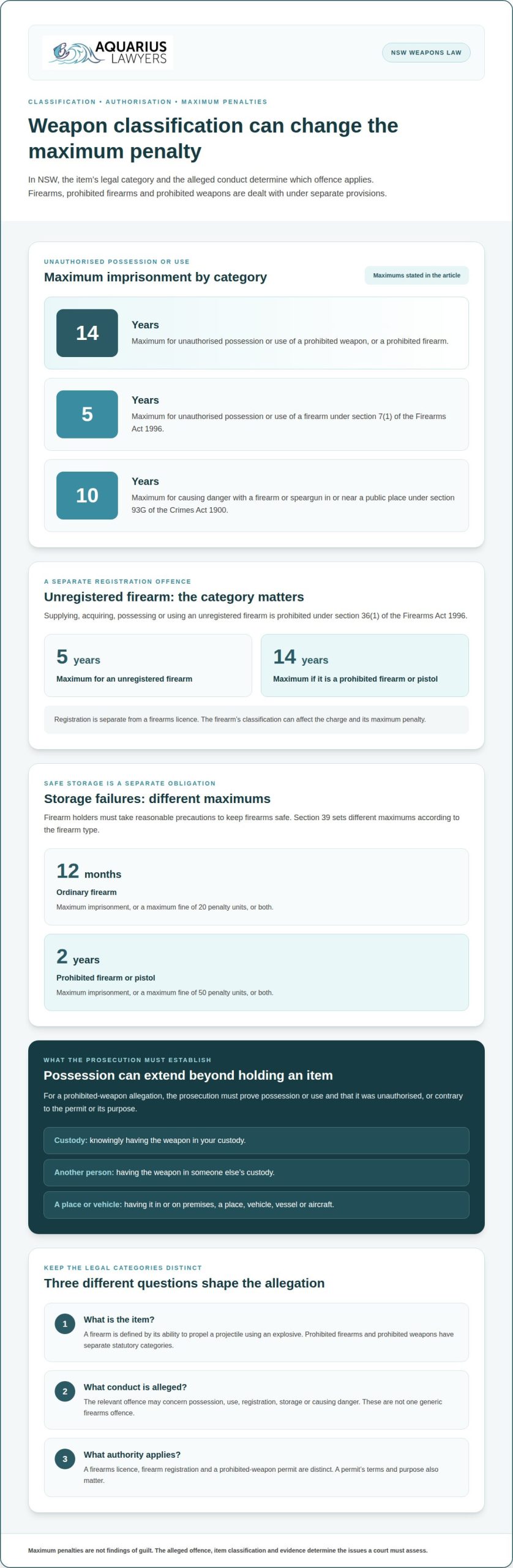
In NSW, a weapon listed in Schedule 1 of the Weapons Prohibition Act 1998 generally requires a permit to possess or use. Section 7(1) makes possessing or using a prohibited weapon without a permit an offence. The prosecution must prove possession or use and that it was unauthorised or contrary to the permit or its purpose.
Possession can mean more than holding an item in your hand. Under the Act, it includes knowingly having custody of a weapon, having it in another person’s custody, or having it in or on premises, a place, vehicle, vessel or aircraft. For example, a weapon in a vehicle may raise a possession issue even if the vehicle belongs to someone else.
Schools, public transport and licensed venues do not change the need to assess the weapon, possession or use, and any permit. For knives, sections 93IB-93IC of the Crimes Act 1900 address custody in a public place or school without a reasonable excuse, and using or visibly carrying a knife in a way likely to cause fear. A venue’s location alone does not establish whether a prohibited-weapon offence has occurred.
Firearm charges are dealt with separately under the Firearms Act 1996. Section 7(1) addresses unauthorised possession or use of a firearm, with a maximum penalty of 5 years’ imprisonment. Section 7A(1) concerns unauthorised possession or use of a prohibited firearm and carries a maximum penalty of 14 years’ imprisonment. The category of firearm alleged therefore matters to the charge and potential penalty.
Registration is a separate issue from a firearms licence. Section 36(1) prohibits supplying, acquiring, possessing or using an unregistered firearm. The maximum penalty is 5 years’ imprisonment, or 14 years if the firearm is a prohibited firearm or pistol. A firearm may also be prohibited under Schedule 1 of the Firearms Act 1996, so the item’s classification can affect the charge even where the allegation also involves registration.
A criminal lawyer can assess how an existing charge or criminal history may affect a firearms licence matter and explain the legal issues relevant to an application or renewal. The lawyer can advise on the criminal-law implications, but a licence application is a separate process from defending a charge.
Firearm and prohibited firearm definitions
NSW law distinguishes a firearm from a prohibited firearm. Section 4 of the Firearms Act 1996 describes a firearm as a gun or other weapon capable of propelling a projectile using an explosive. Schedule 1 of that Act identifies firearms classed as prohibited. Classification matters: it can change the offence alleged and the maximum penalty.
Schedule 1 of the Weapons Prohibition Act 1998 separately lists prohibited weapons. Under section 7, possessing or using a weapon on that list requires a permit. A weapon’s appearance alone may not resolve the issue; the relevant statutory description and the item’s features need to be considered. For example, the Act’s list includes short spear guns, while the firearms legislation has its own prohibited-firearm categories.
To possess or use a firearm in NSW, you need a firearms licence, and the firearm itself must be registered. A prohibited weapon requires a permit under the Weapons Prohibition Act 1998. A firearms licence and a prohibited-weapon permit are distinct authorisations, so one should not be treated as covering the other.
A permit is relevant to whether possession or use is authorised, but its terms and purpose matter too. The prosecution must prove beyond reasonable doubt that you possessed or used the prohibited weapon and that this was unauthorised or contrary to the permit or its purpose. Personal protection is expressly excluded as a genuine reason for possessing a prohibited weapon. The specific statutory category and circumstances therefore shape any defence, and a permit does not automatically answer every allegation.
A Firearms Prohibition Order is a separate legal restriction from a licence or permit. Contravening an order carries a maximum penalty of five years’ imprisonment, or 14 years if the firearm is a prohibited firearm or pistol. That distinction makes it essential to identify both the item and the legal authority said to apply. A charge involving a pistol, for instance, may attract a different maximum from an ordinary firearm offence.
The Crimes Act 1900 also addresses conduct involving firearms. Section 93G concerns causing danger with a firearm or speargun in or near a public place, with a maximum penalty of 10 years’ imprisonment. This is a separate offence from possessing a prohibited firearm without authorisation. The allegation must be assessed under the section police rely on, rather than treated as a single generic firearms offence.
If police allege you possessed a prohibited weapon or breached a firearms restriction, criminal law advice can help assess the charge, permit issue and evidence together.
How can a criminal lawyer help with firearms offence charges in NSW?
A lawyer can assess the charge, the evidence and the relevant provisions of the Firearms Act 1996 or the Crimes Act 1900. NSW Police investigate alleged offences; courts determine whether the prosecution proves the charge and what sentence applies.
Firearm storage and loss reporting
NSW law requires firearm holders to take reasonable precautions to keep firearms safe, and storage failures can be a separate offence. Under section 39 of the Firearms Act 1996, failing to safeguard an ordinary firearm carries a maximum fine of 20 penalty units, imprisonment for 12 months, or both. For a prohibited firearm or pistol, the maximum is 50 penalty units, imprisonment for two years, or both.
Section 41 also sets a maximum of 50 penalty units, imprisonment for two years, or both, when a licence holder fails to store firearms as required. If a firearm is lost, legal advice can help you understand the relevant reporting issue and how it may affect an investigation. A lawyer can assess storage evidence, including what precautions were taken and what the alleged breach involves.
Firearm offence seriousness and sentencing
Sentencing depends on the offence proved, the firearm involved and the circumstances of the conduct. For example, unauthorised possession or use of a prohibited firearm under section 7A(1) carries a maximum of 14 years’ imprisonment. That is a maximum, not an automatic sentence. A lawyer can explain the charge’s elements, examine the prosecution case and identify issues that may affect the available defence or sentence.
The court sentences the offence proved on the evidence. A lawyer can distinguish an allegation involving storage from one involving possession, use or supply, because each has different legal elements and potential consequences. Clear advice helps you understand the prosecution case and the decisions you may need to make as proceedings move through court.
Supplying firearms and firearm parts
Giving a firearm or firearm parts to an unauthorised person is an offence under section 50B of the Firearms Act 1996. The maximum penalty is five years’ imprisonment. The alleged recipient’s authority, what was supplied and the circumstances of the transfer may all matter when assessing the charge.
A lawyer can review the evidence about the alleged supply, including whether the item was a firearm or firearm part and what the accused knew. If police allege you supplied an item, advice can help you understand the prosecution’s case and assess whether the evidence supports each element of the offence.
Discharging firearms near public places
Section 93G of the Crimes Act 1900 addresses causing danger with a firearm or speargun in or near a public place. The offence carries a maximum penalty of 10 years’ imprisonment. Firing a firearm or spear gun in or near a public place without lawful excuse may have serious legal consequences.
A lawyer can examine the alleged location, conduct and evidence, then advise on possible defences. If you need to surrender or dispose of an illegal weapon, legal advice can help you understand lawful options and avoid handling or moving it without advice.
Legal advice before a police interview
Before a police interview, legal advice can help you understand the allegation, the evidence and your options. In a firearms matter, the exact charge under the Firearms Act 1996 matters because different offences have different elements and maximum penalties. For alleged weapons offences in NSW, advice starts with identifying what police say happened.
A lawyer can clarify whether police allege possession, use, supply, an unregistered firearm or a storage breach. The distinction matters: possession raises different issues from supplying a firearm or firearm part to someone unauthorised. The charge determines which elements the prosecution must prove.
Advice before questioning can also focus your account on what is actually in dispute. A lawyer may examine whether the alleged item is correctly classified, whether you knowingly had custody or control of it, and whether the prosecution can prove the required elements. For an unauthorised possession allegation, the prosecution must prove possession or use and lack of authorisation beyond reasonable doubt.
Assess the evidence carefully before responding. A lawyer can consider the police account alongside available material, such as messages, photographs, CCTV or witness statements. For example, if police allege you had access to a firearm in a shared vehicle, access alone is not the same as knowing possession. The evidence and circumstances need to be examined, not assumed.
Police may ask questions about several events or people. Legal advice can help you identify what each question relates to, avoid guessing about details you don’t remember, and understand how an answer may be used in the prosecution case. If an officer refers to a threat or a claimed statement, the wording and context may matter. Don’t treat an interview as an informal chat.
A lawyer can explain the practical consequences of the charge, including how a conviction may affect a firearms licence and what issues may arise in court. The maximum penalty is not automatically the sentence imposed; the charge, evidence and circumstances shape the case. Early advice helps you make informed decisions before your account becomes part of the material considered in criminal proceedings.
If police have asked you to attend an interview, seek advice about the firearms charge before answering questions. A focused review of the allegation and available evidence can help you understand the risks and prepare a considered response.
Aquarius Lawyers
Aquarius Lawyers can help you understand a weapons allegation, review the evidence and consider how the charge may affect your firearms licence. If police have requested an interview or you have received a court attendance notice, early advice can help you understand the issues and prepare for the next stage.
Every matter turns on its facts, including the item involved, the alleged conduct and the evidence relied on by police. Getting advice before deciding how to approach an interview or court response gives you a clearer basis for considering your options.
Contact Aquarius Lawyers to discuss your situation.
Take the next step with a clear plan
A police interview request or firearms charge can affect decisions beyond the immediate investigation. If your work involves marine or fishing operations, related business and licence considerations may also matter. Aquarius Lawyers offers Marine Law, Fisheries Law and Aquaculture Law, as well as legal assistance for criminal matters.
Before responding to police or attending court, get advice tailored to the allegation and evidence. Understanding your position early can help you make considered decisions about what happens next in a weapons offence matter in NSW.
Contact Aquarius Lawyers for legal advice. A clear next step can help you move forward with greater confidence.
Frequently Asked Questions
What specific types of firearms are classified as prohibited firearms in NSW?
A firearm’s classification depends on its design and the category it falls into under NSW law. The exact model, configuration and any modifications can matter, so a generic product name may not settle its legal status. If police have identified a firearm, assess the allegation against the item itself and the specific offence charged, rather than relying only on how it was described when purchased or stored.
Are gel blasters legal in NSW?
You can’t determine a gel blaster’s legal status from its name alone. The relevant question is whether the particular device falls within a category regulated as a firearm or prohibited weapon, taking its features into account. Its appearance or intended recreational use does not resolve the issue. If police have seized one or raised an allegation, assess the item and the specific charge together.
Are tasers legal in NSW?
A taser’s legal status depends on the specific device and the rules governing its classification and possession. The name used to describe a product may not establish whether it is restricted or requires authorisation. If a taser is involved in a police investigation, its features and the circumstances of possession are relevant to assessing the allegation. Don’t assume a particular model is lawful based on its marketing description.
Are there urgent time limits I need to be aware of for firearms offences in NSW?
Act promptly on any date or deadline in a police or court document. A court attendance notice requires you to address the listed court date, while a police interview request raises an immediate decision about how to respond. The next step depends on the document and the stage of the matter. Get legal advice early to understand what is required and avoid missing a scheduled appearance.
Can you carry a pocket knife in NSW?
Whether carrying a pocket knife is lawful depends on the circumstances and your reason for having it. For example, someone carrying a knife as work equipment may need to explain its connection to the task and setting. The purpose, location and manner of carrying can all affect how the situation is assessed. If police question you about a knife, the specific circumstances matter more than the label “pocket knife”.
How does the standard non-parole period apply?
A standard non-parole period applies only to offences for which legislation sets one. It is not a fixed sentence or an automatic release date. The court must take the period into account when sentencing, alongside the offence and circumstances of the case. The sentence imposed and the non-parole period are related but distinct decisions, so first identify the applicable offence and sentencing provisions.
Disclaimer
Please note that legal rules change and this is not a substitute nor construed as legal advice. It is general information only.