
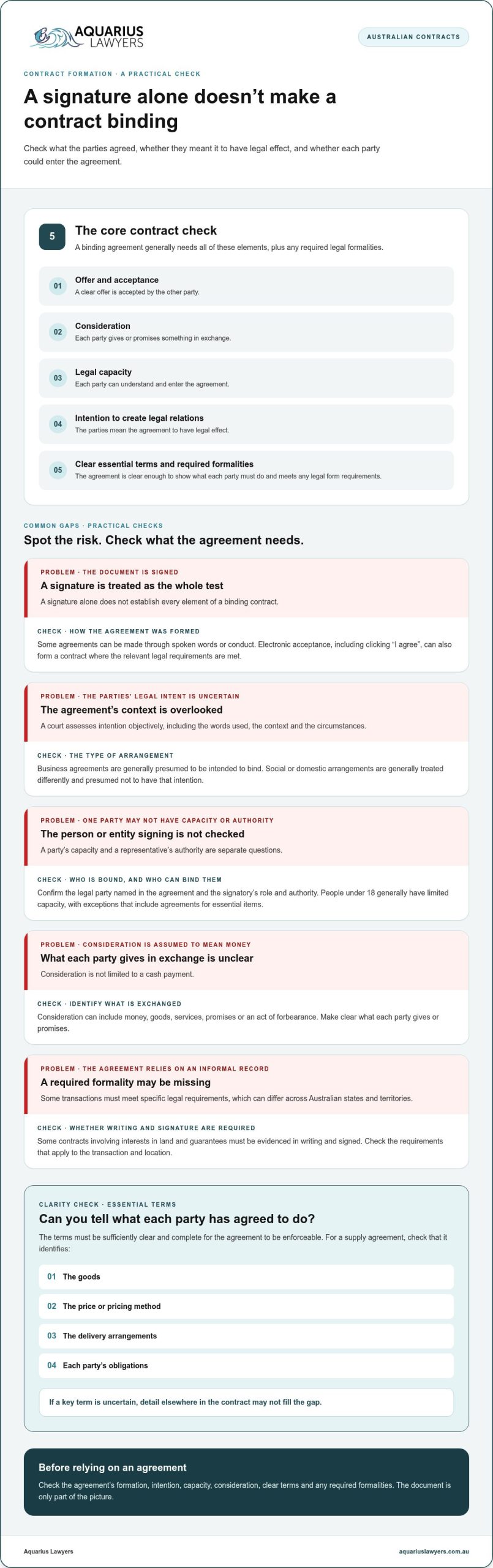
A signature alone doesn’t make an agreement legally binding. In Australia, a contract generally requires a clear offer and acceptance, consideration, legal capacity and an intention to create legal relations, along with any required legal formalities. Its essential terms must also be clear enough to show what the parties have agreed to do.
You might think a contract counts only if it’s written and signed. In Australia, some agreements can be made through spoken words or conduct, while certain transactions must meet specific formal requirements. This distinction matters when a disagreement arises: the question is not just what a document says, but whether the parties formed an enforceable agreement.
This article explains how intention, capacity and consideration affect whether an agreement binds you, and how offer, acceptance and formalities fit into the picture. You’ll also learn why consideration is more than simply paying money and what to check in a business agreement before relying on it.
Key Takeaways
- Look beyond signatures: a binding agreement generally requires offer and acceptance, consideration, capacity and an intention to create legal relations.
- Assess the context and clarity of the essential terms. Commercial agreements are generally presumed to carry legal intent, while social or domestic arrangements are generally treated differently.
- Check who is entering the agreement and whether they can understand its nature and consequences. People under 18 generally have limited capacity, subject to exceptions.
- Identify what each party gives or promises in exchange. Consideration can involve money, goods, services, promises or an act of forbearance.
- Before relying on an agreement, check whether the transaction requires particular formalities: some contracts involving land or guarantees must be in writing and signed.
What is an Intention to Create Legal Relations?
Intention to create legal relations means the parties mean their agreement to have legal effect. Australian contract law generally presumes business agreements are intended to bind, while social or domestic arrangements are generally presumed not to. The High Court considered intention in Ermogenous v Greek Orthodox Community of SA Inc (2002) 209 CLR 95. Courts assess the agreement objectively, including its words, context and circumstances.
That intention is only one part of contract formation. The essential terms must also be sufficiently clear and complete for the agreement to be enforceable. In Pacific Carriers Ltd v BNP Paribas (2004) 218 CLR 415 at [22], the High Court described an objective approach to contractual meaning. For example, a supply agreement should identify the goods, price or pricing method, delivery arrangements and each party’s obligations clearly enough to guide action.
Express terms are terms the parties state, such as a written delivery deadline or a spoken promise about a service. Implied terms are not expressly stated, but may enter through legislation, common law or the circumstances. The Australian Consumer Law 2010 (Cth) is one source of implied terms. For services, a provider may be required to use due care and skill. A court interprets the agreement as a whole, rather than treating one clause in isolation.
Commercial contracts often address confidentiality, termination and force majeure. A confidentiality clause can define protected information and permitted disclosures. A termination clause can explain when and how a party may end the agreement. A force majeure clause can set out how specified events affect performance. Each clause needs clear triggers and consequences. If essential terms remain uncertain, detail elsewhere in the contract may not resolve the gap.
Standard-form small business contracts also face unfair contract terms protections. From 9 November 2023, the reforms apply to new or varied standard-form contracts made or renewed on or after that date. A term may be unfair if it creates a significant imbalance, is not reasonably necessary to protect legitimate interests, and would cause harm if enforced. Only a court makes the final decision.
Contract requirements differ across Australian states and territories because legislation can add local formalities to common law principles. For example, Victoria’s Instruments Act 1958 contains section 126 requirements, while South Australia’s Law of Property Act 1936 addresses land agreements.
Some agreements must be evidenced in writing and signed, including contracts involving interests in land and guarantees. Victoria’s section 126 covers certain land dispositions and guarantees; South Australia requires land sale agreements to be in writing under section 26 of its Law of Property Act 1936.
Electronic agreements can form contracts through online acceptance, including clicking “I agree”, where the relevant legal requirements are met. Companies can execute documents electronically under the Corporations Amendment (Meeting and Documents) Act 2022 (Cth); in Victoria, electronic transactions may satisfy section 126 requirements.
Yes. Misrepresentation, duress, undue influence or unconscionable conduct can affect whether an apparently formed contract may be avoided. The key question is whether the circumstances undermine genuine agreement or make enforcement legally improper.
Capacity to contract
Capacity concerns whether each party can enter a binding agreement. For an organisation, also check whether the person signing has authority to bind it.
Who can consent to a contract
A person has capacity when they understand the contract’s nature and the consequences of entering it. That matters if you later dispute whether consent was real. In Australia, people under 18 generally cannot contract, although exceptions include agreements for essential items. The rules can vary by context: in South Australia, a court may approve a minor’s binding contract under section 6 of the Minors Contracts (Miscellaneous Provisions) Act 1979 (SA).
Intoxication can also affect capacity. A contract may be voidable if significant intoxication prevented someone from understanding its terms. Evidence must address the person’s actual understanding when they agreed, not merely show that they had consumed alcohol. The party seeking to avoid the contract must prove the other person lacked capacity.
Capacity of organisations and other parties
Organisational capacity concerns whether the named entity can make the agreement. Australian companies can make, vary or discharge contracts by executing documents in accordance with the Corporations Act 2001 (Cth). An unincorporated association does not have contractual capacity, so an agreement must instead be made with its members or management committee members.
For a bankrupt party or government entity, identify the legal party and the person acting for it before relying on a signature. The applicable legislation, role and authority can affect who may enter the agreement. Don’t assume a trading name, department or association is itself the contracting party. Check the parties named in the agreement and its execution details.
Capacity and authority
Capacity concerns whether a party can contract; authority concerns whether a representative can bind that party. Both affect whether a contract is binding in Australia. For example, a company may have capacity, but a staff member signing for it may lack authority to approve the transaction.
Check the signatory’s role, the entity named in the agreement and any stated approval process. Where a company executes a document, its execution must comply with the Corporations Act 2001 (Cth). A dispute may turn on whether the person had authority for the actual agreement, not merely whether they worked for the organisation.
Keep the contract, approvals and related communications together. If a representative’s authority is limited, record the approval covering the agreed obligations before proceeding. Clear records help show who agreed, in what capacity, and whether the organisation was bound.
Consideration
Consideration is the value exchanged for a promise, such as a service for payment or one promise for another. It helps distinguish an enforceable bargain from a promise made without an exchange.
The exchange of promises
In a bilateral agreement, each party makes a promise in return for the other’s promise. For example, a supplier promises to deliver goods and a buyer promises to pay under agreed terms. Each promise can be consideration for the other. Check that the agreement identifies what both parties undertake, including any condition that must be met before performance is due.
A unilateral offer works differently: one party promises something in exchange for a specific act. The promise becomes relevant when the requested act is performed. Consideration can also be forbearance, where a party agrees to refrain from doing something. These exchanges clarify each party’s obligations and the action required to earn the promised benefit.
Promises and consideration
Consideration may be executory or executed. Executory consideration is a promise to provide something in the future, such as completing services after signing. Executed consideration is something already provided in exchange for a promise. Identify which applies and state the timing in the agreement. Clear timing can help show whether a promise formed part of the bargain.
It is generally helpful to agree the exchange before carrying out the relevant actions. If a party promises a benefit only after the other party has completed the work, it may be unclear whether that work was consideration for the promise. Record the exchange in writing, including the service, act or promise and the other party’s response.
Consideration does not need to match the promise in commercial value. The peppercorn principle illustrates that nominal consideration can be sufficient when the other elements of contract formation are satisfied. The practical point is to identify a real exchange, not assume a court will assess whether the bargain was financially equal.
Consideration is not required to enforce a deed or where promissory estoppel applies. Promissory estoppel may be relevant when a party makes a promise outside an exchange and later seeks to withdraw it. It is a distinct legal principle, not a substitute for consideration in every dispute. The promise and surrounding circumstances matter.
Before relying on a promise, identify what each party gives, does or promises in return. Check the agreement’s conditions, timing and performance obligations. If the exchange is unclear or disputed, legal advice can help assess the relevant elements and the effect of the documents and communications.
When contracts are legally binding
A legally binding agreement forms when the parties reach agreement and satisfy the requirements for enforceability. The practical question is whether their words and conduct show a concluded deal, rather than an intention to keep negotiating.
Australian contracts don’t always need to be written or signed. Some agreements can be spoken or accepted through conduct, but contracts involving land or guarantees can require writing and a signature. The applicable state or territory law determines which formalities apply.
Formation usually begins with an offer: a proposal to be bound on stated terms. Acceptance must respond to that offer and match its terms. If a buyer changes the proposed delivery date, for example, the response may be a counter-offer rather than acceptance.
Acceptance can be shown by words or conduct. Signing a document, paying an amount required by the offer, or clicking “I agree” may demonstrate acceptance in the right circumstances. Silence alone is insufficient. Check whether acceptance was communicated and matched the offer’s terms.
Timing can determine whether a binding agreement exists. An offer may end if it is revoked, rejected, not accepted within the allowed time, or met with a counter-offer. A condition precedent can also matter: if a stated condition remains unmet, the parties may not yet have to perform.
For online agreements, retain the offer, displayed terms and acceptance record. For example, a business relying on a website order should keep evidence of the terms shown and the customer’s acceptance. Companies can execute documents electronically under the Corporations Amendment (Meeting and Documents) Act 2022 (Cth).
A written signature is useful evidence, but it doesn’t fix every problem with contract formation. If a document leaves an essential matter unresolved, such as what goods a supplier must deliver, the parties may dispute whether they reached a sufficiently certain agreement.
If a party breaches a binding contract, the non-breaching party is entitled to damages as a matter of right. Specific performance or an injunction may also be available as discretionary equitable remedies, for example, where damages would not adequately address the breach.
Start by identifying the broken promise, the relevant clause and the loss or threatened action. Preserve the signed agreement, emails, order records and payment evidence. These materials can help establish the terms, acceptance, performance and breach without relying on recollections alone.
If a contract dispute concerns your business obligations, seek legal advice about your contract before deciding how to respond or pursue a remedy.
Aquarius Lawyers: Marine Law
Aquarius Lawyers advises on contract issues involving marine, fisheries and aquaculture businesses. Its Marine Law, Fisheries Law, Aquaculture Law and Commercial Law services are relevant when an agreement affects a vessel, fishing operations, an aquaculture licence or business obligations.
Seek legal advice when key terms are unclear, a party disputes its obligations, or a proposed variation could affect commercial assets or operations. Reviewing the agreement and related communications can clarify the parties’ positions and inform your next steps.
Contact Aquarius Lawyers to discuss a contract matter, or visit aquariuslawyers.com.au.
Protect your position before the next agreement
Understanding what makes a contract legally binding in Australia is only the starting point. Before signing, varying an agreement or acting on a disputed promise, consider how its terms affect your business operations and commercial assets. A clear plan can help you make informed decisions about what to do next.
If a contract is unclear, disputed or central to an upcoming transaction, contact Aquarius Lawyers for advice about your situation. A considered next step can help you move forward with greater clarity and confidence.
Frequently Asked Questions
What is consideration?
Consideration is the value one party gives or promises in return for another party’s promise. It might be an agreed service, a transfer of goods or a commitment to refrain from an action. For example, a business may promise ongoing maintenance in exchange for a customer’s agreed subscription payments. When reviewing a clause, identify what each side provides and whether the agreement links that value to the promise.
What is offer and acceptance?
Offer and acceptance describe how parties communicate agreement on proposed terms. An offer sets out terms for acceptance; acceptance indicates agreement to those terms. For instance, a supplier emails a quote and the buyer accepts the stated scope and delivery conditions. If the reply changes the scope, it may be a counter-offer instead. Keep the quote and response together to show what was proposed and accepted.
What is capacity?
Capacity is a party’s legal ability to enter an agreement. It matters because a person’s age or actual understanding may affect whether they can be bound. For example, if someone’s understanding was impaired when they agreed, the circumstances and available evidence may become relevant in a later dispute. For a business transaction, identify the correct legal entity rather than relying on a trading name alone.
What is certainty?
Certainty means the agreement’s terms are clear enough to identify what the parties have committed to do. A contract can cause problems if key details conflict or leave performance unclear. For example, a signed proposal may state one delivery schedule while an attached schedule gives another, creating uncertainty. Check that referenced attachments are included and that dates, scope and payment triggers are consistent across the agreement.
What is a contract?
A contract is an agreement the law recognises as enforceable between parties. It sets out commitments, such as a buyer’s obligation to pay and a seller’s obligation to supply specified goods. A casual discussion about a possible deal may remain a negotiation if the parties have not settled their commitments. Keep a record of the final terms and communications to distinguish an agreed transaction from preliminary discussions.
When is an agreement legally binding in Australia?
An agreement is generally legally binding when the parties have formed an enforceable contract and met any applicable formal requirements. Whether a contract is legally binding in Australia depends on its terms, the parties’ conduct and the circumstances of the transaction. For example, an email exchange may show agreement, but a transaction involving land can require additional formalities. Review the relevant documents before acting on the agreement.
Disclaimer
Please note that legal rules change and this is not a substitute nor construed as legal advice. It is general information only.