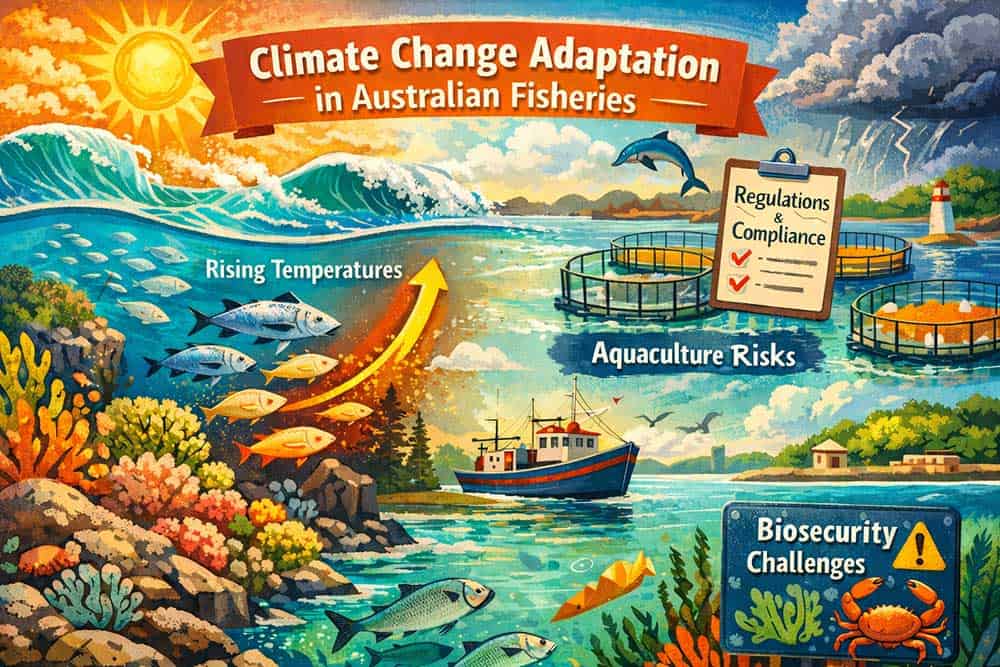
Climate change is no longer a future policy concern for Australia’s fisheries sector — it is a present operational reality. Rising sea temperatures, marine heatwaves, ocean acidification, shifting stock distributions and extreme weather events are already affecting catch patterns, stock assessments and management settings across Commonwealth and State jurisdictions.
In response, climate change adaptation is increasingly embedded — directly and indirectly — within Australia’s fisheries law framework. While few statutes use the phrase “climate adaptation obligations” expressly, legal duties to ensure ecological sustainability, precautionary management and adaptive decision-making are driving practical change.
For commercial fishers, aquaculture operators and licence holders, the implications are significant. Climate change is influencing quota settings, spatial closures, reporting obligations, environmental assessments and licence conditions. Understanding how climate risk intersects with fisheries law is now essential to regulatory compliance and long-term business continuity.
1.The Legislative Framework: Sustainability at the Core
Australian fisheries are regulated under a combination of:
- The Fisheries Management Act 1991 (Cth)
- The Fisheries Administration Act 1991 (Cth)
- The Environment Protection and Biodiversity Conservation Act 1999 (Cth) (EPBC Act)
- State and Territory fisheries legislation
- Subordinate regulations, management plans and harvest strategies
Across these frameworks, the guiding principle is ecological sustainability.
Under Commonwealth law, fisheries must be managed in a manner consistent with:
- Ecologically Sustainable Development (ESD) principles
- The precautionary principle
- Long-term sustainability of fish stocks
- Protection of the marine environment
Climate change is now recognised as a material factor affecting stock sustainability. Consequently, management decisions that fail to account for climate risk may be legally vulnerable.
2.The Precautionary Principle and Climate Uncertainty
The precautionary principle requires that lack of full scientific certainty should not delay measures to prevent environmental degradation where there is a risk of serious or irreversible harm.
Climate change introduces precisely this type of uncertainty:
- Shifting biomass distribution
- Recruitment variability
- Changes in spawning behaviour
- Altered predator-prey dynamics
- Increased disease prevalence
Fisheries managers are therefore under legal pressure to adopt precautionary harvest strategies where climate impacts are uncertain but plausible.
This can translate into:
- Reduced total allowable catches (TACs)
- More conservative biomass reference points
- Increased buffer margins
- Spatial or seasonal closures
While such measures may not be framed as “climate regulations,” they are often justified on climate-linked ecological grounds.
3.Adaptive Management as a Legal Obligation
Modern fisheries law increasingly relies on adaptive management — a structured process of monitoring, reviewing and adjusting management settings in response to new information.
Climate change accelerates the need for adaptive governance because historical data may no longer predict future stock behaviour.
Commonwealth harvest strategies now frequently include:
- Dynamic biomass thresholds
- Trigger points for management action
- Regular review cycles
- Enhanced stock assessment frequency
Failure to incorporate emerging climate science into management reviews could expose regulatory decisions to judicial review on the basis that relevant considerations were ignored.
For licence holders, this means management settings may change more frequently than in the past — not as a regulatory anomaly, but as part of legally required adaptation.
4.EPBC Act Considerations and Export Approvals
The EPBC Act plays a central role in climate-related fisheries regulation, particularly through:
- Strategic assessments
- Wildlife Trade Operation (WTO) approvals
- Listed species protections
- Marine protected area frameworks
To export certain seafood products, fisheries must maintain WTO approval demonstrating ecological sustainability.
Climate vulnerability of target stocks and bycatch species is increasingly relevant in these assessments. If a fishery fails to demonstrate climate resilience in its management regime, export accreditation may be placed at risk.
Additionally, climate change impacts on threatened species — such as marine mammals, seabirds or coral systems — may trigger stricter bycatch mitigation or spatial restrictions.
5.Shifting Stock Distribution and Jurisdictional Complexity
One of the most tangible climate impacts is the southward movement of certain fish stocks along Australia’s coastline as waters warm.
This creates legal and operational complications:
- Stocks historically managed within one jurisdiction may shift into another.
- Quota allocations based on historical catch patterns may become misaligned.
- Interjurisdictional disputes may arise regarding resource sharing.
Australian fisheries law does not automatically reallocate rights when ecological boundaries shift. This raises complex legal questions about:
- Allocation fairness
- Compensation claims
- Reallocation mechanisms
- Intergovernmental agreements
Fishers operating near jurisdictional boundaries should anticipate evolving management discussions in coming years.
6.Marine Heatwaves and Emergency Powers
Marine heatwaves — such as those experienced off Western Australia — can cause rapid stock decline or ecosystem collapse.
Fisheries legislation generally provides emergency powers enabling regulators to:
- Suspend fishing activities
- Reduce quotas mid-season
- Close areas
- Amend licence conditions
While necessary for stock protection, these powers can significantly affect commercial viability.
Climate change increases the likelihood that emergency management interventions will become more frequent. Operators should review licence terms and statutory frameworks to understand:
- Scope of regulator discretion
- Compensation eligibility (if any)
- Appeal mechanisms
In many jurisdictions, compensation is not guaranteed where closures are implemented for sustainability reasons.
7.Aquaculture: Biosecurity and Climate Risk
Climate change presents distinct challenges for aquaculture operators, including:
- Increased disease prevalence
- Harmful algal blooms
- Ocean acidification
- Extreme storm damage
Aquaculture licences often impose biosecurity and environmental management obligations. As climate-related disease risk increases, regulators may strengthen:
- Monitoring requirements
- Reporting thresholds
- Stock density restrictions
- Site relocation requirements
Failure to meet evolving biosecurity obligations may result in licence suspension or cancellation.
Operators should ensure climate risk is incorporated into:
- Farm management plans
- Infrastructure design
- Insurance coverage
- Contingency protocols
8.Climate Reporting and Corporate Governance
Although fisheries legislation focuses on ecological management, climate adaptation obligations increasingly intersect with corporate governance law.
Large seafood businesses may be subject to:
- Climate-related financial disclosure requirements
- ESG reporting obligations
- Modern slavery reporting
- Supply chain transparency standards
Directors have duties to exercise reasonable care and diligence. As climate risk becomes more foreseeable and scientifically documented, failure to consider its operational impacts may raise governance concerns.
Boards of seafood enterprises should ensure that climate adaptation is incorporated into risk management frameworks, not treated solely as an environmental compliance issue.
9.Infrastructure and Coastal Planning Controls
Climate change is influencing coastal planning law and marine infrastructure approvals.
Rising sea levels and extreme weather events may affect:
- Wharf infrastructure
- Processing facilities
- Aquaculture moorings
- Storage and transport logistics
Planning authorities increasingly require climate resilience assessments as part of development approvals. Fisheries businesses seeking infrastructure upgrades may face enhanced design standards and environmental impact requirements.
10.Insurance and Financial Risk Exposure
Insurers are reassessing risk exposure in climate-vulnerable sectors. Fisheries businesses may experience:
- Increased premiums
- Coverage exclusions for climate-related events
- Stricter disclosure obligations
If regulatory adaptation measures reduce catch allocations or suspend operations, insurance policies may not respond unless carefully structured.
Legal review of insurance coverage is becoming an important element of climate adaptation strategy.
11.Emerging Areas of Reform
Several reform trends are likely to shape climate adaptation obligations in coming years:
1.Climate-Responsive Harvest Strategies
Explicit incorporation of climate modelling into stock assessments.
2.Ecosystem-Based Management
Broader ecosystem indicators may influence fishing effort limits.
3.Carbon Accounting
Potential consideration of emissions intensity in marine industries.
4.Greater Data Transparency
Mandatory electronic monitoring and reporting to support adaptive management.
5.Cross-Jurisdictional Agreements
Revisions to resource-sharing arrangements as stock distributions shift.
12.What Are the Risks for Fishers and Licence Holders?
Climate adaptation within fisheries law creates several practical risks:
- Reduced quota allocations
- Increased compliance costs
- More frequent regulatory change
- Emergency closures without compensation
- Heightened monitoring obligations
- Export accreditation risk
However, failure to adapt operationally may create even greater long-term business exposure.
13.Practical Steps for Industry Participants
To navigate evolving climate adaptation obligations, fisheries businesses should consider:
1.Review Management Plans
Understand how climate considerations are embedded in harvest strategies and stock assessments.
2.Engage in Consultation Processes
Regulators often seek industry input when adjusting management settings. Early engagement can influence practical outcomes.
3.Strengthen Data Collection
Robust catch and environmental data may support arguments for balanced management decisions.
4.Assess Contractual Exposure
Supply agreements should account for quota variability and potential closures.
5.Diversify Operational Risk
Geographic diversification or species diversification may mitigate climate-driven volatility.
6.Integrate Climate Risk into Governance
Board-level oversight of climate exposure is increasingly prudent.
Conclusion
Climate change adaptation is reshaping Australian fisheries law — not through a single legislative reform, but through evolving interpretation of sustainability, precaution and adaptive management principles.
For fishers and aquaculture operators, this means regulatory settings may become more dynamic, conservative and data-driven. Emergency interventions may become more common. Compliance expectations may expand.
While these changes present commercial challenges, they also reflect the legal system’s effort to ensure long-term stock viability and industry continuity in a changing marine environment.
Businesses that treat climate adaptation as a core regulatory and governance issue — rather than a peripheral environmental concern — will be better positioned to navigate future reforms and protect their operating rights.
In Australia’s fisheries sector, climate resilience is no longer optional. It is increasingly embedded in the legal architecture governing access to the resource itself.