
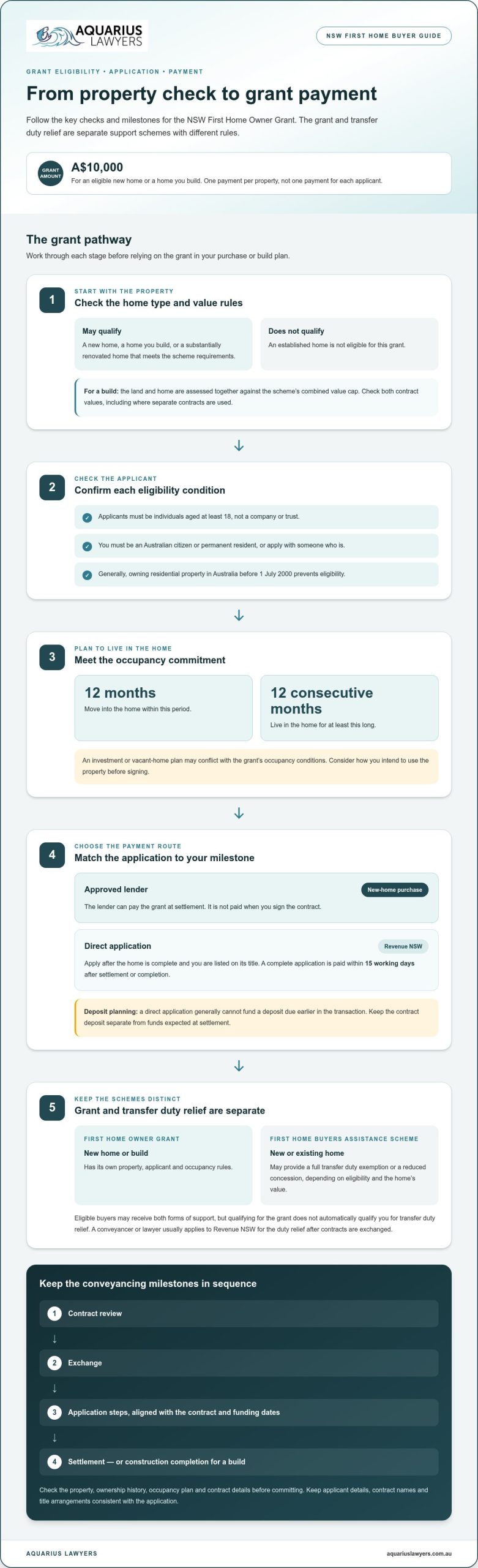
The NSW First Home Owner Grant pays A$10,000 to eligible buyers of a new home or people building one. Conveyancing for a NSW first home buyer grant purchase can also involve a separate transfer duty concession, but the grant and concession have different eligibility rules.
It’s easy to focus on the grant amount and overlook the conditions that determine whether you qualify. The property type and value, your first-home status and how you apply all matter.
This guide explains the property value caps, eligibility, payment timing and application process for the grant. It also clarifies how the grant differs from NSW transfer duty relief, so you can see which support may apply and what to plan for during conveyancing.
Key Takeaways
- Eligible buyers may receive an A$10,000 NSW First Home Owner Grant for a qualifying new home or build.
- For a build, the combined value of the land and home cannot exceed A$750,000, according to Revenue NSW.
- A complete direct grant application is paid within 15 working days after settlement or completion; an approved lender can pay the grant at settlement for a new-home purchase.
- Eligible first home buyers may receive a reduced transfer duty concession on a home worth more than A$800,000 and less than A$1,000,000, according to Revenue NSW.
- Grant applications and transfer duty concessions are separate processes; a conveyancer or lawyer usually applies for the duty relief after contracts are exchanged.
How much is the NSW First Home Owner Grant (FHOG)?
The NSW First Home Owner Grant provides A$10,000 for an eligible new home or a home you build. A new home must meet the scheme’s value requirements. A substantially renovated home may also qualify if it meets the scheme’s requirements. While specialist contractors such as Swiss Build Ltd illustrate the kind of extensive domestic overhauls needed to transform an existing dwelling, Australian purchases must satisfy strict statutory criteria. Established homes do not qualify for this grant. Conveyancing for a first home buyer grant in NSW starts with checking the contract and property type against these rules.
For a build, the combined value of the land and home being built cannot exceed A$750,000, according to Revenue NSW. Assess both contract values together before relying on the grant. The cap applies to the combined land and building value, not just the construction work. If the land and building arrangements use separate contracts, review both as part of the same purchase plan.
Applicants must be individuals aged at least 18, not a company or trust. You must be an Australian citizen or permanent resident, or apply with someone who is. Generally, owning residential property in Australia before 1 July 2000 prevents eligibility. The grant is limited to one A$10,000 payment per property, rather than one payment for each applicant.
Grant recipients must move into the home within 12 months and live there for at least 12 consecutive months. Treat this occupancy commitment as part of your purchase decision. A plan to use the property as an investment or leave it vacant may conflict with the grant conditions. Consider your intended use before signing the contract.
The First Home Buyers Assistance Scheme is separate, and eligible buyers may receive both forms of support. Eligible first home buyers can receive a full transfer duty exemption on a new or existing home valued up to A$800,000. For a home worth more than A$800,000 and less than A$1,000,000, eligible buyers receive a reduced concession, according to Revenue NSW. The duty scheme has its own thresholds, so grant eligibility does not automatically mean you qualify for an exemption.
A conveyancer reviews the contract and can help you understand how the grant and buyers assistance scheme may apply. A conveyancer or lawyer usually applies to Revenue NSW for transfer duty relief after contracts are exchanged. Conveyancing for a NSW first home buyer grant purchase can connect these application steps with key contract milestones.
The usual sequence is contract review, exchange, application and settlement. For a build, construction and completion also affect the process. The steps depend on the contract and property type, so understand the timing before committing.
Before signing, compare the property value, your ownership history, occupancy plans and contract terms with the grant rules. Keep your documents consistent: applicant details, contract names and title arrangements should match the application. A careful review can flag eligibility or contract issues before they disrupt your purchase.
Grant payment timing and use toward a deposit
For a NSW first-home buyer, conveyancing can help align grant applications with contract and settlement dates. Engage a conveyancer before signing or exchanging, so application steps and funding deadlines can be considered early.
Grant payment timing
Payment timing depends on whether you apply through an approved lender or directly to Revenue NSW. For a new-home purchase, an approved lender pays the grant at settlement. The grant may therefore be available when the purchase completes, but it is not paid when you sign the contract.
For a direct application, you can apply after the home is completed and you’re listed on its title. A complete application is paid within 15 working days after settlement or completion. That means a direct application generally can’t fund a deposit due earlier in the transaction. Include this timing in your cash-flow plan, particularly if construction completion and settlement are separate milestones.
Using the grant for a deposit
The grant can contribute to the funds needed to complete an eligible purchase, particularly when an approved lender pays it at settlement. A contract deposit may be due earlier, so don’t treat a later grant payment as funds already available for that payment.
Ask your lender how the grant fits your funding arrangements, and match each payment to its due date. For example, a direct application made after completion won’t provide funds for an earlier contract deposit. Keep the deposit separate from funds expected at settlement when planning conveyancing for your NSW first home purchase.
The Australian Government 5% Deposit Scheme is separate from the NSW grant. Eligible first home buyers can purchase with a minimum 5% deposit. Eligible single parents and legal guardians need a minimum 2% deposit. The scheme is not a cash grant; it supports eligible buyers using a smaller deposit.
From 1 October 2025, the scheme has no income caps for applications. Its property price cap is A$1,500,000 in Sydney and the listed NSW regional centres, and A$800,000 elsewhere in NSW. Check the property’s location and purchase price against the applicable cap before relying on this scheme.
The scheme can remove Scheme LMI, but you remain responsible for the full loan, costs and repayments. It doesn’t reduce the amount you borrow. Compare the deposit requirement with your lender’s approval and repayment arrangements before committing to a contract, especially if your partner will apply with you. Keep grant timing, deposit obligations and settlement funds distinct in your conveyancing plan.
What first home buyer grants and concessions are available in NSW?
NSW buyers may be able to combine a new-home grant with transfer duty relief, but each program has separate tests. The First Home Owner Grant supports eligible purchases or builds of new homes; transfer duty relief may also apply to eligible existing homes. Separate property value caps or occupancy conditions may affect each benefit.
For homes above the full transfer duty exemption threshold, the concession may still reduce duty. In NSW, eligible first home buyers receive a reduced transfer duty concession on a home worth more than A$800,000 and less than A$1,000,000, according to Revenue NSW. That is a concession, not a full exemption. The contract value can therefore affect the duty outcome even where the grant is not available for that property.
Vacant land has its own First Home Buyers Assistance Scheme thresholds. Eligible buyers pay no transfer duty on vacant land purchases up to A$350,000. For land worth more than A$350,000 and less than A$450,000, eligible buyers may receive a reduced concession. This matters if you plan to build: assess the land duty concession separately from the grant’s combined land-and-building cap.
Other support is not a grant or duty concession. The NSW Shared Equity Home Buyer Helper may contribute up to 40% of an eligible property’s purchase price. It may assist single parents with dependent children, single people aged 50 years and over, and first-home buyers working as nurses, midwives, paramedics, teachers, early childhood educators or police officers. The contribution is retained as equity while you remain eligible or until the property is sold.
The Australian Government Help to Buy scheme is another shared-equity option. It can contribute up to 40% of a new home’s price or 30% of an existing home’s price. As at October 2026, income caps are A$103,000 for individuals and A$165,000 for joint applicants and single parents. Applications opened on 5 December 2025, with 10,000 places nationally each year.
The First Home Super Saver Scheme works differently: it lets you save through superannuation rather than providing a property grant. Compare each program’s purpose and eligibility before relying on it in your purchase plan. A conveyancer can help distinguish a duty application from grant or shared-equity arrangements, keeping contract and funding steps aligned.
How much does conveyancing cost for a first home buyer in NSW?
The work involved in a NSW first-home purchase depends on the property, contract and tasks required before settlement. A standard established-home contract differs from a vacant land purchase, new build or off-the-plan transaction. Identify the property type first, then clarify what the conveyancing arrangement covers, from contract review through settlement.
Contract review is central to the process. The conveyancer examines the terms, flags conditions that affect your purchase and explains what needs attention before you commit. If the contract has unusual conditions or the purchase involves linked agreements, make sure those documents are included in the agreed scope.
Understand the work involved
Conveyancing can include contract review, correspondence and settlement preparation. Property searches may also be relevant, depending on the transaction and the information needed. Ask which searches and documents are covered, and how you’ll receive updates as the matter progresses.
For a land-and-build purchase, clarify whether the work covers both contracts and how each stage will be coordinated. An off-the-plan purchase may raise different contract questions from an established home. If you’re considering property transaction support, link the work required to the actual documents and stages in your purchase.
Compare the scope, not just the service label
Before engaging a conveyancer, compare the written scope of work. Check who will review the contract, handle communications, prepare settlement documents and complete the transfer. Clarify how additional work is handled if the contract changes or a new issue arises. A clear scope helps you understand what is covered and what falls outside the arrangement.
Provide the contract and relevant property details at the outset. Tell the conveyancer if the purchase involves vacant land, construction arrangements, unusual conditions or multiple agreements. These details help define the work required, rather than relying on assumptions about a standard purchase.
Keep the written scope with your transaction documents and refer to it as milestones arise. If a lender requests documents or the seller proposes a contract change, establish whether the task is included in the agreed work before proceeding. This clarifies who is handling each step and what information they need from you.
Aquarius Lawyers: Marine Law
Aquarius Lawyers advises on Marine Law matters connected with marine activities and assets. This may be relevant if your property decisions also involve a marine business, fisheries interests or aquaculture assets. It is separate from applying for a first home grant or arranging residential conveyancing.
If buying a home is part of a wider plan involving commercial marine operations, Fisheries Law, Aquaculture Law or Commercial Law may also be relevant. Legal questions can extend beyond the home, particularly when business interests and property decisions intersect. Identify these issues early to understand what needs attention alongside your purchase.
For a straightforward first-home purchase, focus on the grant, duty relief, contract and settlement process outlined above. If you have a related marine or commercial legal issue, contact Aquarius Lawyers to discuss it or visit aquariuslawyers.com.au.
Take your next step with a clear plan
Your property decision may sit alongside broader business or asset questions. If a home purchase connects with marine operations, fishing interests or aquaculture assets, include those issues in your planning. Keeping the residential purchase and commercial interests distinct can help identify which legal questions need attention before you commit.
Aquarius Lawyers offers Marine Law, Fisheries Law and Aquaculture Law. If these areas intersect with your plans, seek advice focused on the relevant legal issues. For first-home buyers, planning carefully around the grant and NSW conveyancing can help align contract commitments with funding arrangements.
Contact Aquarius Lawyers to discuss your legal matter. Take the next step with a clear understanding of the issues, and move towards your purchase with confidence.
Frequently Asked Questions
Who is eligible?
You must apply as an individual aged at least 18, and meet the citizenship or permanent residency requirement. Your purchase must fit the grant’s eligible new-home or building rules, and prior Australian residential property ownership can affect your claim. For a joint purchase, review each applicant’s circumstances and ensure the names and ownership arrangements match the application and title records.
Can temporary residents apply?
Temporary residency alone does not qualify an applicant. You must be an Australian citizen or permanent resident, or apply with someone who is. For example, if you’re buying with a partner who is an Australian citizen or permanent resident, their status may meet this part of the test. The other applicant and the property must still satisfy the grant’s separate requirements.
Is the grant income-tested or taxed?
The NSW First Home Owner Grant is not assessable income for tax purposes. Its eligibility criteria focus on the applicant, property and occupancy requirements, rather than a stated income threshold. Don’t assume the same applies to every home-buying program: the Help to Buy scheme has separate income caps. Assess each scheme separately when planning your borrowing and tax position.
What does the first home buyers grant mean for Sydney buyers?
Sydney buyers face the same NSW grant rules as other eligible buyers, so the property type and value remain central. Location matters separately for the Australian Government 5% Deposit Scheme: Sydney has a A$1,500,000 property price cap. That scheme is not the NSW grant. Check which program you’re relying on, because its cap and funding role differ.
What are the NSW First Home Owner Grant eligibility rules and payment amount?
The grant pays A$10,000 for an eligible new home or build, subject to applicant, value and occupancy rules. It is limited to one grant per property, not one per buyer. Before submitting an application, compare the contract and title details with the applicant names, then check that the property meets the relevant new-home or construction criteria.
Can first home buyers in NSW combine the grant, stamp duty concessions, and federal schemes?
Yes, eligible buyers may be able to combine the NSW grant and First Home Buyers Assistance Scheme with a federal program, provided each program’s conditions are met. For example, the 5% Deposit Scheme supports eligible buyers with a smaller deposit, while Help to Buy uses shared equity. These are different forms of assistance, so check each application’s eligibility and funding arrangements independently.
Disclaimer
Please note that legal rules change and this is not a substitute nor construed as legal advice. It is general information only.