
Shoplifting may amount to larceny. The prosecution must prove that you dishonestly took someone else’s property without consent, intending to permanently deprive them of it. These elements are central to stealing offences in NSW, and the charge and potential penalties depend on the circumstances.
It’s understandable to think that taking something temporarily, or believing it belongs to you, changes the situation. Those details can matter: a genuine claim of right and a lack of intent to permanently deprive may be relevant to a defence. Larceny is usually heard in the Local Court, although some matters may be dealt with in the District Court.
This guide explains what larceny means, how shoplifting is treated, and how taking or driving a conveyance without consent differs from ordinary larceny. It also covers which courts may hear a stealing matter and what factors can affect the applicable penalties. Understanding the charge is a practical first step in assessing the legal risks and issues that may shape your response.
Key Takeaways
- Larceny turns on whether property belonging to someone else was taken dishonestly, without consent, and with intent to permanently deprive the owner.
- The property’s value and whether the prosecution or accused elects a District Court hearing can affect where a matter is heard.
- Taking or driving a conveyance without consent is treated under specific provisions, and the law covers more than motor vehicles.
- Shoplifting may be charged as larceny, but the circumstances and evidence matter when assessing the allegation and possible defences.
Which Court Will Hear the Matter?
Shoplifting describes an alleged taking from a shop, while larceny is the offence the prosecution may charge. Robbery is a separate stealing offence, not simply another name for shoplifting.
Once police charge you, the allegation proceeds through criminal court proceedings. The prosecution must prove every element of larceny beyond reasonable doubt, and the court decides whether you are guilty.
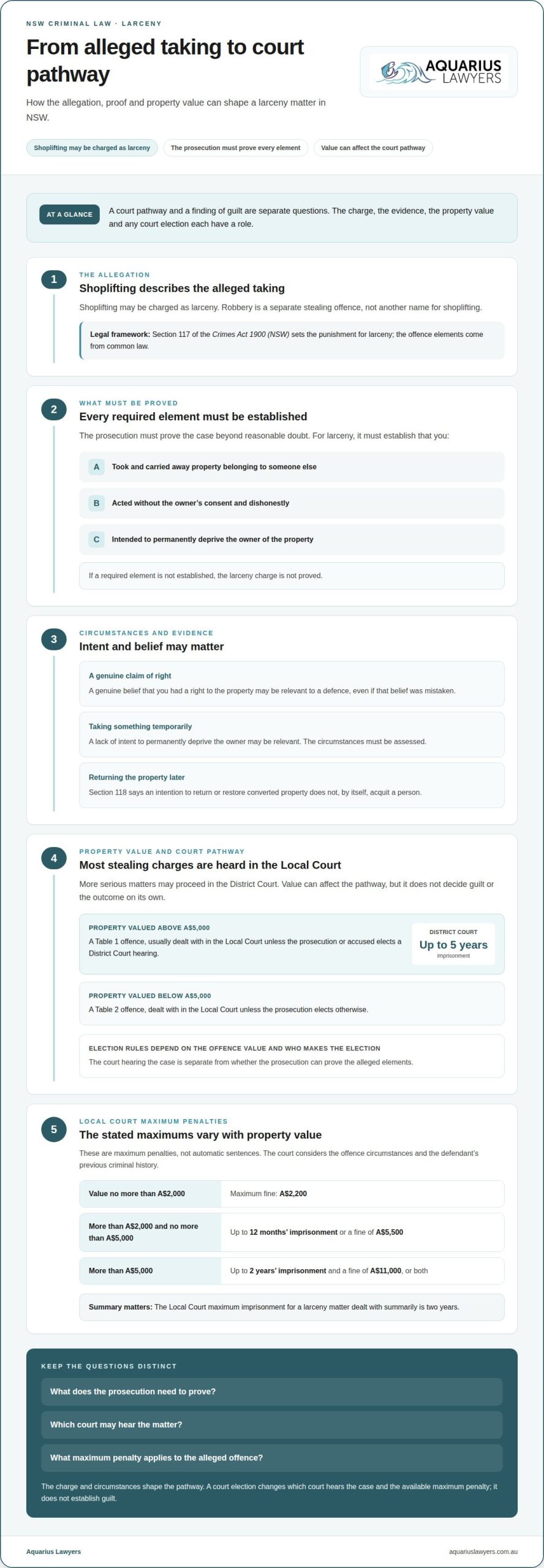
Section 117 of the Crimes Act 1900 (NSW) sets the punishment for larceny, but its elements come from common law. The High Court of Australia discussed those requirements in Ilich v The Queen, at page 124. In practical terms, the prosecution must establish that property belonging to someone else was taken and carried away without consent. It must also prove dishonesty and an intention to permanently deprive the owner. If one required element is not established, the larceny charge is not proved.
Dishonesty is assessed against the standards of ordinary decent people. For example, taking a pen from a counter without asking may not establish larceny if the circumstances do not prove an intention to keep it permanently. A genuine belief that you had a right to the property may also matter to a defence, even if that belief was mistaken. Returning property later does not automatically answer the charge: section 118 says an intention to return or restore converted property does not, by itself, acquit a person.
Most stealing charges are dealt with in the Local Court, while more serious matters may be dealt with in the District Court. The charge and circumstances affect the court pathway, and property value may also be relevant. Some matters may be dealt with summarily, while an eligible matter may proceed to the District Court if the prosecution or accused elects that course. The court hearing the case is a separate question from whether the prosecution can prove the alleged elements.
Section 121 of the Crimes Act 1900 (NSW) addresses a jury’s verdict when larceny and receiving are both charged over the same property. If the jury cannot determine whether the accused stole or received that property, it may return a verdict for the other offence where its elements are present. This direction does not apply to unrelated property. Section 10F also provides for prosecution in NSW of certain larceny offences committed outside the state by a public officer. That provision is specific; it does not make every alleged taking outside NSW a NSW matter.
How does NSW law determine whether a stealing offence is heard in Local Court or District Court?
The alleged value of the stolen property can help determine the charge pathway and possible penalty. It does not decide the outcome on its own: the offence, court election, circumstances and your criminal history also matter.
In the Local Court, the maximum penalty depends partly on the property’s value. For larceny involving property worth no more than A$2,000, the maximum fine is A$2,200. For property worth more than A$2,000 and no more than A$5,000, the stated maximum is 12 months’ imprisonment or an A$5,500 fine. Local Court matters can also carry a maximum of two years’ imprisonment when dealt with summarily.
For property worth more than A$5,000, the stated Local Court maximum is two years’ imprisonment and an A$11,000 fine, or both. These are maximum penalties, not automatic sentences. A court considers the offence circumstances and the defendant’s previous criminal history when determining the penalty.
Value can also affect whether a larceny matter proceeds in the Local Court or District Court. Larceny involving property valued above A$5,000 is a Table 1 offence, usually dealt with in the Local Court unless the prosecution or accused elects a District Court hearing. Larceny involving property valued below A$5,000 is a Table 2 offence, dealt with in the Local Court unless the prosecution elects otherwise. The applicable election rules therefore depend on the value threshold and who makes the election.
If the matter is dealt with in the District Court, larceny carries a maximum penalty of five years’ imprisonment. By comparison, the Local Court’s maximum imprisonment for a summary offence is two years. A District Court election changes which court hears the case and the available maximum penalty, but does not establish guilt.
For an employee accused of taking an employer’s property, the allegation is assessed by the conduct and the property involved, not simply by the workplace relationship. Under section 125 of the Crimes Act 1900 (NSW), a bailee who fraudulently takes or converts property for their own use or another person’s use is deemed guilty of larceny. Embezzling is a separate offence, with a maximum penalty of 10 years’ gaol in NSW.
Dishonesty allegations can arise under different provisions, so the specific charge and evidence matter; see this guide to fraud and dishonesty offences in NSW. If you need advice about a criminal charge, criminal law representation can help you assess the allegation and available options.
Taking and driving conveyances without consent
NSW law distinguishes larceny from specific offences involving conveyances. Sections 154A and 154F of the Crimes Act 1900 (NSW) address different conduct involving vehicles and other conveyances.
Meaning of Fraudulent Taking
Fraudulent taking means dishonestly taking or converting property for your own use or someone else’s use. Section 125 of the Crimes Act 1900 (NSW) treats a bailee who fraudulently converts property as guilty of larceny. A bailee is someone entrusted with another person’s property, so the circumstances of that entrustment matter.
Section 154A covers a different kind of alleged taking. Under section 154A(1)(a), it is an offence to take and drive a conveyance, or take it for specified purposes, without the owner’s or lawful possessor’s consent. Section 154A(2) includes motor cars, bicycles, trailers, tractors and ships used for navigation. This means the charge is not limited to cars.
Section 154A offences are deemed to be larcenies under section 116. However, the prosecution still needs to establish the elements of the particular offence charged. A lawyer assessing a possible conviction would distinguish an allegation of fraudulent conversion under section 125 from unauthorised conveyance use under section 154A.
Temporary Taking and Intent
For ordinary larceny, temporarily taking property without intending to permanently deprive its owner does not establish that element of the offence. The intention behind the taking matters, not just whether the property was moved or later returned. For example, briefly borrowing a vehicle differs from intending to keep it, although the precise circumstances remain relevant.
Section 154A creates a separate issue for conveyances. Its wording covers taking and driving a conveyance without consent, so a person may face an allegation even if they intended to return it. Under section 154A(1)(b), driving a conveyance knowing it was taken without consent, or allowing yourself to be carried in it, is also an offence.
Keep the two questions separate: did you intend to deprive the owner permanently, and was the conveyance taken or driven without consent? The answer to the first may matter to larceny; the second concerns the specific section 154A conduct. A temporary-use explanation alone does not resolve both questions.
Claim of Right and Mistake
A claim of right is a genuine belief that you were entitled to the property, even if that belief was mistaken. It may be relevant to whether the taking was dishonest, an element of larceny. The circumstances behind the belief matter, including what you understood about ownership or permission when you took the property.
A mistake about permission may also be relevant to an allegation under section 154A, which concerns taking or driving without the owner’s or lawful possessor’s consent. The key issue is what you believed and what the evidence shows about consent. A mistaken belief is not the same as permission being given.
These distinctions can affect how an allegation is assessed, but they do not make every unauthorised temporary use a defence. Section 154F separately creates an offence for stealing a motor vehicle, vessel or trailer. The charge, your intention and the evidence of consent must be considered together when assessing potential liability or imprisonment.
Shoplifting and stealing offences in NSW
Shoplifting is not a separate name for every stealing charge in NSW. Where the allegation concerns taking goods from a shop, police may charge the accused with larceny under section 117 of the Crimes Act 1900 (NSW).
Police may issue a fine for stealing instead of taking a person to court. A shoplifting allegation may also proceed as a court charge. If you receive a court attendance notice, take the listed court date and charge seriously.
The prosecution must prove every element of larceny beyond reasonable doubt. It must show that the accused took property belonging to someone else, without the owner’s consent, dishonestly and intending to permanently deprive the owner. A missing item alone does not prove who took it or establish each element.
That distinction matters in a shop. For example, someone may leave with an item because they forgot it was in a basket or believed it had been paid for. Those circumstances do not decide the charge automatically, but may be relevant to dishonesty and intention. The prosecution must still prove the alleged offence with evidence.
Evidence may include accounts of what happened, payment records or observations of the alleged taking. The question is how that evidence supports each required element, not simply whether store staff suspected theft. If the accused says they had permission to take the goods, consent becomes a live issue. If they say they intended to return the item, the alleged intention to permanently deprive remains central.
Section 117 prescribes punishment for larceny, while the appropriate penalty depends on the offence circumstances and the defendant’s previous criminal history. The court may consider the value of the goods and the way the alleged taking occurred. A shoplifting allegation can therefore carry different consequences from one case to another; the label alone does not determine the sentence.
Shoplifting also differs from robbery. Robbery is a separate offence, and NSW law sets distinct penalties for robbery and robbery with circumstances of aggravation. An allegation involving force or aggravating circumstances should not be treated as ordinary shoplifting.
For a summary stealing offence, proceedings must generally begin within six months of the alleged offence. If police issue a fine or charge, read the document carefully to identify the alleged conduct and required response. Criminal law advice can help assess the charge, evidence and any available defence.
Aquarius Lawyers
Aquarius Lawyers can help assess a stealing allegation, the evidence supporting it and the court process ahead. If police have charged you or you have received a court attendance notice, early legal advice can clarify the charge, identify issues in the prosecution case and consider possible defences. The right approach depends on the alleged conduct, available evidence and your circumstances.
Understanding the difference between larceny, shoplifting and unauthorised conveyance taking can help you make sense of the allegation, but it doesn’t replace advice about your case. Contact Aquarius Lawyers to discuss your stealing matter and the next steps.
Take the next step with a clear plan
A stealing charge can affect more than the immediate court process. Your decisions may shape how the allegation is assessed and how you prepare your response. If you’re facing a stealing offence in NSW, seek advice about your specific charge and the evidence rather than relying on assumptions about what happened in another case.
Aquarius Lawyers offers Criminal Law, alongside Marine Law, Fisheries Law and Aquaculture Law. For advice about your situation and a practical way forward, contact Aquarius Lawyers for advice.
Informed action can help you approach the next stage with greater clarity.
Frequently Asked Questions
What is larceny?
Larceny is the formal offence name you may see on a NSW charge document. The charge sets out the allegation, not a court finding. Read the charge title alongside its particulars, which describe the alleged conduct. If the document names a different offence, such as receiving or a conveyance offence, don’t assume it means the same thing as larceny. The wording matters when you respond.
What is stealing?
Stealing is a common, everyday word, while legal documents identify the specific offence police allege. That distinction can help you understand a court notice: the word “stealing” alone doesn’t tell you which offence is charged or what the prosecution must establish. Use the offence name and particulars on the document when discussing the allegation, rather than relying on a general description of what happened.
Will I receive a criminal conviction?
A charge or court attendance notice is not itself a criminal conviction. The court outcome depends on how the matter is resolved, so the notice alone cannot tell you whether a conviction will be recorded. If an employer, licensing body or application form asks about your criminal history, read the exact question carefully and answer accurately. A charge and a conviction are different stages.
How can a criminal lawyer help defend against stealing charges in NSW?
A criminal lawyer can explain the court process, clarify what a court notice requires and help prepare you for the next appearance. They can also discuss how to communicate your position and what material may be relevant, such as receipts, messages or records showing permission to use an item. This preparation can help you make informed decisions as your matter progresses.
What should I ask a lawyer about stealing charges in NSW?
Aquarius Lawyers can discuss the proposed legal work with you directly. Explain whether you have received a police notice, entered a plea or have a court date, and ask what the work will cover. You can also clarify which documents are relevant. This helps define the advice you need at your matter’s current stage.
Is there a time limit for police to charge someone with stealing offences in NSW?
The applicable time limit depends on how the alleged offence is classified and how proceedings are brought. Don’t assume the same deadline applies to every stealing allegation. Keep a record of when the alleged incident occurred and when you received any police or court document. Those dates can help a lawyer assess which timing rules apply and what response is needed.
Disclaimer
Please note that legal rules change and this is not a substitute nor construed as legal advice. It is general information only.