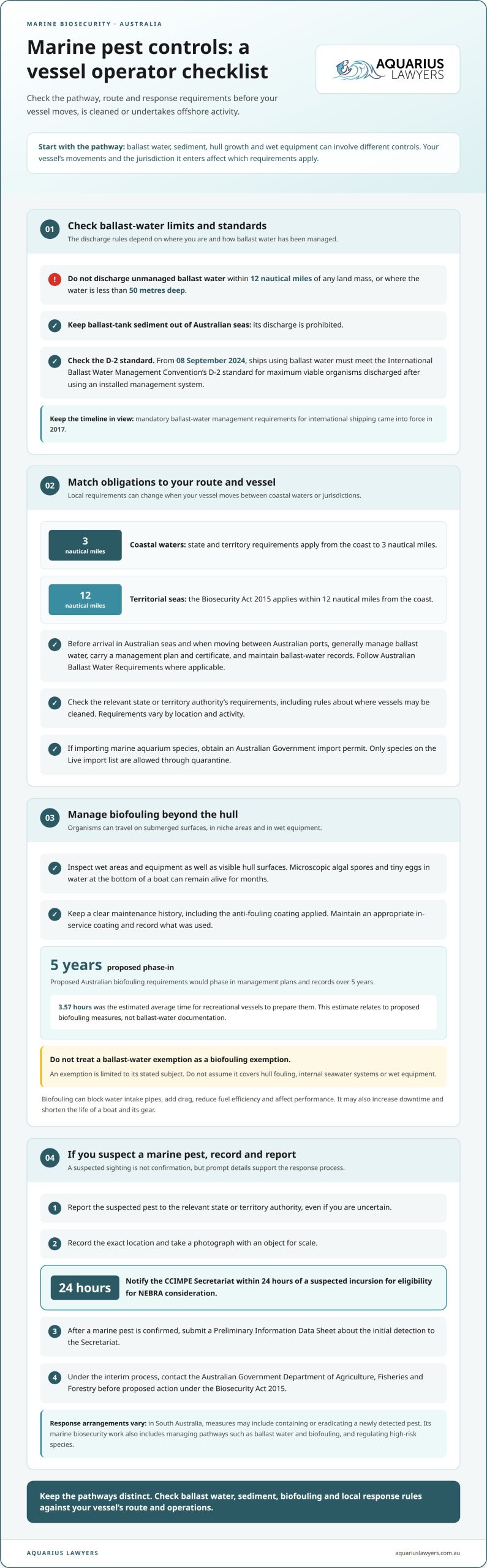
Unmanaged ballast water discharge is prohibited in Australian seas within 12 nautical miles of any land mass or where water is less than 50 metres deep. That’s one clear starting point for understanding marine pest incursion legal obligations, but the rules also depend on where your vessel operates and how it could spread pests. For operators, the practical challenge is recognising which obligations apply to each decision, rather than treating marine biosecurity as a single checklist.
Marine biosecurity involves more than ballast water. Biofouling, declared noxious aquatic species and offshore activities can each trigger different requirements, so a vessel’s route and operations matter. Decisions about vessel movements, cleaning and offshore planning raise distinct questions. Understanding the relevant framework helps you address them in context.
This article explains the Australian rules that shape these obligations, including ballast-water management, vessel biofouling controls and requirements for offshore Environment Plans. It also outlines how state and territory rules may apply and what to do if you suspect a marine pest. The aim is to help you connect the relevant rules to your vessel or operation and recognise when a legal issue needs closer attention.
Use these distinctions to identify legal issues early, before a vessel movement, cleaning decision or offshore activity creates a biosecurity problem. Clear preparation supports informed operational decisions and a considered response when a concern arises.
Key Takeaways
- Identify which state or territory rules apply to your vessel’s route and activities, particularly in coastal waters.
- Ships using ballast water must meet the International Ballast Water Management Convention’s D-2 standard from 08 September 2024.
- Keep vessel biofouling and ballast-water practices in view: both can create pathways for marine pests to spread.
- Report a suspected marine pest to the relevant state or territory authority; notify the CCIMPE Secretariat within 24 hours for NEBRA consideration.
- For offshore petroleum activities that could spread marine pests, account for NOPSEMA Environment Plan requirements and consultation duties.
Australian ballast-water management obligations
Ballast-water rules govern how vessels manage water and sediment to reduce the risk of introducing marine pests. Your obligations depend on vessel movements, ballast-water use and applicable state or territory requirements.
Marine pest laws and import permits
Marine biosecurity laws regulate pest pathways, while import permits control the entry of specified marine species. The Biosecurity Act 2015 and related delegated legislation regulate ballast-water discharge and sediments in Australian waters. Unmanaged ballast water cannot be discharged within 12 nautical miles of any land mass or where water is less than 50 metres deep. Discharging ballast-tank sediment within Australian seas is also prohibited.
Mandatory ballast-water management requirements for international shipping came into force in 2017. From 08 September 2024, ships using ballast water must meet the International Ballast Water Management Convention’s D-2 standard for maximum viable organisms discharged after using an installed management system. People importing marine aquarium species need an Australian Government import permit. Only species on the Live import list are allowed through quarantine.
State and territory response arrangements
State and territory response arrangements are jurisdiction-specific measures for managing marine pest risks. Relevant requirements apply in coastal waters from the coast to 3 nautical miles, while the Biosecurity Act 2015 applies within territorial seas extending 12 nautical miles from the coast.
Requirements vary by location and activity. South Australia’s marine biosecurity work includes managing pathways such as ballast water and biofouling, as well as regulating high-risk species. Response measures may include containing or eradicating a newly detected pest. Vessel operators must meet the relevant authority’s requirements, including applicable rules on where vessels may be cleaned.
Vessel and interjurisdictional responsibilities
Vessel biosecurity responsibilities are the steps operators take to manage pest risks during entry and movement. Vessels generally must manage ballast water before arriving in Australian seas and between Australian ports, carry a management plan and certificate, and maintain ballast-water records. Operators should comply with Australian Ballast Water Requirements where applicable.
Moving a boat between jurisdictions can bring different local requirements into play. If you suspect a pest, report it to the relevant state or territory authority, even if you are uncertain. Record its exact location and take a photograph with an object for scale. These details support an initial report without treating a suspected sighting as confirmation.
Incursion penalties and response arrangements
Incursion response arrangements set out the reporting and response steps when a marine pest is suspected or confirmed. The stated requirements focus on timely notification and the response process.
Notify the CCIMPE Secretariat within 24 hours of a suspected incursion to permit eligibility for NEBRA consideration. After confirmation of a marine pest, submit a Preliminary Information Data Sheet about the initial detection to the Secretariat. Under the interim process, contact the Australian Government Department of Agriculture, Fisheries and Forestry before proposed action under the Biosecurity Act 2015. In South Australia, response measures may include containment or eradication.
Spread through vessel biofouling and ballast water
Biofouling is the growth of organisms on a vessel’s submerged surfaces and equipment. Like ballast water, it can carry marine pests between locations, while also affecting vessel performance and maintenance.
Ballast-water plans, certificates and records
Biofouling management plans and records describe how a vessel manages growth on its hull and related areas. Proposed Australian requirements would phase in these plans and records over 5 years. For recreational vessels, preparing them was estimated to take an average of 3.57 hours per vessel. These figures relate to proposed biofouling measures, not ballast-water documentation.
Use a plan to keep the vessel’s maintenance history clear, including details of its anti-fouling coating. Operators should maintain an appropriate in-service coating and record what was applied. Microscopic algal spores and tiny eggs in water at the bottom of a boat can remain alive for months, so inspect wet areas and equipment as well as visible hull surfaces.
Ballast-water exemptions
A ballast-water exemption is an exception to a particular ballast-water requirement. Treat it as limited to its stated subject. Do not assume it also covers hull fouling, internal seawater systems or wet equipment.
Keep the pathways distinct when planning vessel maintenance. Ballast water and sediment present different issues from organisms attached to a hull or carried in niche areas. Biofouling increases the longer a vessel or structure stays submerged. It can block water intake pipes, add drag, reduce fuel efficiency and affect performance. It may also increase downtime and shorten the life of a boat and its gear.
Plan cleaning around the vessel’s location and condition. Operators should clean between locations using a drydock or slipway, or clean in the water if the relevant authority allows it. In-water cleaning should not damage the anti-fouling coating, and the local authority must determine what biosecurity or contaminant risk is acceptable. Inspect niche areas, flush internal seawater systems, and clean equipment and gear that may get wet.
For vessels under biosecurity control that have not used accepted biofouling management practices, accepted practice includes cleaning all biofouling within 30 days of entering Australian territorial seas. The International Maritime Organization’s ship biofouling management guidelines cited for invasive aquatic species were published in 2011. Together, planned maintenance and targeted inspection help address attached growth and less visible organisms without treating either as a substitute for ballast-water management.
Record the anti-fouling coating applied to the vessel, and inspect and clean all equipment and gear that may get wet. In 2018, the department planned to consult stakeholders on developing biofouling regulations.
What Australian laws govern marine pest incursions and biosecurity?
Australia’s marine biosecurity framework combines Commonwealth legislation with state and territory controls. Your marine pest incursion legal obligations depend on the waters involved, the activity and the pest pathway.
Australia’s National System is an intergovernmental approach to marine pest biosecurity, formalised through an agreement between the Australian, state and Northern Territory governments in April 2005. It provides a shared framework, while states and territories manage marine pest risks in their areas. That includes controls on where vessels may be cleaned. A vessel crossing jurisdictions may therefore encounter different operational requirements.
State and territory biosecurity requirements apply in coastal waters extending from the coast to 3 nautical miles. The Biosecurity Act 2015 applies within Australian territorial seas, described as extending 12 nautical miles from the coast. The distinction helps identify which level of government’s framework applies to a location. The applicable rules still depend on the activity and the relevant jurisdiction.
Some state laws address particular species and pathways. In Victoria, importing declared noxious aquatic species from other parts of Australia without permission is an offence. Western Australia implemented mandatory biofouling requirements for all vessels operating in its waters in 2012. Its Fisheries Resources Management Regulations 1995 make it an offence to translocate live non-endemic species as biofouling. These examples show why marine pest incursion legal obligations need to be considered against the vessel’s location and conduct.
Commonwealth powers can apply where appropriate state or territory legislative powers are absent. The Biosecurity Act 2015 may be used in those circumstances, including for directions to conveyances. Under the manual’s interim process, state or territory officers must be authorised as biosecurity officers under that Act to give directions under it. In-water cleaning in Commonwealth waters may also require referral under the Environment Protection and Biodiversity Conservation Act 1999.
Offshore petroleum activities have a separate environmental planning framework. The Offshore Petroleum and Greenhouse Gas Storage (Environment) Regulations 2009 require Environment Plans to be assessed and accepted by NOPSEMA before activities commence in Commonwealth waters. When an activity could introduce or spread marine pests, the operator must consult relevant agencies and address applicable requirements, risks and controls in the plan.
Policy history also helps explain the current framework. Australia’s biofouling policy operated under the Quarantine Act 1908. Its species-based regulatory approach was put on hold in 2013 while the Biosecurity Act was developed and arrangements were reviewed. The 2015 Review of National Marine Pest Biosecurity made recommendations relevant to regulating biofouling risk. For operators, identifying the jurisdiction and activity is the practical starting point for applying the relevant laws.
Who must report a suspected marine pest in Australia, and how quickly?
A suspected marine pest report alerts authorities to a possible pest before it is confirmed. Vessel operators should report a suspected marine pest to their state or territory authority, even when uncertain. An early report gives the relevant authority information to assess the observation and decide on an appropriate response. Do not wait for certainty before raising a concern with the authority responsible for the area.
The CCIMPE Secretariat should be notified within 24 hours of a suspected marine pest incursion to permit eligibility for NEBRA consideration. This timeframe relates to notifying the Secretariat; it does not replace reporting to the relevant state or territory authority. For a vessel operator, the practical steps are to report locally and ensure the Secretariat notification occurs within the stated period.
Make the report useful by recording the suspected pest’s exact location. Include a photograph with an object for scale, so the image conveys its size. These details help distinguish the reported observation and show where it was made. If the report concerns a vessel, link the observation to its location without assuming that a suspected sighting confirms an incursion.
Keep suspected and confirmed detections distinct. The response process calls for a Preliminary Information Data Sheet about the initial detection to be submitted to the CCIMPE Secretariat after confirmation of the marine pest. This step follows confirmation and is separate from the earlier report of a suspicion. The initial report should still be made promptly, even when identification remains uncertain.
For proposed action under the Biosecurity Act 2015, the interim process calls for the Australian Government Department of Agriculture, Fisheries and Forestry to be contacted beforehand. State or territory government officers must be authorised as biosecurity officers under that Act to give directions under it. A report, a confirmed detection and a direction under the Act are different steps. Keep those distinctions clear when responding to an observation or communicating with officials.
In practice, report the suspected pest to the relevant state or territory authority, provide its exact location and a size-reference photograph, and notify the CCIMPE Secretariat within 24 hours for NEBRA consideration. After confirmation, submit the Preliminary Information Data Sheet through the response process. Before proposed action under the Biosecurity Act 2015, follow the interim contact process. This sequence helps separate prompt notification from later confirmation and response actions.
A clear location note helps authorities understand where the observation occurred and assess the report. Tie the position to the suspected pest itself, rather than relying on a broad description of the surrounding area.
Aquarius Lawyers: Marine Law
Aquarius Lawyers can help you assess how marine biosecurity rules apply to your vessel, operations and commercial interests. Its Marine Law services are relevant when ballast-water controls, biofouling requirements, authority directions or a suspected incursion raise legal questions. Advice can help you understand the issues and plan your next steps.
If the matter also affects fishing operations, aquaculture activity or commercial arrangements, Fisheries Law, Aquaculture Law and Commercial Law may be relevant. Address the legal and operational issues together, particularly when vessel movements or business assets are involved.
For guidance on a marine biosecurity issue, contact Aquarius Lawyers.
Build marine biosecurity into your next decision
Make marine biosecurity part of operational planning, rather than waiting until a vessel is moving or offshore activity is underway. Set clear responsibilities for vessel movements, record keeping and escalation when a possible pest is identified. This gives your team a practical basis for responding to changing operational and regulatory demands.
Understanding your marine pest incursion legal obligations can also help you assess how a biosecurity issue may affect commercial plans, fishing activity or aquaculture operations. The legal questions may span service areas: Aquarius Lawyers offers Marine Law, Fisheries Law and Aquaculture Law. Early advice can help you identify the issues that need attention before making a consequential decision.
If a suspected incursion, authority direction or planned operation raises legal questions, contact Aquarius Lawyers for legal advice. Take the next step with a clearer view of your options and responsibilities.
Frequently Asked Questions
What hull-fouling and ballast-water rules apply to ships in Australia?
Ships must manage ballast water under Australian requirements and applicable international standards, while hull biofouling is addressed through anti-fouling and in-water cleaning guidelines and jurisdictional controls. Treat a proposed hull clean as a separate compliance issue from ballast-water management: the cleaning method and location may involve different rules. The guidelines apply to vessels and movable structures in marine, estuarine and freshwater environments, whether or not they have an anti-fouling coating. Consider the vessel’s route and cleaning location together.
What steps should marinas, aquaculture operators, and ports take after detecting a marine pest?
Report the suspected pest to the relevant state or territory authority, even if uncertain, and note its exact location and take a photo with an object for size reference. Notify the CCIMPE Secretariat within 24 hours; after confirmation, submit a Preliminary Information Data Sheet. Response measures may include containment or eradication.
Disclaimer
Please note that legal rules change and this is not a substitute nor construed as legal advice. It is general information only.