
What if no lock was forced, yet the conduct could still amount to breaking and entering? In NSW, a break-and-enter charge can arise when someone enters a building without lawful authority and commits a serious indictable offence inside. The basic offence under section 112 carries a maximum penalty of 14 years’ imprisonment, with higher maximums for aggravated or specially aggravated offences.
It’s understandable to assume that a break-and-enter case must involve forced entry or a completed theft. The legal issues can be broader: the prosecution may need to prove how entry occurred, what was intended or done inside, and whether aggravating circumstances apply. Possessing a housebreaking implement without lawful excuse can also be a separate offence, even when no break-in is alleged.
This guide explains what counts as breaking and entering in NSW, how serious indictable offences and penalties are treated, and which defences may apply, including duress and necessity. It also covers implement possession, potentially relevant evidence, and why the details of a charge can shape your next steps.
Key Takeaways
- Look beyond signs of forced entry: the alleged entry, authority to enter and conduct or intent inside can all matter.
- Aggravating circumstances can raise the maximum penalty, so identify exactly what the prosecution alleges.
- Possessing a break-and-enter implement without lawful excuse is a separate offence under section 114(1)(b), with a maximum penalty on indictment of 7 years’ imprisonment.
- Duress and necessity may be raised as defences. The evidence and circumstances behind the allegation are central to assessing them.
- Trespass and break and enter are not interchangeable: the charge depends on the alleged conduct and the elements the prosecution must prove.
What is considered breaking and entering?
NSW break-and-enter offences can turn on how entry occurred, what happened inside, and whether aggravating circumstances are alleged. A charge may concern a dwelling-house or another building, including business premises.
Aggravated and specially aggravated circumstances
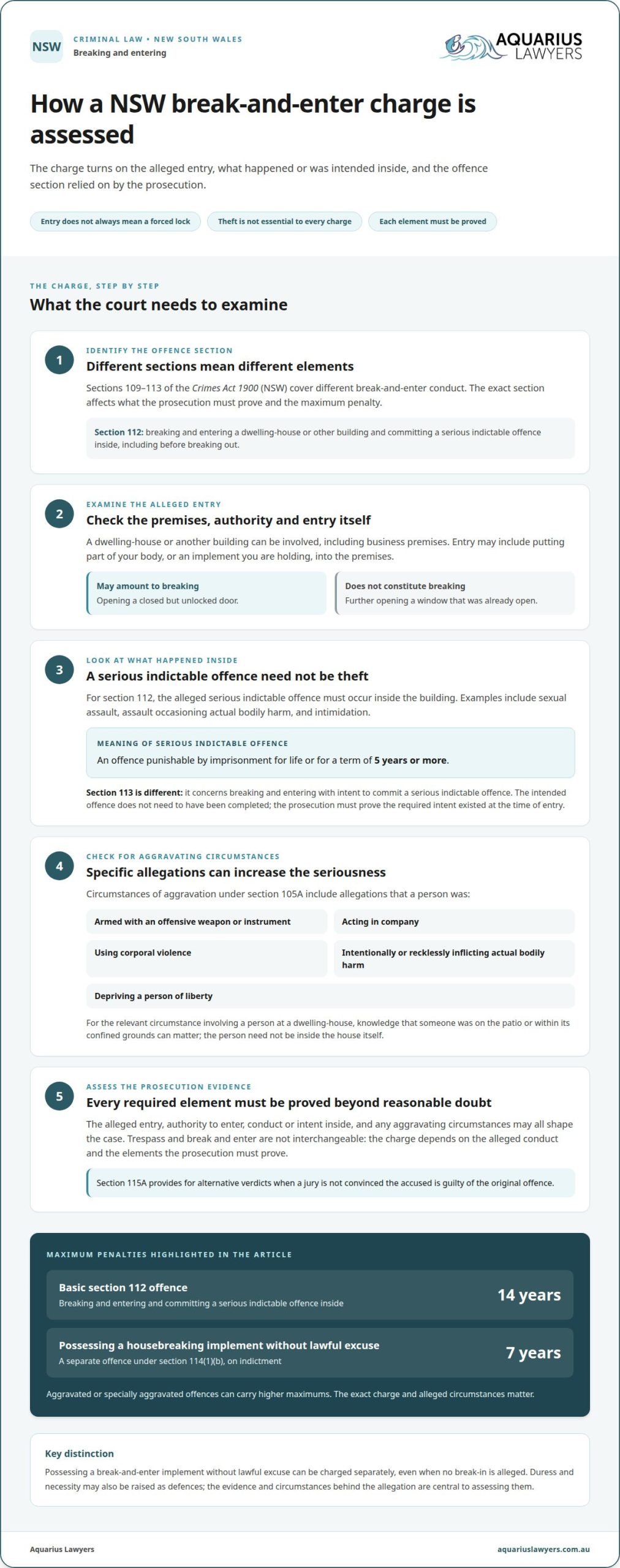
Section 105A of the Crimes Act 1900 (NSW) defines circumstances of aggravation and special aggravation for relevant break-and-enter offences. Circumstances of aggravation include being armed with an offensive weapon or instrument, acting in company, using corporal violence, intentionally or recklessly inflicting actual bodily harm, or depriving a person of liberty. These allegations can increase the seriousness of the offence and the maximum imprisonment available. The exact charge matters: check which circumstance the prosecution alleges, rather than assuming every break-and-enter case carries the same consequences.
A person charged can seek bail in NSW. Bail is separate from whether the prosecution can prove the offence, so seek legal advice promptly about the bail process and any conditions.
Aggravation involving a person on the premises
Under section 105A(1), knowledge that a person was on a patio or within the confined grounds of a dwelling-house can be sufficient for the relevant circumstance of aggravation. The person does not necessarily need to be inside the house itself for this issue to matter. That distinction makes evidence about what the accused knew, and where people were, relevant to the allegation.
Sentencing can also treat an offence against a victim in their own home as an aggravating factor under subsection 21A(2)(eb) of the Crimes (Sentencing Procedure) Act 1999. The home setting may therefore matter beyond the physical entry alleged.
Break and enter compared with trespass
Trespass and break and enter are not interchangeable labels: a break-and-enter charge involves alleged entry and additional offence-related elements. For section 112, the prosecution must prove each element beyond reasonable doubt, including the relevant serious indictable offence. Opening a closed but unlocked door can amount to breaking, while further opening a window that was already open does not constitute breaking for this offence, as stated in (2007) 70 NSWLR 474.
Entry may include putting part of your body, or an implement you are holding, into premises. If you face a charge, a NSW criminal lawyer can assess the alleged entry, evidence, and elements of the offence. Get legal advice before a police interview.
Break-ins at homes and businesses
How does NSW law treat break and enter into a home versus a business? Section 112 refers to a dwelling-house or other building, so a business building can fall within the offence; a dwelling-house has a separate statutory definition. Under section 4(1), it can include a building intended and capable of occupation as a dwelling, even if nobody has lived there. A front or side yard is not part of the dwelling-house for that rule.
If your home is broken into, prioritise safety, report the incident to NSW Police and avoid disturbing potential evidence. To report a break and enter, contact NSW Police and provide the location and details of what happened. A building also includes a place of Divine worship under section 105A(1).
Serious indictable offences
Sections 109-113 of the Crimes Act 1900 (NSW) cover different break-and-enter conduct. The applicable section depends on the alleged entry, intent, conduct inside and circumstances of the offence.
Break and enter offences under sections 109-113
These sections create distinct offences, so the charge’s section number affects the elements the prosecution must prove and the maximum penalty. Section 109 concerns breaking out after committing, or entering with intent to commit, an indictable offence. Section 110 addresses break and enter with assault involving wounding or grievous bodily harm. Sections 111-113 deal with entry or breaking and entering with intent to commit a serious indictable offence, or committing one inside.
A serious indictable offence is punishable by imprisonment for life or for a term of 5 years or more. The prosecution must establish the required elements beyond reasonable doubt; the alleged offence and evidence determine which section applies.
Breaking in to commit a serious indictable offence
Section 112 covers breaking and entering a dwelling-house or other building and committing a serious indictable offence inside. It also covers committing that offence inside before breaking out. The maximum penalty for the basic section 112 offence is 14 years’ imprisonment. The serious indictable offence must occur inside the building, and the prosecution must prove each element beyond reasonable doubt.
The alleged conduct inside need not involve stealing. Examples of serious indictable offences in this context include sexual assault, assault occasioning actual bodily harm, and intimidation. The charge depends on the specific offence alleged, not simply on whether property was taken. For more on the elements and penalties, see our guide to stealing offences in NSW.
Attempting an indictable offence after breaking in
Section 113 concerns breaking and entering with intent to commit a serious indictable offence. Unlike section 112, the prosecution need not prove that the intended offence was actually committed. It must prove the required intent existed at the time of entry, making evidence about conduct and circumstances relevant.
Section 115A provides for alternative verdicts when a jury is not convinced the accused is guilty of the original offence. That distinction matters where the evidence supports a different offence but does not establish every element charged. A lawyer can assess the charge and evidence under NSW criminal law services.
Maximum penalties for break and enter offences
Maximum penalties vary by section and circumstances. Section 111 carries up to 10 years’ imprisonment; section 109 carries up to 14 years. Section 110 carries up to 25 years for breaking and entering with assault involving wounding or grievous bodily harm.
For section 112, the maximum rises to 20 years for an aggravated offence and 25 years for a specially aggravated offence. Section 113 carries up to 10 years for the basic offence, 14 years if aggravated and 20 years if specially aggravated. These are maximums, not automatic sentences. The offence proved and its circumstances shape sentencing.
Defences including duress, necessity and honest mistake
In NSW, possible defences to a break-and-enter charge include duress and necessity. An honest mistake may also be relevant if it challenges whether you had the intent alleged. The right issue depends on the charge under the Crimes Act 1900 and the evidence.
Duress and necessity are possible defences, but raising either does not resolve a charge by itself. The circumstances and supporting evidence matter. For example, evidence of what was said or happening at the time may help explain why you entered a dwelling or acted as alleged. A defence must address the prosecution case, not merely offer a different account.
An honest mistake can matter where the offence requires proof of intent. For a section 113 charge, the prosecution must establish that the intent to commit a serious indictable offence existed at the time of entry. If you say you entered believing you had permission, or misunderstood why you were there, that account may be relevant to whether the required intent existed. The circumstances and available evidence need to support the explanation.
Assess evidence against each element of the charge. Relevant material may include:
- Messages or other records that show what you understood about permission to enter.
- CCTV or witness accounts that may support or contradict the alleged sequence of events.
- Evidence about any threat or urgent situation relied on for duress or necessity.
For a section 112 charge, the prosecution must prove each element beyond reasonable doubt. A defence may challenge an element directly, such as whether the alleged offence occurred inside the building, or raise duress or necessity based on the circumstances. These are different approaches: one disputes whether the prosecution has proved its case; another relies on a recognised defence.
Keep relevant messages, photographs, and other records in their original form. Don’t edit or delete material that could relate to the alleged entry, a conversation about access, or a claimed threat. A clear timeline can help show what supports your account and what conflicts with it.
The maximum penalty depends on the charge and any aggravating circumstances, so a possible defence should be considered alongside the exact section alleged. A section 112 charge carries different consequences from a section 113 charge. Get legal advice on how the prosecution evidence relates to each element before deciding how to respond in criminal proceedings.
What is the difference between break and enter and trespass in NSW?
If an allegation is described as trespass or break and enter, first identify the exact offence named in the police paperwork. The label is only a starting point. The alleged date, address, conduct, and supporting material show what the case concerns and which details need careful examination.
Build a timeline of the event. Note when you arrived and left, who was present, and what happened before and after the alleged conduct. Keep your notes factual, separating what you remember personally from what someone else told you. A clear sequence can help identify gaps or conflicts without relying on assumptions about the allegation.
Next, organise records by source and date. Retain relevant messages, work schedules, entry logs, photographs, or video in their original form. A staff roster might help establish who was working at a business; a dated message could clarify the purpose of a planned visit. Don’t alter files or delete material that may relate to the incident.
For business premises, records may have several custodians. Access logs could be held by a building manager, while the business may hold internal messages or staff records. Identify what records exist and where they are kept. This helps clarify the facts, particularly if accounts of the same event differ.
Be specific about the location. A street address alone may not identify the room, entrance, or area involved. A site plan, floor plan, or photograph may help show where people were and which part of the premises the allegation concerns. Use existing records where possible. Don’t enter a location or handle property to recreate an event.
Write down what remains uncertain as well as what you remember clearly. For example, distinguish a time you know from one you estimate. This can help prevent an uncertain detail from later being presented as definite. Preserve original records and keep a separate copy of your notes, dated while your recollection is fresh.
These steps don’t determine how an allegation should be classified. They give you a more reliable account to discuss with a lawyer, who can compare the paperwork and available material with the charge. Don’t contact others to align accounts or ask them to change their records. Keep communications and documents intact so the circumstances can be assessed on their actual contents.
Aquarius Lawyers
Aquarius Lawyers can help you understand the charge, the evidence relied on, and the legal issues that may affect your next steps. If police have contacted you, you have received a court attendance notice, or you’re unsure how an allegation fits the facts, seek legal guidance before deciding how to respond.
The key is to assess the specific allegation, not assume every unauthorised entry is the same. The section of the Crimes Act 1900 cited, the alleged intent and the available evidence can all shape the matter. Aquarius Lawyers also works across Marine Law, Fisheries Law, Aquaculture Law and Commercial Law, supporting clients with legal issues affecting individuals and businesses.
Contact Aquarius Lawyers to discuss your situation and the legal questions you’re facing.
Choose your next step with clarity
If you’re facing a break-and-enter allegation in NSW, focus on what happens next. Make a clear record of key dates, communications, and documents. Before deciding how to respond, make sure you understand the charge and evidence. A lawyer can review the available material and explain how it relates to the allegation.
Aquarius Lawyers can advise you on the charge, evidence and your options in criminal proceedings. The firm also works in Marine Law, Fisheries Law, and Aquaculture Law, supporting clients with legal issues connected to businesses and their operations.
Discuss your circumstances and the questions you need answered. Contact Aquarius Lawyers for legal advice.
With legal advice specific to your matter, you can make informed decisions about your response.
Frequently Asked Questions
Where will the matter be heard?
Some break-and-enter charges can be dealt with summarily in the Local Court, depending on the offence, property value or damage, and statutory conditions. For eligible section 112 matters involving stealing or property damage, the threshold is $60,000. A prosecutor or the person charged may elect for an eligible matter to proceed on indictment. The charge and any election help determine the pathway.
What must be proved?
The prosecution must establish every legal ingredient of the charge beyond reasonable doubt. Compare the charge particulars with the brief of evidence: identify which witness, recording, or document supports each allegation, and note any conflicting accounts. A claim in a statement is not automatically proof. The court assesses the evidence supporting the charged case, rather than deciding on suspicion or assumption.
What if nothing was stolen?
Missing property does not, by itself, resolve the charge. The allegation may concern another offence, or the prosecution may allege an intention that was not carried out. If the charge specifically alleges stealing, evidence about what property was handled and what happened to it may matter. Keep relevant records intact, including messages or inventory material, so the circumstances can be assessed against the particular allegation.
What is a building or premises?
The statutory wording relevant to section 112 has included “any dwelling-house or other building” since 15 February 2008. A place’s legal classification can therefore depend on the exact offence and location alleged, not simply on how people describe the site. In a case involving a multi-use property, the charge documents and evidence should identify the particular building or area said to be involved.
What penalties can the court impose?
The court may consider a discount for an early guilty plea. The maximum sentence discount described for an early plea is 25%. The timing and circumstances of a plea can therefore have sentencing implications, but the discount is not automatic. Before entering a plea, understand the charge and the evidence against you, as well as how the plea decision may affect the case.
Which court will hear the matter?
A strictly indictable matter starts in the Local Court, but is finalised in the District Court. There, the matter is heard before a judge and a jury of 12 citizens. The Local Court appearance is therefore not necessarily the court that will decide the final outcome. This is different from an eligible matter dealt with summarily, which can be determined in the Local Court.
Disclaimer
Please note that legal rules change and this is not a substitute nor construed as legal advice. It is general information only.