
The headline terms rarely tell the whole franchise story. A franchising agreement review in Australia should examine the agreement and disclosure material, then identify issues that may affect your decision to sign, renew or exit. Franchisors must provide an accurate, up-to-date disclosure document at least 14 days before you sign; it contains financial, legal and operational information.
It’s reasonable to want clear advice before committing to a franchise. A review can help you understand the obligations, risks and practical consequences in the documents, rather than leave you to interpret dense clauses alone.
This guide explains what a review covers, how disclosure documents fit in and what a fixed-fee package may define about its scope. It also outlines issues to consider when a franchise term is approaching renewal or you’re planning an exit, so you can decide what to do next with a clearer view of the terms.
Key Takeaways
- Compare renewal, termination and exit terms early so you can plan around notice requirements, handover obligations and potential disputes.
- A franchise agreement generally has a 5-year term and may include one or more rights of renewal. Check the conditions attached to each renewal option.
- Review the franchisor’s and franchisee’s rights and obligations together, including how the agreement affects your day-to-day operations.
- Franchisors must provide an accurate, up-to-date disclosure document at least 14 days before you sign. Read it alongside the agreement, not as a substitute for reviewing the contract.
- Before choosing a fixed-fee review package, understand which documents, advice and follow-up work its scope covers.
Franchise renewals, terminations and exit agreements
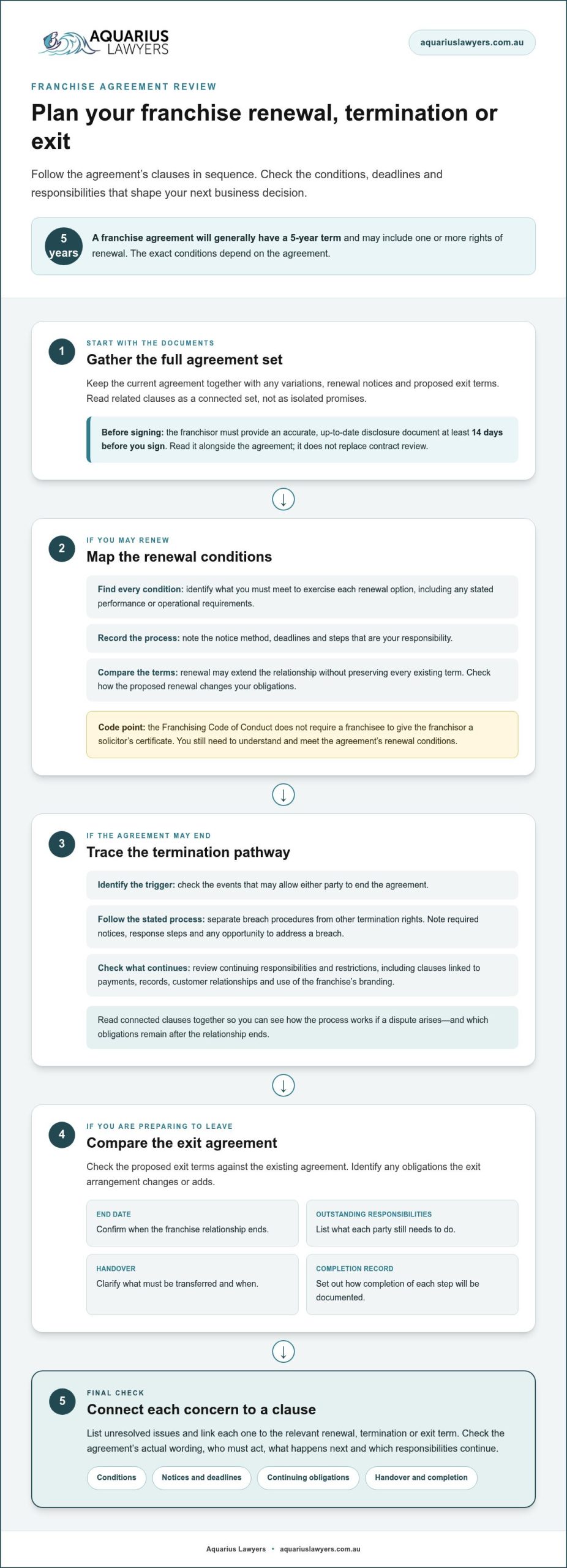
A franchise agreement will generally contain a 5-year term, with one or more rights of renewal. Review those options alongside termination and exit terms, because each can shape your next business decision.
Renewal conditions
Start with the renewal clause and identify every condition you must meet to exercise the option. Note the notice process and deadlines, and check whether the agreement requires you to meet stated performance or operational requirements. Then compare the renewal terms with your current obligations: an option may extend the relationship without preserving every existing term.
For example, mark the renewal notice date in your calendar and list the steps the agreement makes your responsibility. The Franchising Code of Conduct does not require a franchisee to give the franchisor a solicitor’s certificate. That does not remove the need to review the renewal conditions and understand what you must do to exercise the option.
Termination terms
Read the termination clause to identify events that may allow either party to end the agreement. Separate any stated breach process from other termination rights, then note required notices, response steps and any opportunity to address a breach. This gives you a practical sequence to follow if a dispute arises, rather than leaving you to piece the process together from several clauses.
Check what the agreement says happens after termination, including continuing responsibilities and restrictions. Read related clauses together, especially where termination connects with payments, records, customer relationships or use of the franchise’s branding. A review should explain how those terms interact and identify which obligations continue after the relationship ends.
Exit agreement conditions
An exit agreement can record the parties’ arrangements for ending the franchise relationship. Compare its terms with the existing agreement and identify any obligations it changes or adds. Pay particular attention to the agreed end date, outstanding responsibilities, handover arrangements and how the parties will document completion of each step.
Before signing, list unresolved issues and match each one to the relevant exit clause or proposed term. For example, if a handover is required, clarify what must be transferred and when. A clear written record can reduce uncertainty about what each party has agreed to do after the franchise ends.
Keep the documents together: the current agreement, any variations, renewal notices and proposed exit terms. Review the clauses as a connected set, not as isolated promises. A 12-month transition period for the Treasury Laws Amendment (More Competition, Better Prices) Act began in November 2023. When considering renewal or exit, focus on the agreement’s actual wording and the steps it sets out for your circumstances.
What’s covered in your Franchise Agreement Review?
Under Australian law, a franchise agreement is a legally binding contract that outlines the relationship between franchisor and franchisee. Before signing, check the parties’ rights and obligations, how risks are allocated, and how the agreement relates to the Franchising Code of Conduct.
Franchisor and franchisee obligations
Match each party’s promises to the clause that creates them. For example, identify what the franchisor must provide and what the franchisee must do to operate under the agreement. Then check whether each obligation has a clear trigger, process or deadline. If a term gives one party discretion, consider how that power could affect your operations or decisions.
Rights matter as much as duties. Look for the franchisor’s contractual powers and the franchisee’s corresponding protections, including any process for raising concerns or seeking approval. A review should explain the practical effect of those terms, not simply restate them. This helps you see where the contract places responsibility and where it gives either party room to act.
Contractual risks and obligations
Identify clauses that create obligations across different parts of the agreement. A payment provision, for instance, may connect with reporting duties, record keeping or consequences for non-compliance. Read those clauses together and write down the action each one requires from you. This makes dependencies visible before signing, rather than leaving you to discover them during day-to-day operations.
Next, distinguish fixed commitments from terms that depend on approval, performance or another event. Check who makes the decision, what process applies and what the agreement says happens next. If the wording is broad, consider what practical outcomes it allows. A clear risk review should connect each concern to a clause and explain its possible effect on your business.
Franchising Code obligations
Review the agreement alongside the Franchising Code of Conduct, not as a standalone document. Note any Code-related process the agreement refers to, then compare its wording with the practical steps set out in the contract. This helps you spot gaps, inconsistent language or responsibilities that need clarification before you commit.
Keep a list of questions linked to exact clauses. For example, if the agreement refers to a notice or approval process, record who must act and what happens next. Avoid assuming that a general reference to the Code explains every contractual obligation. The review should make the relationship between the agreement and Code processes easier to understand.
Pre-signing agreement checks
Before signing, read the complete agreement and identify every document it refers to. Check that the parties, business arrangement and key obligations match what you understand you are accepting. Mark unclear terms, cross-references and blanks for resolution. Then compare the agreement’s practical requirements with your intended business operations.
Finally, organise your questions by topic: duties, decision-making, risk and dispute processes. Ask for explanations of specific clauses, not general assurances. Keep written records of agreed changes and make sure the final version reflects them. This step-by-step check gives you a clearer basis for deciding whether the written terms match your expectations.
Review of franchise agreements and disclosure documents
Review the franchise agreement alongside its disclosure document and every document it incorporates. The agreement sets out contractual terms; the disclosure document provides information to help you assess the opportunity.
Franchise agreement review
Read the agreement alongside its schedules, annexures, variations and referenced policies. These documents may add practical requirements or change how a clause operates. Note each incorporated document by name, then check that you have the version the agreement refers to. If a policy is mentioned but missing from the material you received, record it as a question to resolve before signing.
Compare the agreement’s terms with the business arrangement presented to you. For example, check whether the written description of your responsibilities matches the contract. Flag differences, unclear cross-references and terms that depend on another document. A clause-by-clause review should explain what the terms mean in practice, not merely repeat their wording.
Disclosure document review
Check the disclosure document for financial, legal and operational information. Compare those areas with the proposed agreement and note any apparent inconsistencies. For example, if an operational process described in the disclosure material differs from a contractual requirement, identify both passages and ask how they fit together.
Also check that the document is accurate and up to date, and record its date and version. Keep the disclosure document, agreement and related material together so you can compare them. Failure to comply with disclosure document requirements can give franchisees the right to exit an agreement or seek compensation. Treat missing or inconsistent information as a specific issue to resolve.
Disclosure preparation and timing
In Australia, franchisors must provide franchisees with an accurate and up-to-date disclosure document at least 14 days before the franchisee signs. Record when you receive it and compare that date with the proposed signing date. If a revised document arrives, note the version and review what has changed before proceeding.
The disclosure document must contain financial, legal and operational information to help potential franchisees make informed decisions. Read those sections carefully, then list questions that need answers before signing. Franchisees must also provide the franchisor with a statement indicating whether they received independent legal advice about the franchise agreement. Understand what the statement asks before completing it.
To identify the documents your review should cover, assemble the proposed agreement, disclosure document, schedules, annexures, variations and any policies the agreement incorporates. Compare related terms rather than treating each document separately. A simple table listing each document’s name, version, date received and questions raised can help you track differences and follow up on each point.
Fixed-fee franchise agreement review packages
A package review is useful when its scope is clear before work begins. Compare the documents covered, advice provided and meeting arrangements, rather than relying on the package label alone. The key question is practical: will the review address the decisions you need to make about the franchise agreement?
A basic franchise agreement review includes a 90-minute meeting. Treat that as one defined component, not proof that every review covers identical work. Before proceeding, clarify which agreement version is being assessed and whether the disclosure document, schedules or related material form part of the scope. That distinction shapes the questions the review can address.
When comparing franchise agreement review services across Australian lawyers, assess the stated scope and outcomes side by side. Consider whether the work includes an explanation of key clauses, a discussion of practical implications and an opportunity to ask questions. Check whether written follow-up or proposed changes are covered. A like-for-like comparison helps you understand what each service is designed to deliver.
- Documents: Identify which agreement versions and related materials are covered.
- Advice: Clarify whether the review explains clauses and their practical effect.
- Meeting: Understand how the stated meeting time will be used.
- Follow-up: Ask what happens if you have questions after the discussion.
These points define the work, rather than assuming every review includes the same tasks. For example, if a revised clause arrives after your meeting, clarify whether reviewing that change is within the agreed scope. Also establish whether connected documents are assessed together or separately. Clear boundaries help you match the service to the decisions you face.
Prepare by organising your questions around the choices you need to make. Group them by topic, such as operational responsibilities, decision-making powers or dispute processes. Mark the relevant clauses and note what you need clarified. This preparation keeps the meeting focused on your priorities, rather than using discussion time to locate documents or reconstruct your concerns.
Use the written scope to decide whether the review suits your circumstances. Reviewing one agreement may call for a different approach from reviewing revised terms or several connected documents. Confirm what the review will address and what falls outside its scope before proceeding. That clarity helps you plan the next step and identify any remaining questions.
Organise your documents and priorities before arranging a review. Arrange a franchise agreement review when you need advice on the terms before signing.
Aquarius Lawyers: Marine Law
Aquarius Lawyers may be a relevant next step if your franchise operates in the marine, fisheries or aquaculture industries. These agreements can intersect with commercial arrangements, operating rights, licences and marine assets, so identify the issues that need advice before you sign, renew or exit.
Aquarius Lawyers offers Marine Law, Fisheries Law, Aquaculture Law and Commercial Law. Consider the firm when franchise terms affect these areas, such as responsibilities connected with an aquaculture operation or commercial fishing business. For franchise matters outside these fields, seek advice suited to the issue.
Prepare the agreement, related documents and a short list of your concerns to make the next discussion focused. Contact Aquarius Lawyers to discuss your matter.
Take your next step with clarity
Before committing to a franchise, turn unanswered questions into a practical decision plan. Record which terms need clarification, what changes you want discussed and which documents relate to each issue. This gives your review a clear purpose and keeps the focus on the commercial effect of the agreement, not just its wording.
A franchising agreement review in Australia can help you understand how the written terms apply to your plans. Raise your questions before signing or deciding what to do about your franchise relationship. Clear advice can help you work out what to address next.
Contact Aquarius Lawyers about your review and take the next step with confidence.
Frequently Asked Questions
Can I negotiate the terms of the franchise agreement?
You can propose changes, but the franchisor must agree before they become part of your contract. Put each proposed change in writing and compare the final agreement with the version you reviewed. For example, if you discuss a different operational requirement, check that the agreed wording appears in the signed documents. Do not rely on an informal assurance that conflicts with the written terms.
What documents should I receive from the franchisor?
You should receive the franchise agreement and an accurate, up-to-date disclosure document at least 14 days before signing. Gather any schedules, annexures, policies or other documents the agreement refers to, so you can understand the terms as a complete set. Keep copies of each version and note when you received them. If a referenced document is missing, raise that specific gap before you decide whether to sign.
How long does the review take?
The time needed depends on the documents involved, their length and complexity, and the questions you want addressed. A basic franchise agreement review includes a 90-minute meeting. That meeting duration is not necessarily the full time needed to assess documents or prepare advice. Send the relevant material and your main concerns early, then ask how the agreed review scope accounts for document assessment, discussion and any follow-up.
What happens if a franchise agreement is breached?
A breach may trigger consequences set out in the agreement, so start by locating the relevant clause and any notice process. For example, a missed contractual obligation may require a written response or another step within a specified period. Keep the agreement, related correspondence and records of what happened. Avoid assuming that ending the relationship is the only response; the available options depend on the contract and circumstances.
What does the Australian Franchising Code of Conduct require before signing a franchise agreement?
Before signing, the franchisor must provide an accurate, up-to-date disclosure document at least 14 days beforehand. The document contains financial, legal and operational information to help you assess the proposed franchise. Franchisees must also provide the franchisor with a statement indicating whether they received independent legal advice about the agreement. Read that statement carefully and make sure your response accurately reflects your position.
What is the 14-day disclosure period for Australian franchise agreements?
The 14-day period means the franchisor must provide the accurate, up-to-date disclosure document at least 14 days before you sign. Use that time to compare the document with the proposed agreement and note any gaps or differences requiring an explanation. If you receive an updated version, record when it arrived and review the changes. A franchising agreement review in Australia can help you assess the documents before making your decision.
Disclaimer
Please note that legal rules change and this is not a substitute nor construed as legal advice. It is general information only.