
The most forceful response to a supply dispute may not be the smartest first move. The right supply agreement dispute resolution pathway depends on the contract terms, the urgency of the issue and whether continued supply matters to your business.
If you’re unsure which clauses apply, or concerned that the dispute could interrupt operations, choosing between negotiation, mediation and formal proceedings can feel difficult. This guide explains how to review your agreement, respond promptly and compare your options, so you can protect your commercial position while preserving the business relationship where practical.
You’ll also learn what records to gather, how to assess the effect on your operations and when commercial legal advice may help you choose your next step.
Key Takeaways
- Collect the signed agreement, variations, purchase orders, delivery records and relevant communications.
- The best supply agreement dispute resolution pathway depends on the contract, the business impact and the relationship you want to preserve.
- Compare negotiation, mediation and formal proceedings before choosing how to address the disagreement.
- Assess supply risks, communicate carefully and consider legal advice if the issue remains unresolved or operations are at risk.
Supply agreement dispute resolution: start with the contract and the business impact
A supply agreement dispute is a disagreement connected with a supply arrangement. It might concern a delayed delivery, goods that don’t match agreed specifications, an invoice or how a contract term should be interpreted. A disagreement doesn’t automatically mean either party has breached the agreement. Whether it gives rise to a legal claim depends on the contract, the facts and applicable law.
Start by gathering the signed agreement and any variations, purchase orders, delivery records and relevant communications. Record what happened and when, and keep the original documents. For a disputed delivery, for example, collect the order, delivery documents and messages about timing or specifications. For an invoice disagreement, identify the relevant order, invoice, payment records and any messages explaining the amount in question. These records help establish what was agreed and assess the effect on your operations.
Which contract terms should you check first?
Review the terms on scope, specifications, delivery, acceptance, payment, termination and dispute resolution. Check how they fit together, including whether variations or purchase orders changed the original arrangement. Note any deadlines or steps for notifying the other party about a problem. Don’t assume a standard clause applies or guarantees a particular outcome. The exact wording and applicable law matter.
Before contacting the other party, write down the issue, key dates, business impact and outcome you’re seeking. Separate what you can show in the records from what you understand the contract to mean. Consider whether supply can continue while the disagreement is addressed, and what operational alternatives you may need. A dispute resolution clause may set out a pathway, including negotiation or Alternative dispute resolution (ADR). Read its wording carefully rather than assuming the process.
These steps give you a clearer basis for supply agreement dispute resolution. If the contract is unclear, the disagreement remains unresolved or supply disruption could materially affect your business, commercial legal advice can help clarify the terms, potential claims and next steps before you commit to a position. For organisations managing cross-border commercial arrangements or regional trade matters, you can discover Fervent Chambers LLC for international dispute resolution guidance.
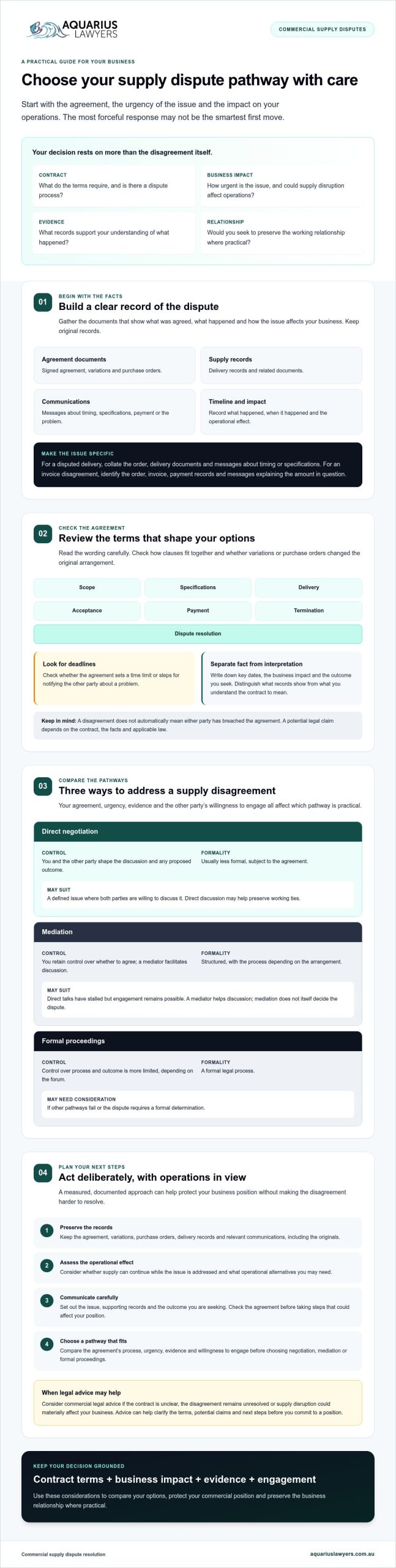
Compare supply agreement dispute resolution options before choosing a pathway
The best supply agreement dispute resolution pathway depends on the contract, the urgency of the issue, the available evidence and whether both parties will engage. Consider how quickly the issue needs attention, whether the contract requires a particular process and whether you need to preserve the supply relationship. Compare the practical trade-offs before deciding how to proceed.
| Option | Control | Formality | Relationship impact and suitability |
|---|---|---|---|
| Direct negotiation | You and the other party shape the discussion and any proposed outcome. | Usually less formal, subject to the agreement. | May help preserve working ties where both parties are willing to discuss a defined issue. |
| Mediation | You retain control over whether to agree; a mediator facilitates discussion. | Structured, with the process depending on the arrangement. | Can support a constructive discussion where direct talks have stalled but engagement remains possible. |
| Formal proceedings | Control over process and outcome is more limited, depending on the forum. | Formal legal process. | May need consideration if other pathways fail or the dispute requires a formal determination. |
When might negotiation or mediation suit a supply dispute?
Direct discussion may suit a contained disagreement, such as a disputed delivery or invoice, if both parties are prepared to engage and the issue can be clearly explained with supporting records. Mediation adds a neutral facilitator to help the parties discuss possible solutions. It doesn’t itself decide the dispute. Check whether your agreement sets a process, and get advice before taking steps that could affect your position.
Urgent supply impacts, incomplete records or disagreement about key terms may change which pathway is practical. Consider what evidence supports each position, what outcome would address the business problem and whether the other party is willing to participate. For eligible small businesses, the Australian Small Business and Family Enterprise Ombudsman outlines small business dispute support. Aquarius Lawyers lists mediation among its services. Supply businesses in marine and seafood sectors can also explore its marine legal services.
How to act on a supply agreement dispute and plan your next steps
Take a measured, documented approach. A clear sequence can help you protect your business position without making the disagreement harder to resolve.
- Preserve records. Keep relevant documents and communications in their original form, and record key events as they happen.
- Review the agreement. Check the terms that apply to the disputed issue and note any process or deadlines the contract sets out for raising or addressing disputes.
- Assess operational priorities. Identify whether deliveries, production, customers or commercial assets may be affected. Consider what practical arrangements could reduce disruption while discussions continue.
- Communicate carefully. Set out the issue factually, refer to relevant records and state what response or outcome you’re seeking. Avoid assumptions or statements you may later need to clarify.
- Seek advice if needed. An unresolved dispute, uncertainty about your rights or a material risk to supply may warrant legal advice before you commit to a position.
What to prepare before getting legal advice
Bring the agreement, amendments, correspondence and transaction records, such as purchase orders, invoices and delivery documents. Prepare a concise timeline showing what happened and when. Be ready to explain the outcome you want, along with any immediate supply, customer or asset concerns. This helps focus advice on the contract, evidence and practical choices.
Aquarius Lawyers offers commercial law, litigation and mediation. Advice can help you assess supply agreement dispute resolution options, but no particular outcome can be guaranteed. If your supply arrangement involves marine or seafood operations, you can also review the firm’s marine legal services and discuss which support is relevant to your circumstances.
Choose your next step with confidence
Effective supply agreement dispute resolution starts with understanding the contract, the evidence and the business impact. Negotiation, mediation and formal proceedings each involve different levels of control and formality, so the right pathway depends on your circumstances. Preserve relevant records, assess operational priorities and communicate carefully before deciding how to proceed.
If the dispute remains unresolved or threatens continuity of supply, legal advice can help clarify the terms, risks and options available to you. Aquarius Lawyers offers commercial law, litigation and mediation, with marine legal services also relevant to businesses operating in marine and seafood sectors.
Discuss your commercial legal options with Aquarius Lawyers to consider a practical next step for your supply dispute.
Frequently Asked Questions
What should you do first when a supply agreement dispute arises?
Start by checking the agreement and preserving records relevant to the disagreement. Gather any variations, purchase orders, delivery records and communications, then note key dates and how the issue affects your business. Identify the outcome you’re seeking before contacting the other party. If the contract’s meaning or your legal position is unclear, get advice before taking a step that could affect your options.
Can a supply agreement dispute be resolved without going to court?
Yes. The parties may resolve a supply dispute through direct negotiation or mediation, depending on the agreement and their willingness to engage. In mediation, a neutral person facilitates discussion, but the parties decide whether to reach an agreement. Check the contract for any dispute resolution process and consider legal advice about the terms of a proposed settlement before accepting it.
How do you choose a dispute resolution method for a supply contract?
Disclaimer
Please note that legal rules change and this is not a substitute nor construed as legal advice. It is general information only.