
A substance sold as a prohibited drug can still lead to a supply charge, even if it turns out to be counterfeit. In NSW, supply can include selling or distributing a prohibited drug, offering or agreeing to supply it, and possessing it for supply. The potential penalty depends on factors such as the drug, its quantity and how the matter is dealt with.
It’s understandable to focus on what the substance actually was. But the law also addresses substances supplied as drugs, and the prosecution must prove the elements of the alleged offence. The consequences can be severe: supplying a large commercial quantity can carry a maximum penalty of life imprisonment.
This guide explains what counts as supply, how counterfeit substances may affect a charge, and how quantity and other circumstances shape penalties. It also covers possible defences and sentencing factors, helping you understand the issues that may matter in your case.
Key Takeaways
- A substance that is not actually a prohibited drug may still raise a separate supply issue if it was supplied as a drug.
- Offers, agreements and possession for supply can matter, not just a completed sale or handover.
- For ongoing supply, the number and timing of occasions, the substance involved and any reward are key details.
- Quantity and the court handling the charge can affect the maximum penalty, so the alleged amount matters.
- Reviewing the evidence, the alleged role and any relevant sentencing circumstances can help identify issues that may affect the case.
What if the drug was counterfeit and not an actual drug?
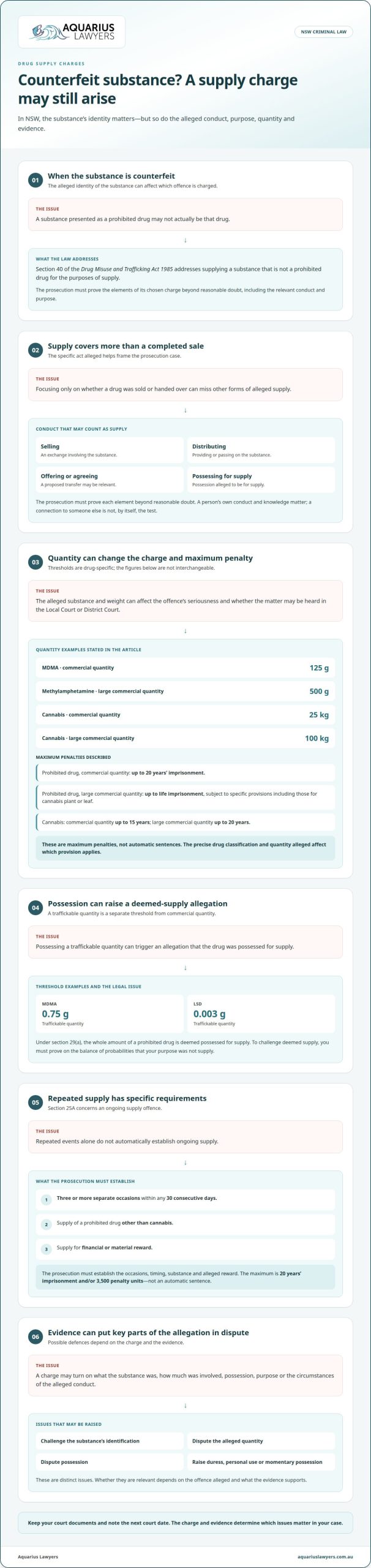
A counterfeit substance is presented as a prohibited drug but is not that drug. Section 40 of the Drug Misuse and Trafficking Act 1985 addresses supplying a substance that is not a prohibited drug for the purposes of supply. The substance’s identity can therefore affect which offence the prosecution alleges. The prosecution must prove the elements of its chosen charge beyond reasonable doubt, including the relevant conduct and purpose.
Schedule 1 of the Act sets quantity categories for prohibited drugs. Those categories help determine the offence’s seriousness and whether a matter may be heard in the Local Court or District Court. The alleged substance and its weight matter: 125 grams of MDMA is the stated commercial quantity, while 500 grams of methylamphetamine is the large commercial quantity.
A commercial quantity is a drug-specific threshold associated with a higher maximum penalty. Supplying a commercial quantity of a prohibited drug can carry up to 20 years’ imprisonment. For a large commercial quantity, the maximum can be life imprisonment, subject to specific provisions, including those for cannabis plant or leaf. These are maximum penalties, not automatic sentences.
For cannabis, the stated commercial quantity is 25 kilograms, and the large commercial quantity is 100 kilograms. The cannabis provisions carry different maximums: supply of a commercial quantity can carry 15 years, and supply of a large commercial quantity can carry 20 years. The precise drug classification and quantity alleged affect which provision applies.
A traffickable quantity is an amount that can trigger a deemed-supply allegation when possessed. The threshold varies by substance: for example, it is 0.75 grams for MDMA and 0.003 grams for LSD. Under section 29(a), the whole amount of a prohibited drug is deemed possessed for supply. For deemed supply, you must prove on the balance of probabilities that your purpose was not supply.
Possible defences depend on the charge and evidence. They may include challenging the substance’s identification, disputing the alleged quantity or possession, or raising duress, personal use or momentary possession. These are distinct issues, and their relevance depends on what the prosecution alleges and what the evidence supports.
If you have been charged, keep your court documents and arrange legal advice promptly. For legal aid, apply through Legal Aid NSW; NSW Health services can connect you with drug and alcohol support. These supports address different needs, so seeking one does not replace advice about your criminal charge.
What is Supplying a Prohibited Drug?
In NSW, supply is defined broadly under the Drug Misuse and Trafficking Act 1985, and section 25 creates the main offence. The details of the alleged act, your knowledge and your role help frame the prosecution case.
The Drug Supply Offence Definition
Supply is conduct that provides, or is intended to provide, a prohibited drug to another person. Section 3 includes selling, distributing, offering or agreeing to supply, and possession for supply.
These forms of conduct are not identical. A sale involves an exchange, while an offer or agreement may concern a proposed transfer. Distribution focuses on providing or passing on the substance. The charge should identify the alleged conduct, and the prosecution must prove each element beyond reasonable doubt. The words used, actions taken and surrounding events may help show what was intended.
For example, an alleged arrangement to pass a substance to another person raises different factual questions from a claim that someone merely knew about it. The court considers evidence connected to the specific allegation, rather than treating every association as supply.
Knowingly Taking Part in Drug Supply
Knowingly taking part means participating in the supply offence with the required knowledge. Section 6 of the Act explains taking part in an offence, and section 25 covers knowingly taking part in supplying a prohibited drug.
A person accused of participating need not be alleged to have personally handed over the substance. The prosecution must prove that person’s own conduct and knowledge, not simply a connection to someone else. Evidence of their actions in an alleged arrangement may be considered alongside communications and other circumstances. The key question is whether the evidence proves knowing participation in the charged conduct.
Ongoing Supply Offences
Ongoing supply is a separate offence for repeated supply of a prohibited drug other than cannabis, for financial or material reward. Section 25A applies where the alleged supplies occurred on three or more separate occasions within any 30 consecutive days.
The prosecution must establish the occasions, their timing, the substance and the reward alleged. Repeated events do not automatically establish this offence: the evidence must support the statutory features. Section 25A carries a maximum of 20 years’ imprisonment and/or 3,500 penalty units. That maximum is not an automatic sentence.
If you’re charged, preserve your court documents and note the next court date. Avoid discussing the allegation publicly, and get legal advice before deciding how to respond. Reviewing the charge and evidence can help clarify what conduct the prosecution says you knowingly took part in, and what remains disputed.
Whether the case turns on an alleged offer, participation or repeated conduct, the evidence must be assessed against the specific offence charged. You can seek criminal law advice about the allegation and your next steps.
Aggravating and mitigating sentencing factors
An aggravating factor increases an offence’s seriousness; a mitigating factor may support a less severe sentence. In NSW, the court considers the offence proved and the circumstances relevant to the person being sentenced. A charge alone does not establish guilt, and sentencing follows only after guilt is established or admitted.
The court’s task is to assess the proven conduct, not simply apply a label such as drug supply. The Drug Misuse and Trafficking Act 1985 sets out the offence, while sentencing requires attention to the particular facts. The prosecution and defence may present material relevant to the court’s assessment. Clear distinctions between admitted facts and disputed allegations matter.
A guilty plea is an admission of the offence, and its timing can affect the sentence. An early guilty plea can attract a maximum sentence discount of 25% in NSW. The maximum discount is not automatic: the court determines the reduction that applies. Before deciding how to plead, you need to understand the charge, the prosecution case and the consequences of an admission.
Mitigating material gives the court information about circumstances relevant to sentence. Its purpose is to provide a grounded account, not to minimise the offence’s seriousness. The court assesses the material in context and against the facts it has accepted. Accuracy matters, particularly where the prosecution disputes a claim.
For drug supply offences, courts should exercise considerable caution when applying the mitigating factor that injury, emotional harm, loss or damage caused by the offence was not substantial. The absence of substantial harm cannot, by itself, resolve the sentencing assessment. The court also considers the offence and other relevant material presented by the prosecution and defence.
A conviction is the court’s formal finding of guilt. A sentence is the consequence imposed after that finding, within the legal limits for the offence. Full-time custody means imprisonment served in a correctional facility. It is one possible outcome, not an automatic result of a supply conviction. The court determines the sentence by assessing the proven offence and relevant circumstances.
If you’re charged, keep the allegation separate from sentencing: the court must first determine guilt or receive a guilty plea. If guilt is established, prepare accurate material addressing the circumstances you want considered. Do not assume a deemed-supply allegation or the substance named in the charge decides the sentence on its own. The court’s assessment depends on the case before it.
Penalties for supplying prohibited drugs in NSW
A maximum penalty is the highest sentence the law permits for an offence, not the sentence imposed in every case. In NSW, the applicable maximum depends on the drug, quantity and court pathway. Identifying the charge and court is essential to assessing potential exposure.
A summary matter is one dealt with in the Local Court rather than on indictment. For a supply offence dealt with there, involving no more than a small quantity, the maximum is 2 years’ imprisonment, 50 penalty units, or both. Where the amount is no more than the indictable quantity, the Local Court maximum is 2 years’ imprisonment, 100 penalty units, or both. The charge’s precise quantity category affects which limit applies.
An indictable offence is one capable of being dealt with on indictment in a higher court. For a supply charge dealt with in the District or Supreme Court, the maximum is 15 years’ imprisonment, 2,000 penalty units, or both. A District Court supply charge involving cannabis carries a maximum of 10 years’ imprisonment and/or A$220,000. These are maximums, not predictions of the outcome.
Commercial quantity is a statutory threshold that carries a higher maximum than lower quantity categories. Supplying a commercial quantity can carry up to 20 years’ imprisonment. The listed maximum fine for this quantity category is A$385,000. The threshold differs by drug, so the substance and alleged weight both matter when identifying the applicable penalty.
Large commercial quantity is a higher statutory threshold that can expose a person to the most severe penalties. For a prohibited drug other than the specified cannabis plant or leaf offence, supply of at least a large commercial quantity can carry life imprisonment, a fine of 6,000 penalty units, or both. The standard non-parole period for this category is 15 years. A standard non-parole period guides sentencing; it does not replace the maximum penalty.
Cannabis has distinct maximums. Supplying a large commercial quantity of cannabis carries a maximum of 20 years’ imprisonment. For cannabis quantities greater than commercial and up to large commercial, the stated maximum is 15 years. The specific cannabis provision matters, so don’t assume the general large-commercial rule applies unchanged.
Possession for supply can also lead to a supply charge, even without evidence of a completed handover. The alleged amount may affect both the charge’s quantity category and whether the matter can proceed summarily. A charge involving more than a trafficable quantity and up to the indictable amount, when dealt with summarily, carries a maximum of 2 years’ imprisonment and/or A$11,000.
If you’re charged, establish the precise quantity alleged, drug classification and court pathway before making decisions about your plea. Get advice on the drug supply charge and penalty provisions that may apply. For a comparison with other property-related charges, see this guide to stealing offences NSW.
Aquarius Lawyers
Aquarius Lawyers can help you understand the issues raised by a prohibited drug supply charge and assess how the evidence relates to the allegation. This may involve examining the alleged substance, quantity, your role and the prosecution’s case. Early advice can help you understand your options before deciding how to plead or respond in court.
If police have charged you, or you’re preparing for a court date, seek legal guidance promptly. The right issues to address depend on the charge and evidence in your case. Contact Aquarius Lawyers to discuss your situation.
Take a clear next step
A prohibited drug supply charge in NSW can raise practical concerns about work, family responsibilities and what to do next. Keep your court documents together, note important dates, and avoid discussing the allegation publicly while considering your response. A focused legal discussion can help identify the issues that need attention and prepare for the next stage.
If you’re facing a supply charge in NSW, base your next steps on the charge and evidence, not assumptions about what may happen. Aquarius Lawyers provides national legal advice and representation for criminal matters, including break and enter NSW, as well as Marine Law, Fisheries Law and Aquaculture Law.
Take the next step when you’re ready: contact Aquarius Lawyers for advice. A clear plan can help you approach what comes next with greater confidence.
Frequently Asked Questions
What Must Be Proven?
The prosecution must prove every element of the charged offence beyond reasonable doubt. The evidence must establish the alleged conduct and connect you to it. To assess the case, separate the allegations: what substance is identified, what conduct is said to amount to supply, and what evidence links you to that conduct? A gap in one element can affect the outcome.
Can I get bail on a supply charge?
Yes, bail may be available, but some serious supply charges face a show-cause requirement under section 16B of the Bail Act 2013 (NSW). This applies to certain offences involving commercial or large commercial quantities. You must address why your detention is not justified before the bail decision proceeds under the usual assessment. The charge, alleged quantity and material presented to the court are important to the application.
What actions constitute supply?
Supply can include selling or distributing a prohibited drug, as well as offering or agreeing to provide it. Possessing a drug for the purpose of supply can also fall within the definition. For example, an alleged agreement to provide a substance may matter even if no money changes hands. The precise conduct alleged is important, so distinguish what police say you did from what the evidence can establish.
What is a commercial quantity?
A commercial quantity is a threshold amount set for a particular prohibited drug under NSW law. There is no single universal weight: the threshold varies by drug. This classification can affect the offence provisions and potential penalty. Identify the substance and amount alleged in the charge, then compare them with the statutory threshold for that substance.
What is a traffickable quantity?
A traffickable quantity is a drug-specific amount that can trigger a deemed-supply allegation when the drug is possessed. The threshold varies between substances, so the same weight can have different legal significance depending on the drug. The substance and amount police attribute to you are central. If either is disputed, it may affect whether the deemed-supply rule applies.
What is deemed supply?
Deemed supply is a legal rule that treats possession of more than a drug’s trafficable quantity as possession for supply. Section 29(a) addresses how the amount is treated. For a charge based on deemed supply, you must prove on the balance of probabilities that you possessed the drug for a purpose other than supply. Evidence about the circumstances of possession may therefore become important.
Disclaimer
Please note that legal rules change and this is not a substitute nor construed as legal advice. It is general information only.